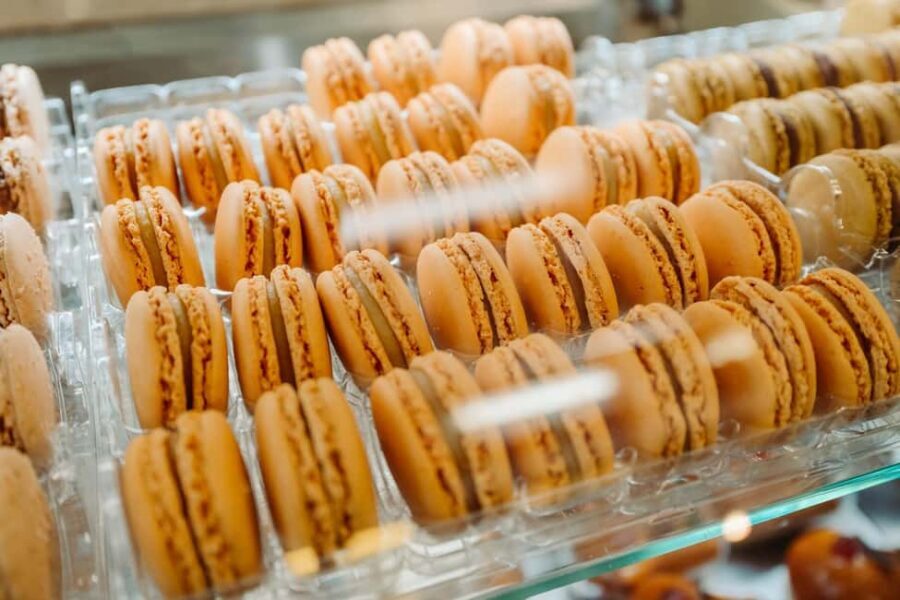
Paris smells like bread for a reason.
This Saint-Germain Food & Wine Tour turns that smell into a smart, guided tasting route: you hit legendary shops and classic flavors with a local guide, plus a church stop for art and a fountain moment. In about 3 hours, you sample food and drink at seven hand-picked places, with plenty of time to ask questions and learn what makes each ingredient tick.
I love the small group setup. It is listed as capped at 12 people, and this experience may run even tighter (up to 8), which means you are not shouting over a crowd while you’re trying to taste. I also love the range of tastings, from wood-fired pastries at Boulangerie Poilâne to sustainable caviar, then through cheese, chocolate, and a proper Armagnac and vintage Port moment.
One consideration: this is a tasting-focused walk, not a sit-down meal. If you do not want to eat and sample repeatedly, or if you drink more than the included pairings, the overall cost can creep up fast because extra drinks and tips are not included.
Key highlights in plain terms
- Seven hand-picked tasting stops packed into ~3 hours on the Left Bank
- Legendary names like Boulangerie Poilâne, Jacques Genin, and Caviar de Neuvic
- A real guide with Q&A so you’re not just receiving food, you’re understanding it
- Tight group size for a more conversational pace
- Not just wine: you’ll taste chocolate, caviar, cheese, and spirits
- Diet notes welcomed, but severe allergies are not a fit
In This Review
- 3 hours in Saint-Germain: what you actually get
- How hungry should you be?
- Boulangerie Poilâne: wood-fired classics and the stitched apple tart
- Art stops and Chapon chocolate near Saint-Sulpice
- Caviar de Neuvic: sustainably farmed sturgeon with blini and sparkling wine
- Maison Mulot quiche and a Saint-Germain market wander
- L’Avant Comptoir du Marché: farm-to-table French comfort in a neo-bistro
- Barthélémy cheese: fontainebleau and presidential suppliers
- Jacques Genin chocolate: mint ganache and mango passion caramel
- Ryst Dupeyron spirits: Hors d’Âge Armagnac and vintage Port
- The guide makes or breaks it: Q&A, pace, and insider tips
- Price and value: why $160.91 can make sense
- Dietary needs, allergies, and who should pass
- Should you book this Saint-Germain food and wine tour?
- FAQ
- How long is the Eating Paris Saint-Germain Food & Wine Tour?
- Is the tour in English, and how big is the group?
- What tastings are included?
- Can the tour accommodate dietary requirements?
- Do children need a ticket?
- Where do you meet and where does the tour end?
3 hours in Saint-Germain: what you actually get
This tour is designed for people who want Paris flavor fast, without spending the day guessing which shop is worth your time. You’re looking at an about-3-hour stroll that starts on the Left Bank (Bar de la Croix Rouge, Pl. Michel Debré in the 6th) and ends near Rue de Varenne (7th). It is also scheduled in English, and you get a mobile ticket plus handy “Food & the City” insider tips.
What makes the timing work is the stop rhythm. You get enough time at each place to taste and ask questions, but you’re not stuck waiting for a long explanation before the next bite. And because the group is kept small, it stays more like a shared food walk with a guide than a theme-park line.
How hungry should you be?
Come hungry. This is a sequence of tastings that adds up quickly: apple tart plus cookies, chocolate mousse, caviar and blini with sparkling wine, quiche, a bistro bite, cheese, more chocolate, and then Armagnac and Port. If you arrive full from a big breakfast, you’ll still enjoy it, but you might feel like you’re powering through instead of savoring.
Boulangerie Poilâne: wood-fired classics and the stitched apple tart
Your first stop is Boulangerie Poilâne, founded in 1932 and known for wood-fired breads and pastries. The point here is not just to eat something tasty. It’s to taste a Paris institution style: butter-forward, bread-led, built on craft rather than gimmicks.
You try their iconic apple tart, hand-folded in a unique “stitched” look, plus classic butter cookies. Even if you’re not an expert baker, you’ll notice how the tart holds structure and flavor, and how the pastry tastes like it was made to be eaten, not admired from behind glass.
A practical tip: pace yourself for the sweet start. This sets the tone, but later tastings turn savory and boozy, so save room in your stomach so you can enjoy the full arc.
Art stops and Chapon chocolate near Saint-Sulpice
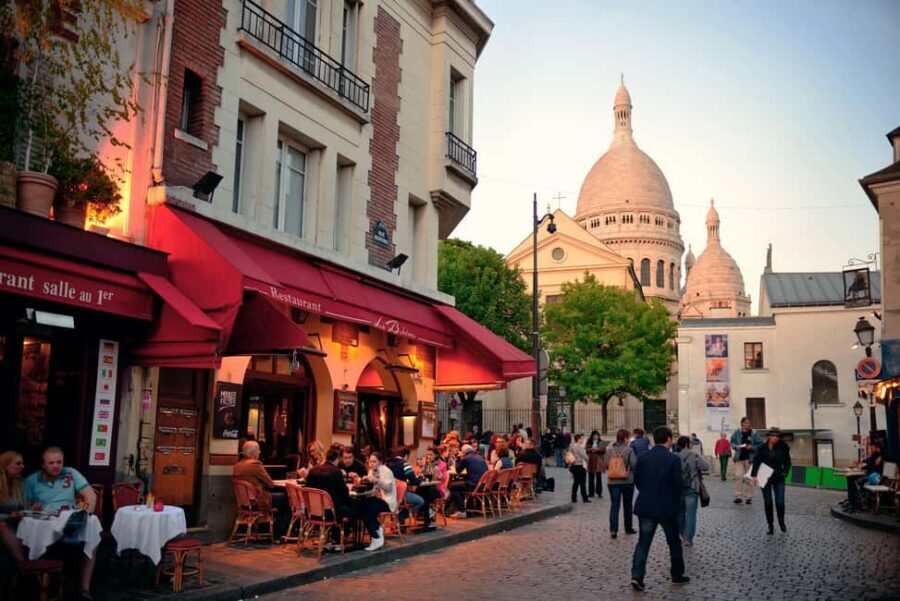
Between tastings, you get a quick culture hit. You’ll pause at a major church known as Paris’s third-largest, famous for Delacroix’s monumental fresco Jacob Wrestling with the Angel. You also get a look at the 19th-century fountain outside, with bishop statues representing the four cardinal points.
This matters because it gives your brain a break from only eating. In Paris, that mix is gold: you see art you might not otherwise seek out, then you go back to food with fresh energy.
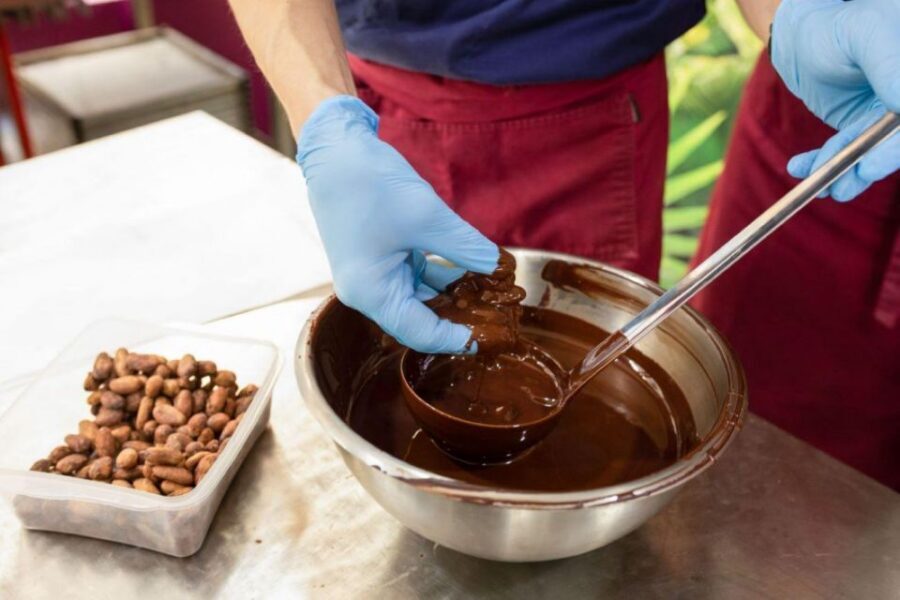
Right after that, it’s Chapon Chocolaterie Saint Sulpice, where you taste a single-origin chocolate mousse made from rare cacao sourced from South America, Madagascar, and Fiji Islands. That is a lot of geography for a spoonful, and it gives you something fun to talk about on the walk: how the origin of cacao shifts flavor.
You’re not just getting sweet. You’re sampling a chocolate maker’s point of view.
Caviar de Neuvic: sustainably farmed sturgeon with blini and sparkling wine
Next up: caviar at Caviar de Neuvic. This house specializes in sustainably farmed sturgeon caviar, so you’re getting a premium ingredient with an eco-conscious angle built in.
The tasting is a classic, but elevated: sturgeon rillettes on blini with delicate caviar, paired with sparkling wine. The practical value here is learning the pairing logic. Caviar can feel intense alone; blini adds texture and comfort, and the sparkling wine brings lift so the flavor stays bright instead of heavy.
If you’ve never had caviar before, this is a friendly introduction. You’re not being asked to eat a plate of plain roe. You’re trying it as part of a composed bite.
Maison Mulot quiche and a Saint-Germain market wander
Then you move to Maison Mulot, a prestigious Parisian bakery and traiteur founded in 1975. Their tasting is a classic Quiche Lorraine, a straightforward dish that shows skill in the basics: eggs, cream, and that savory, butter-satisfying balance.
After that, you spend time around the Saint-Germain Market, a modern covered market with 112 stone arcades. This is where the tour shifts from pure tasting to atmosphere. You get to browse fresh produce, fish, meats, and international foods while you’re in the middle of the neighborhood’s daily life.
It’s useful because it helps you connect what you just ate to what you can buy next time. Leave this kind of market knowing where you could shop for a picnic, a snack, or a gift.
L’Avant Comptoir du Marché: farm-to-table French comfort in a neo-bistro
At L’Avant Comptoir du Marché, you’re eating at a popular neo-bistro tied to Yves Camdebord’s Avant-Comptoirs group. The tasting leans into farm-to-table French comfort.
You try caramelized pork belly with red wine, plus French cornbread and freshly churned butter. This is where the tour adds real “meal energy,” not just samples. Pork belly gives you richness, the red wine adds warmth, and butter-and-cornbread brings in the bread-and-salt comfort that makes French bistro food feel easy to love.
Timing note: this stop can feel like your second peak after the caviar moment. If you’re sensitive to rich food, slow down here and take water sips when you can.
Barthélémy cheese: fontainebleau and presidential suppliers
Next is Barthélémy, a top cheese shop where you’ll sample a selection of French cheeses and their signature fontainebleau. Fontainebleau is creamy and sweet-tart in a way that feels distinctly French once you’ve tasted it alongside savory cheese.
A fun credibility detail: this shop has been an official supplier of cheese to French presidents since 1970. You can treat that as trivia, or you can treat it as a quality signal. Either way, it helps you understand why this stop is built into the route.
If you like learning while you taste, ask your guide what to pair with what. This is the kind of stop where a quick explanation turns a few bites into a mini lesson on balance.
Jacques Genin chocolate: mint ganache and mango passion caramel
Now you’re back in chocolate territory, this time at Jacques Genin, an ultra-modern shop focused on flavors rather than old-school display cases. The tasting includes mint-infused dark chocolate ganache and mango passion caramel.
This is a great combo because it covers contrast. Mint brings cool edge to dark chocolate, while mango passion adds fruit brightness and perfume-like sweetness. It’s not just dessert taste. It’s flavor structure.
If you have a sweet tooth, you’ll love this stop. If you do not, it’s still worth tasting because the mint keeps it from being one-note candy.
Ryst Dupeyron spirits: Hors d’Âge Armagnac and vintage Port
For the finish, the tour goes to Ryst Dupeyron – Vintage and Co, a historic shop and distiller crafting Armagnac and rare spirits since 1905. Here, you taste rich Hors d’Âge Armagnac and vintage Port wine.
This ending works because it changes the texture again. Cacao and fruit are gone; now you’re tasting something warm, aromatic, and slow-sipping by nature. Pair that with the fact that you’ve already eaten through multiple courses, and the flavors feel complete instead of random.
Practical advice: go easy on the first sip. Spirits open up as they warm slightly, but you’re walking afterward, and you’ve still got your senses to enjoy for the rest of the day.
The guide makes or breaks it: Q&A, pace, and insider tips
The tour’s value isn’t only in the famous names. It’s in how the guide handles the flow. This is meant to be question-friendly, with the designated group guide helping you understand what you’re tasting and why the stops matter.
In the experience, guides have shown up with a friendly, welcoming style, and names like Betsy, Saeed, and Sabine come up as standouts. What you should expect from that kind of guide: clear explanations, practical neighborhood knowledge, and a pace that lets you taste without feeling rushed.
Also, those insider tips that come with the tour can be handy later. You’re leaving with a mental map of what to buy and where to return for a second bite.
Price and value: why $160.91 can make sense
At $160.91 per person, this isn’t a budget snack crawl. But it does look like strong value when you break it down by type of tasting.
You’re getting:
- a bakery stop with a signature apple tart and cookies
- a chocolate stop with a single-origin mousse
- a premium caviar tasting with sparkling wine
- a classic savory stop with Quiche Lorraine
- a bistro bite with pork belly, cornbread, and butter
- a cheese shop tasting including fontainebleau
- a high-end chocolate shop with ganache and caramel
- a spirits finish with Hors d’Âge Armagnac and vintage Port
That mix is the real pricing argument: caviar, specialty chocolate, and spirits are the kinds of things that cost real money if you order them à la carte. Add a guide who keeps the route efficient and the group small, and the tour starts to look less like a price tag and more like a shortcut to high-quality tastings.
What can add cost: extra drinks and tips. If you keep it to included tastings and stick to water between stops, you’ll control the budget.
Dietary needs, allergies, and who should pass
The tour does try to accommodate diets. If you have dietary requirements, you can email or add a note at booking, and the team will do its best for vegetarian, gluten-free, or other needs. That’s a big deal on food tours, because it means you’re not stuck with a sad plain option.
There’s also a clear boundary: this experience isn’t suitable for guests with severe or life-threatening food allergies. If allergies are a factor, take this seriously and ask questions before booking.
For children: under 4 years old can join for free, but food is not included. Paid tickets with food included are available for ages 4 and up.
Should you book this Saint-Germain food and wine tour?
Book it if:
- you want a guided tasting route with minimal planning
- you enjoy a mix of classic Paris foods and a few “wow” items (caviar, Armagnac, vintage Port)
- you like walking neighborhoods and popping in where locals actually eat and shop
- you value a small group pace where you can ask questions
Skip it (or think carefully) if:
- you hate being tasting-heavy and would rather have one full sit-down meal
- you have severe allergies that require strict control
- you’re not interested in the included spirits and extra premium tastings, because that’s a big chunk of what makes the price feel worthwhile
My take: this is a strong choice for first-time visitors to Paris who want the Left Bank vibe and a guided “greatest hits” day without turning the trip into a spreadsheet.
FAQ
How long is the Eating Paris Saint-Germain Food & Wine Tour?
It runs for about 3 hours.
Is the tour in English, and how big is the group?
It’s offered in English. The experience is kept small, listed as capped at 12 people, and the specific tour size may be limited to a maximum of 8 travelers.
What tastings are included?
You’ll sample apple tart, chocolate tastings, caviar with sparkling wine, Quiche Lorraine, food at a neo-bistro, cheeses including fontainebleau, additional chocolate, plus Armagnac and vintage Port. Exact selections can vary by day or season, but the tastings are described as a selection of the featured items.
Can the tour accommodate dietary requirements?
You can request dietary accommodations by emailing in advance or adding a note at booking. The tour can do its best for needs like vegetarian or gluten-free, but it isn’t suitable for severe or life-threatening allergies.
Do children need a ticket?
Children under 4 can join for free, but food is not included. Tickets with food included are available for ages 4 and up.
Where do you meet and where does the tour end?
Meet at Bar de la Croix Rouge, 2 Pl. Michel Debré, 75006 Paris. The tour ends at 27 Rue de Varenne, 75007 Paris. It’s near public transportation.