Champagne gets real when the winemaker explains it. On this 6-hour, English tour from Reims, Champagne Marie Senellart guides you from the Montagne de Reims vineyards to cellars, with tastings tied to named plots and specific production steps. It’s not a generic Champagne stop. It’s a focused look at how the wine is made and why those choices matter.
I love the small group size (up to 6). That means you can actually ask questions instead of shouting over the bus. I also like that the tastings are spread across the day: the Brut Réserve en danger 2018 at Chapelle Saint-Lié, plus cuvée Isid’or at Villedommange, ending with a food-friendly lineup of 3 champagnes and local specialties.
One consideration: this is a day of moving between villages and spending time in cellars. Bring comfortable shoes and keep your pace moderate.
In This Review
- Key Things That Make This Champagne Tour Worth Your Time
- From Reims Station to Premier Cru Hills: Why the Setting Matters
- Parc Naturel Régional de la Montagne de Reims: Village Views and Premier Cru Clues
- Chapelle Saint-Lié: A Plot-Based Tasting With the Vine Step-by-Step
- Sermiers Cooperative: Presses, Vats, and Bottling From Bunch to Bottle
- Villedommange Cellars: Wood Vinification and Chalk Tunnels
- How Much This Tour Costs and Whether It’s Good Value
- Best Fit: Who This Tour Works For (and Who Might Want Another Option)
- Practical Tips So Your Day Runs Smooth
- Should You Book The Secrets of Champagne by a Passionate Winemaker?
- FAQ
- Is the tour offered in English?
- How long is the Champagne tour in total?
- What is the maximum group size?
- Where do we meet in Reims?
- Does the tour end back where it started?
- What time does the tour start?
- Is the Champagne tasting available for minors?
- Is there a mobile ticket?
- Is there any extra admission fee for the stops?
- What is the cancellation policy?
- Is the tour physically demanding?
Key Things That Make This Champagne Tour Worth Your Time
- Winemaker-led access with Champagne Marie Senellart guiding what you see and what you taste
- Premier Cru scenery on the Montagne de Reims Ouest including Sermiers, Chamery, Ecueil, Sacy, and Villedommange
- Two production perspectives: a cooperative view (presses and vats) plus wood vinification in a cellar
- Plot-specific tasting at Chapelle Saint-Lié with the Sous Saint Lié area tied to the cuvée
- Food and wine pairing built in with local specialties alongside 3 champagnes
From Reims Station to Premier Cru Hills: Why the Setting Matters
You start at the EFFIA Parking Reims Station area (Cr de la Gare). From there, the tour follows the Montagne de Reims Ouest, where the vines aren’t just a backdrop—they shape the flavor story. You’ll get to see the côteaux and the villages tied to Premier Cru identity, including Sermiers, Chamery, Ecueil, Sacy, and Villedommange.
This matters because Champagne can feel confusing if you only hear marketing terms. Here, you’re learning geography and craft at the same time. When you later taste, you have something solid in your head: the view you saw, the plot name you heard, and the production step you were shown.
The pace is also practical. It’s built as a 6-hour experience with multiple short segments rather than one long lecture. You’re moving, looking, tasting, and then checking your understanding right away.
Parc Naturel Régional de la Montagne de Reims: Village Views and Premier Cru Clues
The first stop is Parc Naturel Régional de la Montagne de Reims. Think of this as your “map in the air” moment. You’ll travel between viewpoints that let you admire the famous côteaux and the named villages classified Premier Cru.
Highlights here include the circus of Chamery—yes, that’s the name—and the quieter vibe of Ecueil. You’ll also pass through the discreet charm of Sacy and end up with Villedommange perched on the hills. Even if you’re not a geology nerd (no judgment), these are the kinds of places that help you understand why slopes and exposure matter in wine.
Time is about 30 minutes for this segment, so it’s not a long hike. But it’s enough time for your eyes to lock onto what you’ll hear later. You’re basically setting up the tasting notes you’ll get in the cellars.
Chapelle Saint-Lié: A Plot-Based Tasting With the Vine Step-by-Step
Next is Chapelle Saint-Lié, a small but meaningful stop. The point isn’t just a pretty chapel view (though you get that). The focus is a tasting of the winemaker’s Brut Réserve en danger 2018, paired with an explanation from a specific angle: your eye goes to the winemaker’s plot called Sous Saint Lié, right at the foot of the chapel.
This is the kind of detail I like because it makes the wine feel less random. You’re not just tasting a label—you’re seeing how a particular place feeds into decisions made in the vineyard.
You’ll also get an explanation of the conduct of the vine: the steps involved in managing the vines through the growing cycle. It’s useful even if you’re new to Champagne. Instead of getting lost in jargon, you get a clear sequence of how the vineyard side supports what ends up in the glass.
This stop lasts about 1 hour, and it has a nice balance: view, tasting, then practical vineyard explanation. It’s an easy anchor for the rest of the tour.
Sermiers Cooperative: Presses, Vats, and Bottling From Bunch to Bottle
After the chapel, you head to Sermiers, where you’ll visit the cooperative. This is a big deal for how you understand Champagne production. Cooperatives have a different mindset than single-vineyard, single-producer narratives. They’re about stages, consistency, and turning many contributions into cuvées.
You’ll discover the production stages in presses and vats, from the bunch all the way through bottling. Expect a behind-the-scenes look at how fruit becomes structured wine and then becomes ready for the next phases of Champagne.
What I find valuable here is that it reframes Champagne. A lot of people picture it as something mysterious that only happens in deep cellars. This cooperative stop shows the earlier machinery of the process: handling the fruit, pressing, and managing the wine in vats and equipment that do the heavy lifting before anything gets refined.
This portion is about 1 hour and is usually the most “process-forward” stop in the day. If you love when a guide shows you the steps in order, you’ll appreciate how the tour builds from vineyard conduct into the press-and-vat reality.
Villedommange Cellars: Wood Vinification and Chalk Tunnels
Villedommange is where the tour gets hands-on in a different way. You start with a visit to the cellar of the cooperative to understand the subtleties of wood vinification. That phrase can sound abstract, but it’s the right kind of topic for a small-group experience—because you can ask questions as you go.
Then there’s tasting time with cuvée Isid’or, described as coming from the barrels of the cellar. If you’re comparing across stops, this is where your memory work pays off: you’ve already tasted at the chapel, now you’re tasting with a cellar technique in mind.
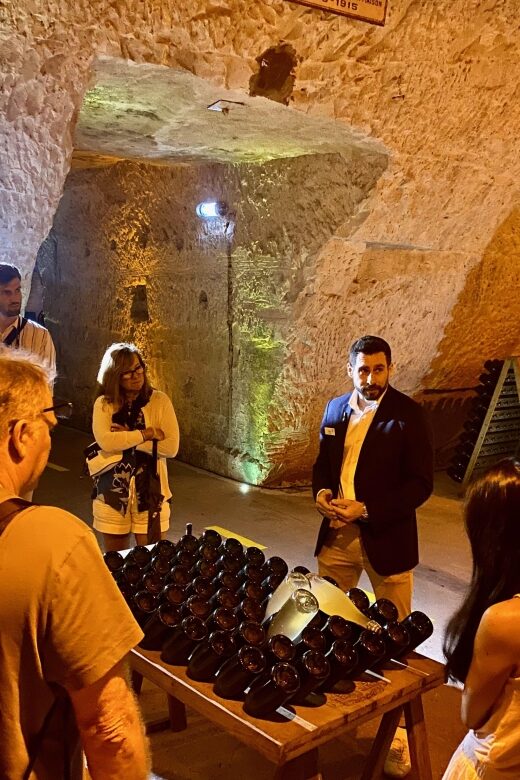
After that, you’ll tour a typical Champagne cellar excavated from chalk more than 200 years ago. Chalk cellars are part of Champagne identity for a reason: they help create stable conditions for maturation. Even if you don’t memorize every cellar fact, you’ll feel the difference. Chalk tunnels tend to make the whole process seem real, not just romantic.
The day ends at a tasting in their house with a pairing format: 3 champagnes plus local specialties. This is a strong finish because you leave with a practical sense of food and wine matching, not only what you like on its own.
Time for this section is about 2 hours 45 minutes, so you get depth rather than a quick taste-and-run. It’s also the stop where the tour’s “winemaker’s perspective” really comes through, especially in how the food is served alongside the champagnes.
How Much This Tour Costs and Whether It’s Good Value
The price is $211.84 per person for about 6 hours in a group of max 6, offered in English. That’s not a budget Champagne sampler. But you’re also not buying a generic tasting room experience.
Here’s what you’re paying for:
- Small-group access with real conversation and the chance to connect vineyard and cellar explanations to what’s in your glass
- Multiple tastings across the day, including Brut Réserve en danger 2018 and cuvée Isid’or, plus a final tasting of 3 champagnes with local specialties
- Structured production visits, including a cooperative stage walkthrough (presses/vats/bottling) and wood vinification in a cellar setup
- Premier Cru setting where the tasting feels anchored to geography, not just a menu
So if your goal is Champagne basics, you might find cheaper. But if you want a day that connects where the grapes come from, how the wine is made, and what works on the table—this is the kind of value that adds up.
Best Fit: Who This Tour Works For (and Who Might Want Another Option)
This tour is a great match if you:
- like Champagne explained by someone who cares about the vineyard details
- want to see more than one kind of production setup (cooperative stages plus cellar technique)
- enjoy tastings that end with food pairing, not only sip-by-sip sampling
- prefer smaller groups and a calmer pace around wine
It may be less ideal if you:
- want a purely sightseeing day with minimal time in cellars and tastings
- don’t like walking between stops or prefer a fully seated experience
- are under 18, since Champagne tasting is only offered to people over 18
Also, remember it’s tasting-heavy. Plan your rest of the day accordingly—this is the kind of tour where you’ll feel the wine.
Practical Tips So Your Day Runs Smooth
A few small things can make this kind of tour feel effortless:
- Wear comfortable shoes. You’ll be moving between villages and going through cellar spaces.
- Bring a layer. Cellars are often cool, and you’ll be grateful for a light jacket.
- If you’re 18+, have ID handy. The tasting is only for adults.
- If you want the most out of the day, slow down during the vineyard and plot explanations. Those plot names are the thread that ties the tastings together.
And yes: keep your notes simple. You don’t need a wine encyclopedia. Just remember which stop gave you which cuvée and what production idea was being explained.
Should You Book The Secrets of Champagne by a Passionate Winemaker?
If you care about the craft behind Champagne—and you like your wine education tied to place—book it. This tour’s strongest advantage is not just tastings. It’s the way the day connects vineyard management, cooperative production stages, and cellar technique, all guided by Champagne Marie Senellart in a small group.
If you’re the type who wants a quick sip with minimal explanation, you might feel this is more than you asked for. But if you want a day that feels specific, thoughtful, and genuinely instructional, this one earns your time.
FAQ
Is the tour offered in English?
Yes, the experience is offered in English.
How long is the Champagne tour in total?
It runs for approximately 6 hours.
What is the maximum group size?
The tour has a maximum of 6 travelers.
Where do we meet in Reims?
You meet at EFFIA Parking Reims Station, Cr de la Gare, 51100 Reims, France.
Does the tour end back where it started?
Yes, it ends back at the meeting point.
What time does the tour start?
The start time is 9:30 am.
Is the Champagne tasting available for minors?
No. Champagne tasting is only offered to people over 18 years old.
Is there a mobile ticket?
Yes, it includes a mobile ticket.
Is there any extra admission fee for the stops?
The information provided lists admission ticket free for each stop.
What is the cancellation policy?
Free cancellation is available. You can cancel up to 24 hours in advance for a full refund.
Is the tour physically demanding?
It requires a moderate physical fitness level.