REVIEW · PARIS
Canadians in Normandy D-Day beaches Juno Beach and Pegasus Bridge (3/7 pax)
Book on Viator →Operated by ADRIAN ROADS · Bookable on Viator
A Canada-shaped Normandy day.
What makes this tour special is the focus: Canadian roles in the first days of the D-Day invasion, told across key sites on the same practical route. I like that it combines famous landmarks like Pegasus Bridge with the human-scale sites at Juno Beach, including the Juno Beach Centre.
Two things I really value here are the small group size and the guide. With a maximum of seven people, you actually get time to ask questions and get answers in plain language, not just sit and listen. On top of that, guides like Adrian and Régis (from past groups) bring a serious, careful tone that makes the history feel personal without turning it into a lecture.
One thing to consider: this is a 13 to 14 hour day. It moves, and you cannot linger like you would on a self-drive trip, so if you want slow wandering and long museum time, build in extra days in Normandy.
In This Review
- Key highlights worth your time
- A Normandy day trip that stays focused on Canadians
- Leaving Paris early: the real trade-off is time, not comfort
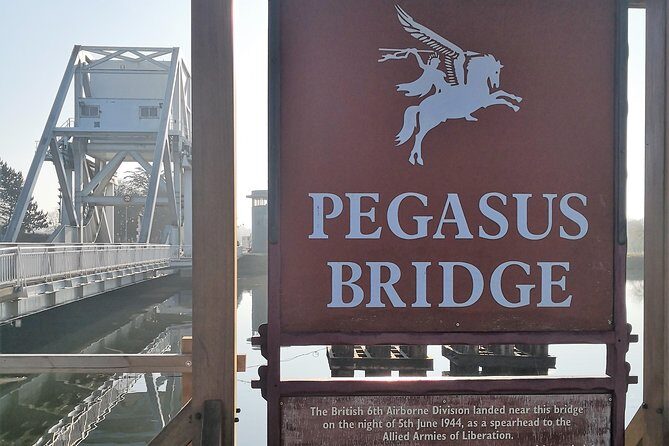
- Pegasus Bridge: where the airborne mission starts to make sense
- Bény-sur-Mer Canadian War Cemetery: the landscaped quiet hits hard
- La Maison des Canadiens: the view is part of the story
- Juno Beach Centre: your best chance to connect facts to emotion
- Croix de Lorraine and the Churchill AVRE: a visual ending to the day
- Price and value: what $288.99 buys you in real-world terms
- How to plan for a long, meaningful day (and not burn out)
- Who this Canadian Normandy tour is best for
- Should you book this Normandy day?
- FAQ
- What time does the tour start, and how long is it?
- What is included in the tour price?
- Is lunch included?
- Do I need to pay admission at the other stops?
- How large is the group?
- What if the weather is bad?
Key highlights worth your time
- Small-group size (up to 7) keeps the day personal and question-friendly
- Pegasus Bridge first, so you start with the invasion’s early “bridge” fight
- Juno Beach Centre admission included, with films and galleries organized by Canadian involvement
- Canadian War Cemetery + Canada House gives you both grief and context, not just scenery
- Croix de Lorraine and a Churchill AVRE tank add a sharp ending to the Normandy timeline
A Normandy day trip that stays focused on Canadians
A lot of Normandy tours cover the beach and move on. This one keeps the lens on Canada. You’ll see how Canadian units fit into the wider Allied plan, but you also get the Canadian story at ground level: what happened, where it happened, and what it cost.
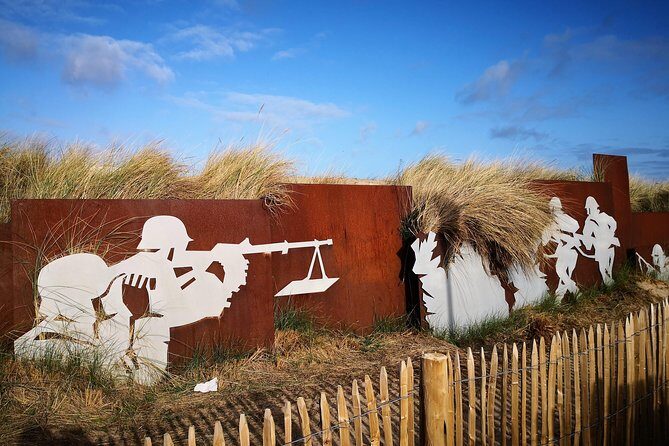
That matters because Normandy can feel like a blur of locations. When the day is organized around one national thread, you get better mental pictures fast. I also like that the tour doesn’t treat Canada’s role as a footnote. It gives you the stakes—especially in the opening minutes of June 6, 1944.
You can also read our reviews of more tours and experiences in Paris.



Leaving Paris early: the real trade-off is time, not comfort
The meet-up point is right in the Paris tourist-workhorse zone on the Champs-Élysées area, and you start at 6:30 am. The long drive is part of the deal. The good news is the transportation is air-conditioned, which helps on warm mornings or hot afternoons when Normandy traffic can feel endless.
This is also a day where you’ll want to manage your energy. The schedule stacks several meaningful stops, and you’ll be in transit between them. If you know you’re the type who needs food on the hour, plan ahead—lunch and drinks are not included.
Pegasus Bridge: where the airborne mission starts to make sense

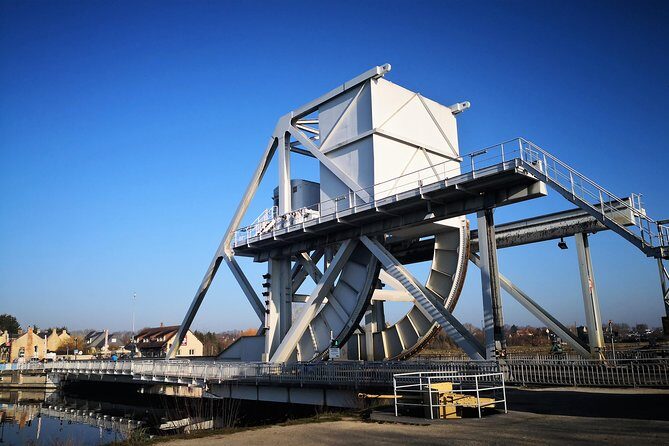
Pegasus Bridge is a bascule bridge over the Caen Canal, and it’s remembered because the bridge crossings were strategic targets on D-Day. You’ll learn how this site—paired with the nearby Ranville Bridge over the river Orne—became a major objective for British airborne troops in the very first moments of the Allied invasion.
The story centers on Operation Deadstick, part of Operation Tonga. A glider infantry unit was tasked to land, seize the bridges, and hold them until relieved. What I like about visiting early in the day is that it gives you a foundation before you reach beaches. You start understanding that Normandy wasn’t only about landing craft and shorelines. It was also about controlling choke points so the invasion could keep moving.
Practical note: admission at Pegasus Bridge is free on this tour, and you should be ready for a short stop that still feels dense—because the details are what make it powerful.
Bény-sur-Mer Canadian War Cemetery: the landscaped quiet hits hard
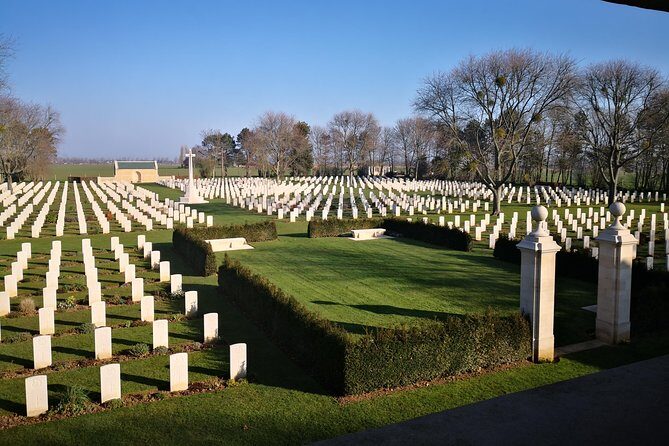
Next you go to the Bény-sur-Mer Canadian War Cemetery, one of the most beautifully kept military cemeteries in the region. It’s known for predominantly Canadian soldiers killed in the early stages of the Battle of Normandy. You’ll see the Cross of Sacrifice, a Commonwealth War Graves Commission memorial style you’ll recognize across many Commonwealth cemeteries.
The numbers are sobering: there are 2,049 headstones, marking the dead of the 3rd Division, plus the graves of 15 airmen. Even with that scale, the design helps you slow down. Pines and maples line the grounds, and the layout guides you through names without shouting at you.
What makes this stop especially worthwhile is how it connects the battlefield to real people. Even though the cemetery name points to one place, it’s near Reviers. The locals also take a special interest in the cemetery, and that care shows in the hedges and the thoughtful planning.
This isn’t a quick photo stop. If you let it land, you’ll feel the difference between reading about WWII and standing where some of it ended.
La Maison des Canadiens: the view is part of the story
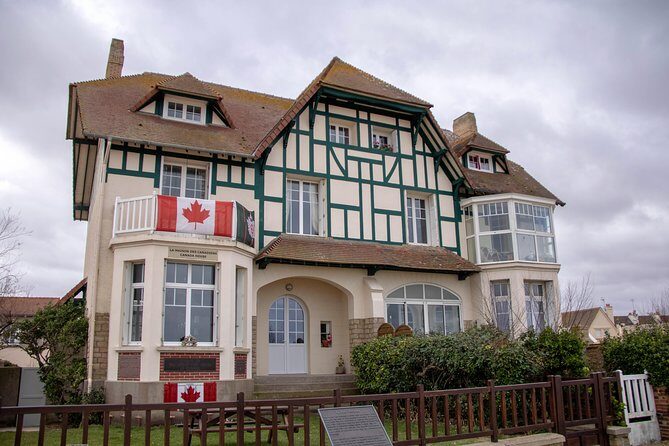
La Maison des Canadiens, also called Canada House, looks like the kind of timber-framed building you could pass without thinking. Then you read the inscription at the entrance, and you get the gut-punch: over 100 men of the Queen’s Own Rifles were killed or wounded in the first minutes of the landings, with the house within sight of Juno Beach.
This is the Canadian story with a sharp edge—history in the background, but not hidden. The building is said to have survived because it was possibly favored by a German officer. Later, the family of Hervé Hoffer had ownership before the war, and he met returning Canadian veterans around the 40th anniversary of D-Day.
You’ll understand why this house has become a landmark for black-and-white photographs of troops landing. It’s not just a structure; it’s a fixed point in a landscape where the war moved fast.
The stop is brief, and that’s the only drawback: you may want more time to look closely and let the scene sink in. But even a short visit works well because the location does the heavy lifting.



Juno Beach Centre: your best chance to connect facts to emotion
This is where the tour earns its keep. The Juno Beach Centre has the permanent exhibit, and admission is included. Expect a full 2 hours here, which is enough time to do more than skim.
The permanent exhibits are organized into rooms that help you follow a story line instead of bouncing around randomly. You’ll start with the June 06, 1944 focus, where you stand in a simulated landing craft and watch a film that puts you in the mindset of Canadians during the war.
From there, the museum moves backward and forward:
- Canada in the 1930s sets your baseline with geography, demographics, politics, and the social climate on the eve of war. You’ll also meet virtual young characters, Peter & Madeleine, who keep the experience grounded for different ages.
- Canada goes to War shows how Canada transformed and mobilized, including civilians and soldiers on every front.
- Road to Victory covers major campaigns and other branches tied into the outcome: medical roles, engineers, war correspondents, and more.
- Some Came Back, Others Did Not is the human toll section, with names scrolling across the ceiling to remember those who died, plus listening alcoves featuring letters and essays in English and French.
- They Walk With You is a film experience using video and audio, with voices of Canadian war correspondents Marcel Ouimet and Matthew Halton. Viewer discretion is advised, and the film reenacts the role and sacrifice of infantry soldiers during D-Day and the Battle of Normandy.
What I like most is that the museum doesn’t try to make you feel one way only. It offers facts—maps, documents, multimedia, artifacts—then steps aside so you can absorb the human cost. And because you’ll already have seen locations like Pegasus Bridge and the Canadian cemetery, you’re not learning history in a vacuum.
Croix de Lorraine and the Churchill AVRE: a visual ending to the day
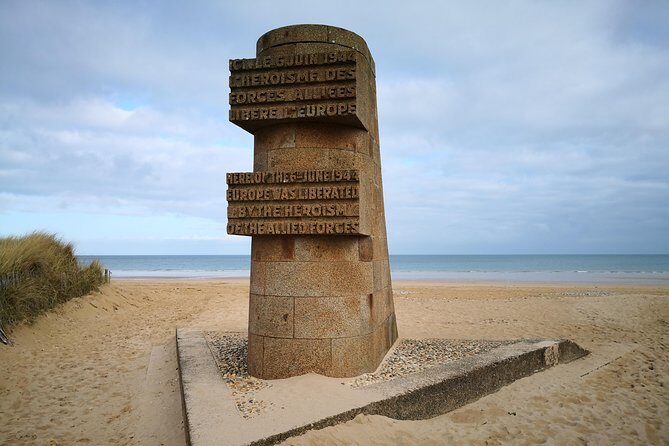
The tour’s final set of stops leans toward commemoration and battlefield machinery. You’ll visit the Croix de Lorraine, a monument over 18 meters high facing the sea. It commemorates General de Gaulle’s return to French soil on June 14, 1944 after crossing the English Channel on the French destroyer La combattante.
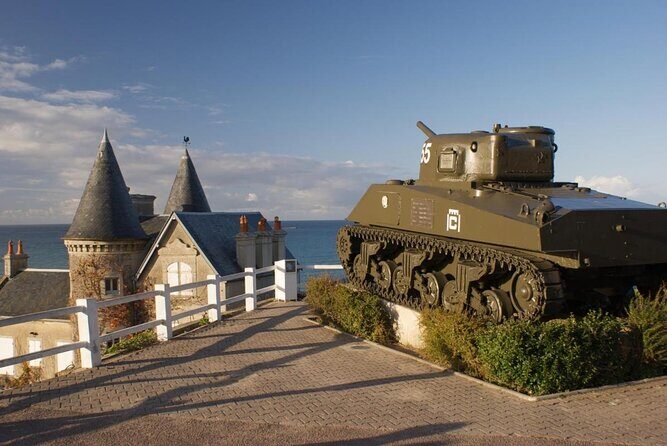
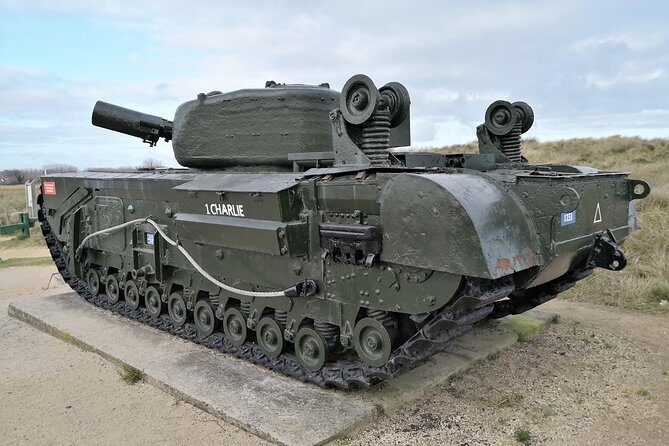
Then you’ll see the Churchill AVRE tank, known as One Charlie. It’s a memorial tied directly to landing operations on June 6, 1944, when it was unable to bridge a deep culvert about 100 yards south of the site. The crew had to escape under enemy fire with very heavy casualties.
That combination—political commemoration plus a specific piece of battlefield equipment—gives your day a clean timeline from airborne tactics to later liberation and remembrance.
Price and value: what $288.99 buys you in real-world terms
At $288.99 per person, you’re paying for a full-day package that includes transportation, a guide, and Juno Beach Centre admission. Other key stops along the way (Pegasus Bridge, the cemetery, and Canada House) have free admission on this itinerary, so your money is mostly going to the logistics and the guided interpretation, not repeated ticketing.
Whether it feels like a bargain or a splurge depends on how you travel:
- If you’re comparing to self-driving, you’re paying to avoid time, parking stress, and route-planning on a packed day.
- If you’re comparing to cheaper group tours, you’re paying for the small-group size that keeps the day personal and easier to manage.
Also remember the big “hidden cost” of a long day: you’ll want to bring snacks or plan for buying food yourself since lunch and drinks aren’t included.
How to plan for a long, meaningful day (and not burn out)
Start time is 6:30 am, and the day runs about 13 to 14 hours. That’s a marathon. Here’s how to make it work without feeling rushed:
Bring layers. Normandy weather can change fast, and you’ll be outside around the memorial sites even when the museum time is scheduled. Wear shoes you trust; the ground around cemeteries and monuments is managed, but you still want comfort for walking.
Also, pack your expectations. This tour hits several major sites, so you won’t get long, unstructured downtime. The payoff is that each stop has context and you connect the dots in one line instead of scrambling on your own.
Good weather matters, too. The experience requires good weather, and if it’s canceled for poor conditions, you’ll be offered a different date or a full refund.
Who this Canadian Normandy tour is best for
This one is a great match if you want:
- A Canada-focused D-Day day trip from Paris (not a general Normandy overview)
- A route that includes both key sites and the emotional context inside the museum
- A guided day with a small group limit of up to seven people so the conversation stays human
Families with history-minded kids often do well with the Juno Beach Centre because it includes “young public” elements through the Peter & Madeleine circuit. Adults who love WWII will also appreciate the specificity: Operation Deadstick, the cemetery numbers and memorial design, and the film-based exhibit with Canadian voices.
Should you book this Normandy day?
Yes, if you want a structured, Canadian-centered Normandy day with a guide who can explain the significance without turning it into a nonstop speech. I’d book it when you only have one day to spare, because the combination of Pegasus Bridge, Bény-sur-Mer, La Maison des Canadiens, and the Juno Beach Centre is hard to replicate with the same flow.
Skip it (or plan extra time in Normandy) if you hate long days and want to linger. This tour is meaningful, but it is still a packed schedule.
If you like clear direction, thoughtful storytelling, and a museum stop that actually takes time—this is a strong choice.
FAQ
What time does the tour start, and how long is it?
It starts at 6:30 am and runs about 13 to 14 hours.
What is included in the tour price?
The price includes transportation in an air-conditioned vehicle, a guide, and admission to the Juno Beach Centre.
Is lunch included?
No. Lunch and drinks are not included unless specified.
Do I need to pay admission at the other stops?
Admission for Pegasus Bridge, the Bény-sur-Mer Canadian War Cemetery, and La Maison des Canadiens is listed as free on this itinerary. Juno Beach Centre admission is included.
How large is the group?
This tour is limited to a maximum of seven people.
What if the weather is bad?
The experience requires good weather. If it’s canceled due to poor weather, you’ll be offered a different date or a full refund. You also can cancel for free up to 24 hours in advance for a full refund.