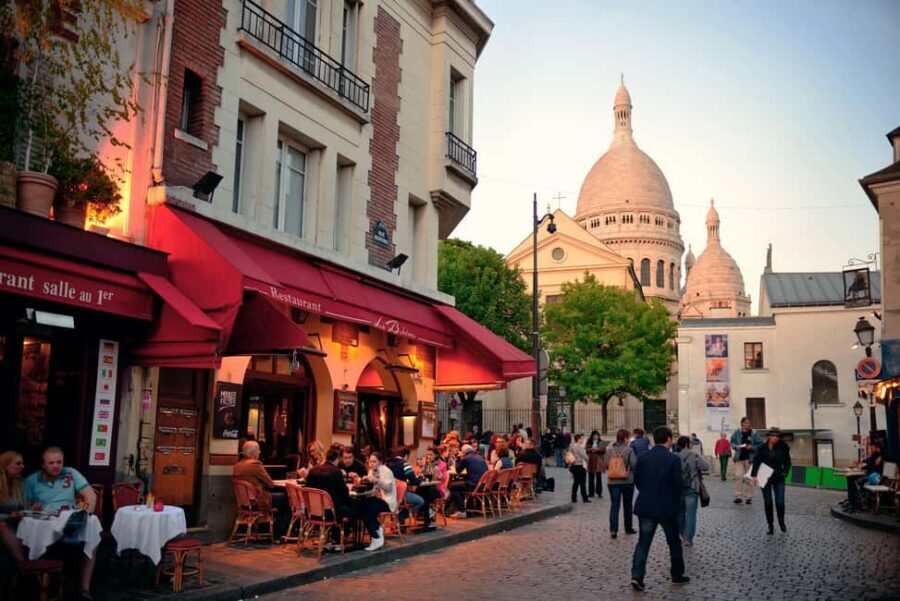
Montmartre is made for a story-based walk. This 2-hour tour is built to help you get your bearings fast and understand why artists, nightlife, and big views all cluster on these hills. I love the small group size (max 15), and I love that you get live commentary the whole way, including guide storytelling from people like Sacha, Max, and Catherine.
The main thing to consider is the effort. Expect lots of uphill walking and stairs, so plan for a moderate fitness level, especially if you choose an afternoon start.
In This Review
- Key highlights at a glance
- Why This Montmartre Walk Works in Just 2 Hours
- From Blanche Meeting Point to Place du Tertre Finish
- Sacré-Cœur on the Hill: Fresco 480 m² and a Big Paris View
- Moulin Rouge Outside: The Red Windmill and the Cancan Backstory
- Montmartre’s Artist Streets: Monet, Van Gogh, Picasso, and Friends
- Pigalle’s Red-Light District: Cafés, Cabarets, and Past Writers
- Place du Tertre: Vineyards, Bocce Fields, and a Calm Square Near the Night
- Price and Value: What $47.79 Buys You Here
- Hills, Crowds, and When to Start (Morning vs Afternoon vs Evening)
- Who This Tour Is Best For (and Who Might Want Something Else)
- Should You Book This Montmartre Highlights Tour?
- FAQ
- What is the duration of the Montmartre Highlights tour?
- How much does the tour cost?
- How large is the group for this tour?
- Is the tour offered in English?
- Where does the tour start and end?
- Is Sacré-Cœur admission included?
- Is Moulin Rouge included inside the tour?
- Is the tour mostly walking?
- Is there a mobile ticket?
- Is the tour affected by weather?
Key highlights at a glance
- Max 15 people keeps the pace friendly and the history personal
- Live guide narration using a loudspeaker helps the group stay spread out
- Sacré-Cœur visit with free admission ticket plus a big view payoff from the hill
- Moulin Rouge outside only, so you focus on meaning and stories, not lines
- Ends at Place du Tertre where you can keep exploring right away
Why This Montmartre Walk Works in Just 2 Hours
You’re paying $47.79 for a focused hit of Montmartre, not a half-day marathon. The duration (about 2 hours) matters because Montmartre rewards momentum: once you understand the layout—hilltop church, artist streets, then Pigalle and down into Place du Tertre—you’ll navigate it much easier on your own after.
The tour’s format is designed for efficiency. You’ll have a professional guide, a real walking itinerary, and live storytelling that ties each stop together. It’s also offered in English, with a mobile ticket, which makes the whole thing feel smoother once you’re in Paris.
And yes, it’s popular. On average, it’s booked around 55 days in advance, so if you’re traveling in peak season (or on a specific day), I’d treat it like a “book sooner” item rather than a “maybe later” one.
From Blanche Meeting Point to Place du Tertre Finish
The tour starts in Blanche (75018 Paris) and finishes at Place du Tertre, the main square where painters and caricaturists hang out. That end point is practical: after the tour, you’re dropped right into the area most people want to linger in anyway—restaurants, cafés, and the lively village-square vibe right around you.
This route also makes sense geographically. You begin near the Montmartre edge of the action, climb into the hilltop landmark first, then work your way through the artist neighborhood down toward Pigalle and back into the Place du Tertre zone. By the time you’re done, you’re not just memorizing names—you’re walking the neighborhood logic.
One more logistics detail that helps: the guide uses a loudspeaker to help maintain physical distance. In a crowded place like Montmartre, that’s not a gimmick. It makes it easier to hear the next story even when foot traffic gets loud.
Sacré-Cœur on the Hill: Fresco 480 m² and a Big Paris View
Stop one is Basilique du Sacré-Cœur de Montmartre, one of the largest churches in Paris. What makes this more than a quick photo stop is the scale and design focus: you’ll see the biggest fresco on its walls (480 m²) and take in the impressive cupola.
There’s also a very tangible payoff after the visit. You get to enjoy the view from the top of the Montmartre hill, looking out over Paris. That matters because Montmartre isn’t a flat sightseeing district. Once you stand up high, the streets below start to make sense, and you’ll understand why artists and writers gravitated here at the turn of the 1900s.
Admission is a plus for value: the tour lists an admission ticket free for this stop, so you’re not paying extra just to experience the main landmark and the hilltop perspective.
Moulin Rouge Outside: The Red Windmill and the Cancan Backstory
Next you’ll see Moulin Rouge from outside—no ticket included. That’s actually a smart choice for a 2-hour highlights tour. Instead of spending time queuing or scanning tickets, you get the meaning: the history behind the red windmill symbol, and the idea of this being a legendary place where the French can-can was introduced to the Paris public.
What you should expect here is orientation. You’ll see the façade and understand why Moulin Rouge became a cultural emblem beyond just the entertainment industry. If you want to go inside on your own later, you’ll at least know what to look for and why it matters.
Since admission isn’t included, plan your expectations around that. You’re buying context and a key photo angle, not a full cabaret visit.
Montmartre’s Artist Streets: Monet, Van Gogh, Picasso, and Friends
Now you move into the heart of Montmartre storytelling. You’ll walk on the steps of artists and writers who lived or worked here around the end of the 19th century and the start of the 20th century—names like Monet, Manet, Van Gogh, Pisarro, Rodin, Picasso, and Zola.
This stop works when you’re in “pattern recognition” mode. Your guide connects the neighborhood to the people—where they used to go out, where they lived, and the kinds of stories that explain why Montmartre feels like a creative island inside Paris.
The practical benefit for you: once you’ve heard the guide’s version of Montmartre, you’ll spot the character of the streets more easily when you wander later. Montmartre can look like any old maze to first-timers. This turns it into a map made of ideas.
Admission here is free, and the time is set for you to absorb without being stuck in one place too long.
Pigalle’s Red-Light District: Cafés, Cabarets, and Past Writers
After Montmartre proper, the tour moves into Pigalle, including the area known historically as the red light district. The description doesn’t try to shock you—it explains what you’re seeing: cafés, cabarets, and sex shops, plus the “hidden pearls” tied to a past era when painters and writers lived and worked nearby too.
This is one of those stops where you get value from framing. If you walk Pigalle on your own without context, it can feel like noise. With a guide, it becomes a lesson in how Paris mixes art, nightlife, commerce, and celebrity geography all in the same blocks.
The tour keeps it efficient: about 30 minutes, and the focus stays on understanding the layers rather than lingering in crowds.
Admission is listed as free, and that makes sense—this part of the experience is the streets and their stories, not ticketed monuments.
Place du Tertre: Vineyards, Bocce Fields, and a Calm Square Near the Night
You end at Place du Tertre, but you also get to feel the contrast inside the tour itself. The stop is described like a pocket of countryside charm—only a few hundred meters from the night energy of Pigalle.
Here you’ll be shown the square’s bucolic feel, including mentions of vineyards, bocce-fields, and hidden parks. That’s the kind of detail that changes how you see the place. If you only notice the painters and caricaturists, you miss the “village square” mood that still lingers in the structure of the area.
Also, this is where the tour finishes. The main square is surrounded by places to eat and rest, so you can make the walk part of a longer outing. If you like the idea of turning a guided tour into an easy, self-guided second act, this is a clean handoff.
Price and Value: What $47.79 Buys You Here
At $47.79 per person for about 2 hours, this is best thought of as a “guided orientation + landmark views + story map” deal. You’re not just paying for someone to point at buildings.
What you get that supports the price:
- A professional guide and full walking tour
- Small group size (max 15), which usually means you can actually hear and follow the narration
- A major landmark visit at Sacré-Cœur, with the tour listing a free admission ticket for that stop
- Multiple quick, high-impact neighborhood stops that build a coherent picture of Montmartre
What you don’t get:
- Meals (so budget time for a snack or sit-down after you finish)
- Moulin Rouge admission (you see it outside, with history and symbol explained)
If you want Montmartre in a tight time window, the structure is the value. If you already know the area deeply and want a long sightseeing day, you might feel the time is short—but for first-time footing, it’s a strong use of your hours.
Hills, Crowds, and When to Start (Morning vs Afternoon vs Evening)
The biggest consistent theme in the experience is physical effort. The tour involves lots of walking uphill and up and down steep hills and steps. One review specifically warns that an afternoon start can mean a lot of climbing, and the advice was to arrange it early so you get more of the day in daylight hours.
So here’s how I’d plan your slot:
- If you’re sensitive to stairs or fatigue, prefer morning.
- If you want a relaxed pace, give yourself an easier schedule before and after.
- If you’re okay with exercise, pick the time that best matches your comfort level with daylight and crowd density.
Montmartre can get busy. One guide-based note from the reviews points out that even when it’s crowded, the group moves through pedestrian traffic with the guide keeping things organized. That’s exactly why a guided route helps: you’re not just walking—you’re being guided through the flow.
Finally, good weather matters. The tour notes it requires good weather, and if conditions are poor, you’ll be offered a different date or a full refund. So if you’re booking during unpredictable seasons, have a Plan B day in mind.
Who This Tour Is Best For (and Who Might Want Something Else)
This is a great fit if you want:
- A high-effort sightseeing district handled with a guide
- Lots of history and storytelling tied to real places
- A short, focused Montmartre route that ends where the action is
It’s also ideal for visitors who like art and cultural connections—because the guide ties the neighborhood to artists and writers by name. The experience is structured around understanding why Montmartre shaped creative lives, not just taking pictures.
You might want a different option if:
- You have limited tolerance for steep uphill walking and steps
- You specifically want indoor attractions beyond the listed Sacré-Cœur visit
- You want a longer, slower day with more time in one location
Should You Book This Montmartre Highlights Tour?
Book it if you’re using Montmartre as a first-time orientation or you want a smart mix of landmark views and neighborhood context in a tight window. The small group size, live commentary, and the efficient sequence—from Sacré-Cœur to Moulin Rouge outside, through artist streets, then down into Pigalle and finishing at Place du Tertre—makes it an efficient way to “learn the lay of the land.”
Skip it (or at least consider another format) if hills and stairs are a deal-breaker for you. This walk is part workout, part storytelling, and the tour assumes you can handle that pace.
If you go into it prepared for the stairs and crowd flow, it’s a very solid Montmartre experience for the money.
FAQ
What is the duration of the Montmartre Highlights tour?
The tour lasts about 2 hours.
How much does the tour cost?
It costs $47.79 per person.
How large is the group for this tour?
The tour has a maximum of 15 travelers.
Is the tour offered in English?
Yes, it is offered in English.
Where does the tour start and end?
It starts at Blanche (75018 Paris) and ends at Place du Tertre (Pl. du Tertre, 75018 Paris).
Is Sacré-Cœur admission included?
Yes, the tour lists a free admission ticket for Sacré-Cœur.
Is Moulin Rouge included inside the tour?
No. Moulin Rouge is viewed from outside, and admission is not included.
Is the tour mostly walking?
Yes. It is a walking tour and includes steep hills and steps, with a moderate physical fitness level recommended.
Is there a mobile ticket?
Yes, the tour includes a mobile ticket.
Is the tour affected by weather?
Yes. It requires good weather, and if canceled due to poor weather you’ll be offered a different date or a full refund.