REVIEW · PARIS
Le Marais Paris Private Transfers
Book on Viator →Operated by Tour Passion · Bookable on Viator
Le Marais can feel like a whole city inside Paris. This experience pairs a guided walk through classic spots like Place des Vosges with stops tied to the neighborhood’s Jewish and LGBTQ communities, then finishes with a metro hop to Gare du Nord for a booked vegetarian Indian lunch.
I especially like how the tour starts with the kind of scenery that makes you slow down—arches, red-brick facades, and courtyard settings—before shifting into neighborhood streets like Rue des Rosiers. I also like the practical support once you’re moving: guidance during the metro helped my group avoid typical chaos, and I heard from one guest that the guide Helena (from Greece) shared smart tips.
One thing to keep in mind: it’s about 3 hours, so it’s not a “sit and linger all day” plan. You’ll be walking, you’ll see key sights (including the Shoah Memorial from the outside), and lunch drinks are not included.
In This Review
- Key things to know before you go
- How the Le Marais private transfers fit together in about 3 hours
- Place des Vosges: the postcard start that actually helps you navigate
- Hotel de Sully courtyard: where Henry IV’s France still shows
- Rue des Rosiers: Jewish food, LGBTQ pride, and streets made for strolling
- Saint-Paul-Saint-Louis, the Shoah Memorial, and Hôtel de Ville: big meaning, handled with care
- Saint-Paul-Saint-Louis Church
- The Shoah Memorial (seen from outside)
- Hôtel de Ville de Paris
- Metro to Gare du Nord: the practical shortcut that saves your energy
- Vegetarian Indian lunch near Gare du Nord: easy, booked, and not stressful
- Price and value: what you’re really paying for at $203.62 per person
- Who this Marais experience is best for
- Should you book Le Marais Paris Private Transfers?
- FAQ
- What is the duration of the Le Marais Paris Private Transfers experience?
- What does the tour price include?
- Is lunch included, and is it vegetarian?
- Does the tour include hotel pickup and drop-off?
- Is this tour just for my group?
- Can I get a full refund if my plans change?
Key things to know before you go
- Hotel pickup and drop-off in an airconditioned vehicle keeps your day smooth, especially if you’re starting from farther out.
- Courtyard and square time: Place des Vosges and the Hotel de Sully courtyard give you those classic Paris views fast.
- Rue des Rosiers context: this is a street where you’ll pick up the neighborhood’s Jewish roots and also its LGBTQ energy.
- A guided metro segment reduces the stress of navigating Gare du Nord’s scale.
- Booked vegetarian Indian lunch with a fixed menu—easy win when you don’t want to decide at lunchtime.
- Some stops are exterior-only (like the Shoah Memorial), so you’ll be absorbing atmosphere more than going deep inside.
How the Le Marais private transfers fit together in about 3 hours
This is a guided walking tour of the Marais with private transfer support around it. You’ll get picked up from your hotel in an airconditioned vehicle at a preferred time, then you’ll spend the main part of the experience on foot in the neighborhood. After the sightseeing, you’ll be brought back to your hotel in the same way.
What makes the structure work well is that it’s paced in chunks. You start with easy-to-understand landmarks, then you move into streets with lots of shops and food, and finally you end with a metro ride and lunch. That last step matters: Gare du Nord is huge—one of the busiest stations in Europe—so having the guide coordinate the metro ticket and help you reach the restaurant saves time and stress.
Also, even though the tour is described as “private” (your group only), the experience isn’t positioned as a fully solo, one-on-one custom guide. Think of it as your group getting guided attention, with a set itinerary and set stops.
You can also read our reviews of more tours and experiences in Paris.



Place des Vosges: the postcard start that actually helps you navigate
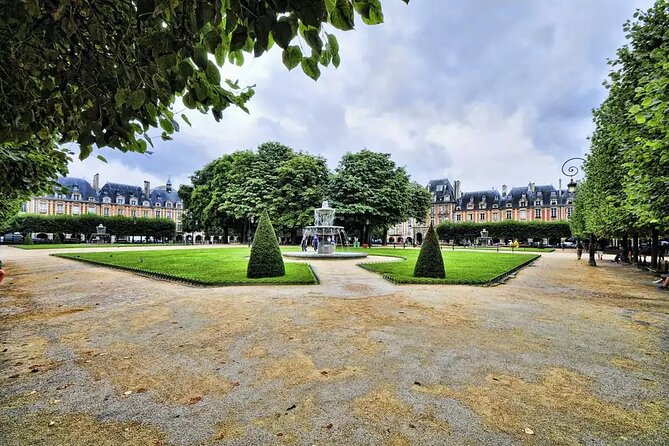
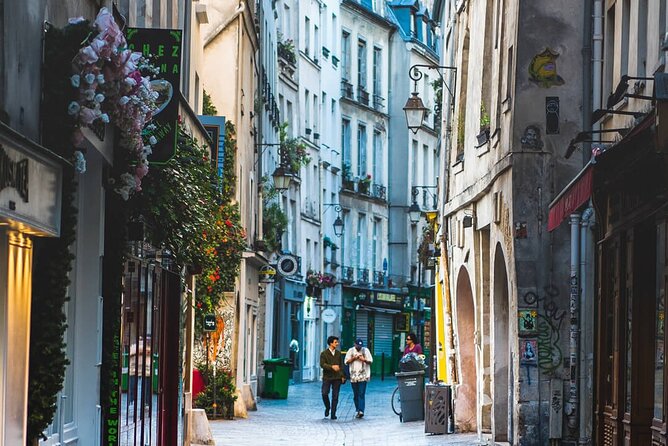
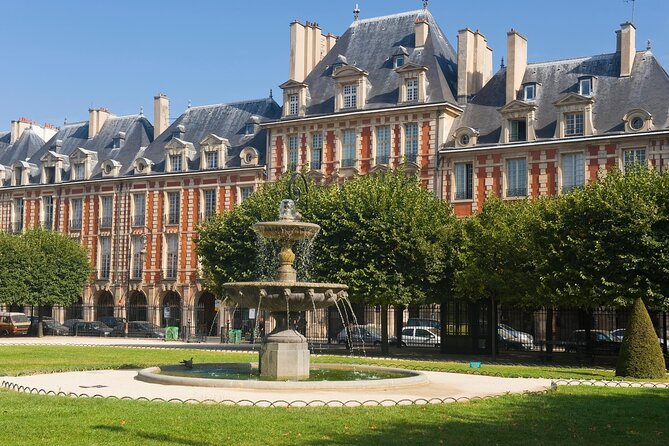
Your first big stop is Place des Vosges, one of the oldest squares in Paris. The layout is part of what makes it special: you can stroll along the garden paths, look up at the arches, and admire the red-brick facades.
This is a great starting point because it gives you a mental map of the area. Once you’ve seen this square, Rue des Rosiers and the surrounding streets feel less like random turns and more like a neighborhood system. It also sets the tone for the day: elegant but lived-in. The square’s shops can be lively on Sundays too, and that fits the Marais mood well.
You don’t need to pay admission here—your ticket info for this stop is free. Expect about 30 minutes on foot from the meeting point through the square area, so you get atmosphere without feeling rushed.
Hotel de Sully courtyard: where Henry IV’s France still shows
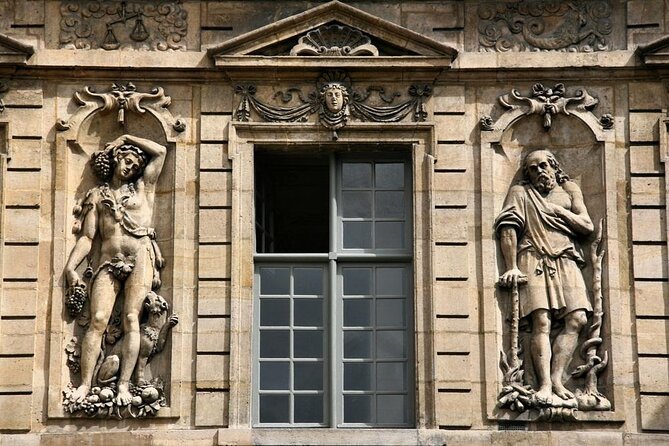
Next comes the Cour et jardin de l’Hotel de Sully, a standout if you like architecture you can actually see up close. This townhouse started as a private mansion in the 1600s and was later listed as a historical monument in 1862. You’re not just passing by a facade; you’re walking around in a setting connected to major names.
What I like about this stop is how specific the story is. It was commissioned by King Henry IV and overseen by Maximilien de Béthune, Duke of Sully (1559–1641). The Duke bought the residence in 1634, and it stayed in the Sully family until the mid-18th century. Even famous guests like Madame de Sévigné and Voltaire stayed there.
It’s also another “easy pause” in the schedule. With about 15 minutes here and free admission, it’s enough time to look carefully without turning the day into a museum crawl.
Rue des Rosiers: Jewish food, LGBTQ pride, and streets made for strolling
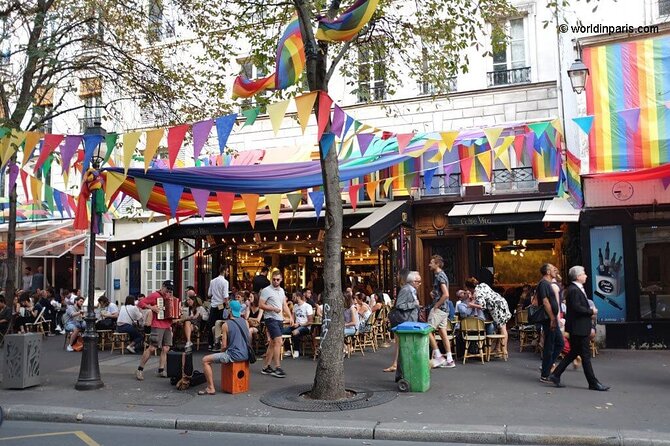
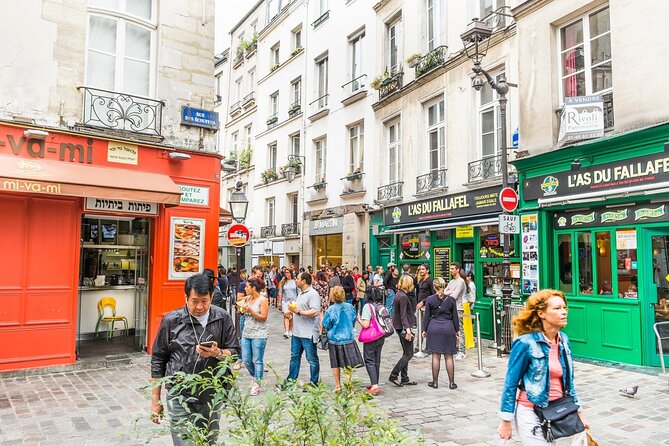
Rue des Rosiers is the kind of street where you can feel multiple communities at once. In this part of the Marais, the street name itself points to its identity, and it’s widely known as the center of the Parisian Jewish community. You’ll get the atmosphere through shops and restaurants that reflect that heritage.
Then there’s the other layer: the Marais is also known as the biggest gay district in France. So Rue des Rosiers works well as a “double lens” street—you’ll notice the mix of culture, nightlife energy, and everyday life happening side by side.
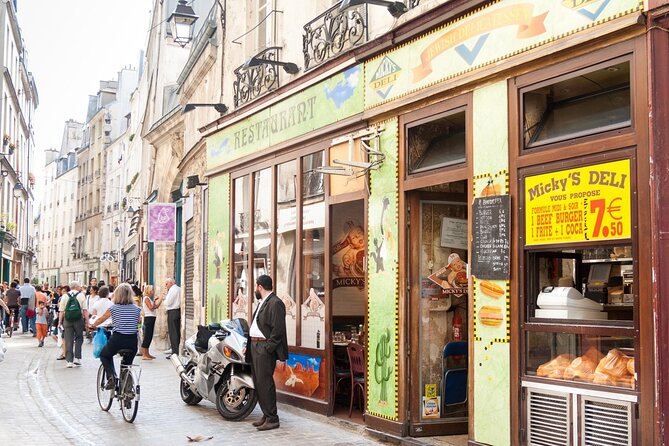
This is also where the famous falafel talk starts. One big name that comes up for this street is L’as du falafel. You don’t have to plan a stop right on the dot to enjoy the area—you can just use the street as your marker for where you are in the neighborhood’s story.
You’ll spend about 20 minutes here, and the ticket info is free. That timing is good. It gives you a taste of the street’s energy without forcing you into long lines or expensive detours.
Saint-Paul-Saint-Louis, the Shoah Memorial, and Hôtel de Ville: big meaning, handled with care
After Rue des Rosiers, the route turns toward places that make the Marais more than shops and sidewalks.



Saint-Paul-Saint-Louis Church
You’ll see the Saint-Paul-Saint-Louis Church as you stroll through the neighborhood. It’s listed as a historical monument since 1887 and fully renovated in 2012, so the building’s look is part of the payoff.
Construction dates matter here: built between 1627 and 1641, it was originally Jesuit and was the first in Paris to move from Gothic style to baroque. You’ll also hear how, after the Jesuit order was forbidden and banished in 1762, the church was entrusted to local clergy. During the French Revolution, it was used as a storehouse.
This is a “pause and look” stop more than a long visit. It’s a good reminder that the Marais has been shaped by shifting power, religion, and daily life for centuries.
The Shoah Memorial (seen from outside)
Then comes one of the most serious parts of the route: the Shoah Memorial. Here, you’ll visit by viewing it from the outside, focusing on the memorial wall of names.
The numbers are heavy but important: names of 76,000 Jews are engraved, including 11,000 children, deported from France with the Vichy government’s collaboration as part of Nazi plans during 1942–1944. Most of those victims were murdered in Auschwitz-Birkenau, with others sent to Sobibor, Lublin, Majdanek, and Kaunas/Reval. Only 2,500 survived.
I appreciate that this stop is included but not treated like a quick photo opportunity. It’s the kind of moment that slows your thinking down, even if you’re not going inside.
Hôtel de Ville de Paris
Finally, you reach the Hôtel de Ville de Paris, the seat of the City Council since 1357. The building you see now was rebuilt after the original Hôtel de Ville burned during the Paris Commune in 1871. Architects Théodore Ballu and Edouard Deperthes created the neo-renaissance style design.
This stop is also interesting for how it links governance to spectacle. The city offers guided tours by reservation only, and there’s a function room designed as a replica of the Hall of Mirrors at Versailles. Even without a tour, it’s a powerful landmark to stand near before heading to the train station chaos.
Metro to Gare du Nord: the practical shortcut that saves your energy
Your last major movement is the metro segment, which is one of the smartest parts of the experience.
From Hôtel de Ville, you take the metro to Gare du Nord. The guide buys the metro ticket, and once you arrive, it’s about a 10-minute walk to the Indian restaurant where lunch is booked.
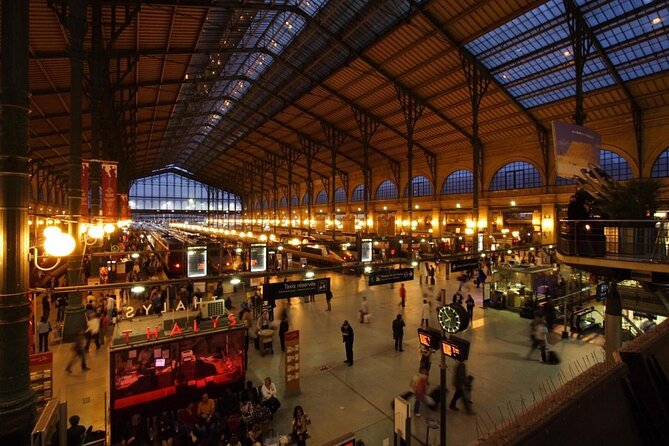
Gare du Nord is a beast of a station: one of Europe’s busiest, with capacity around 700,000 passengers and roughly 2,200 train movements a day. That scale can be intimidating—especially if you’re juggling language, directions, and crowds.
This is where the guide’s “how to survive the metro” advice really helps. In one account, the guide Helena (from Greece) gave practical pointers about metro etiquette, including limiting phone and camera use while riding. That kind of guidance might sound small, but it reduces distractions and keeps everyone moving safely.
Vegetarian Indian lunch near Gare du Nord: easy, booked, and not stressful
Lunch is set up for you: you walk from Gare du Nord to the restaurant, and you’ll have a fixed vegetarian Indian menu. The guide accompanies you to the restaurant and then says goodbye.
Two value points here:
- You don’t waste time comparing menus or trying to find a place during peak hours.
- The food decision is handled, which is a relief when your brain is already full of walking and sights.
Drinks are not included, so if you want water or anything stronger, plan to pay separately. It’s also worth noting that the day is built around getting you back on track smoothly—this lunch is meant to be convenient, not an all-day foodie marathon.
Price and value: what you’re really paying for at $203.62 per person
At about $203.62 per person for roughly 3 hours, the price looks like it’s paying for more than just walking.
Here’s what you get that most DIY plans usually struggle to coordinate well:
- Airconditioned pickup and drop-off from your hotel (real convenience cost)
- A guided walk through several meaningful Marais sites
- Free-admission stops at key squares/courtyards where tickets are listed as free
- A metro transition with the guide handling the metro ticket
- A booked vegetarian lunch with a fixed menu (that decision fatigue is real money in time saved)
What you might not get is a fully private, custom, one-person guide experience. The tour is private in the sense that it’s only your group, but it’s still an itinerary with set stops.
So in value terms: if you want structure, minimal navigation stress, and a guaranteed lunch setup, this can feel like a good deal. If you already enjoy getting lost on purpose and you don’t want any guided assistance, a cheaper do-it-yourself day might satisfy you.
Who this Marais experience is best for
I’d put this tour in the “smart sightseeing plan” category. It’s a good fit if you:
- Want Le Marais highlights without building an itinerary from scratch
- Like architecture and streets with distinct cultural identities
- Appreciate a guide who keeps you moving through crowded zones
- Prefer a set lunch plan, especially if you’re traveling as a group
It may be less ideal if you need lots of long, unhurried museum time. The schedule is compact by design. You’re getting a lot of viewpoints and context in a short window.
Should you book Le Marais Paris Private Transfers?
I’d book it if your ideal day looks like this: start with the classic Marais square, mix in courtyard architecture, stroll the street that tells you what Rue des Rosiers stands for, pause at landmarks that carry real weight, then finish with a guided metro transfer and a booked vegetarian lunch.
I would think twice if you hate outdoor walking, because the experience relies on good conditions and includes several exterior or short interior-look moments rather than long sit-down visits. And if you’re the type who always orders drinks with lunch, plan for extras since drinks aren’t included.
If you want a guided Marais day that avoids logistical stress and still covers the important parts of the neighborhood, this one is a solid choice.
FAQ
What is the duration of the Le Marais Paris Private Transfers experience?
It’s approximately 3 hours.
What does the tour price include?
It includes a walking tour of Le Marais, airconditioned hotel pickup and drop-off, and a guide for the walking portion. The lunch portion is a booked fixed menu vegetarian Indian lunch, and the metro ticket is handled by the guide. Some stops have free admission.
Is lunch included, and is it vegetarian?
Yes. You’ll be taken to a restaurant for a booked fixed menu vegetarian Indian lunch. Drinks are not included.
Does the tour include hotel pickup and drop-off?
Yes. Pickup is offered from your hotel at your preferred time, and you’ll be dropped back after the sightseeing in an airconditioned vehicle.
Is this tour just for my group?
Yes. It’s described as a private tour/activity, so only your group participates.
Can I get a full refund if my plans change?
You can cancel up to 24 hours in advance for a full refund. If it’s canceled due to poor weather, you’ll be offered a different date or a full refund.