REVIEW · NOTRE DAME TOURS
Medieval Paris: Notre Dame, Sainte Chapelle and Conciergerie
Book on Viator →Bookable on Viator
Gothic Paris in just three hours. This tight route is all about the city’s medieval DNA, with tickets handled and a guide who makes the details click fast. I especially loved the way the tour teaches you what you are actually looking at on Notre-Dame’s façade and then lands you in Sainte-Chapelle for that jaw-dropping stained glass effect. The main tradeoff: Notre-Dame is split between outside context and a shorter interior stop, so you may want extra time later if you like to linger.
You start right on the Île de la Cité, so the “getting from one site to the next” part is almost comically easy. I also liked that it is a true private tour for up to four, meaning you can ask questions without the awkward pause. One more consideration: with a 3-hour overall timeline, the pace is informative rather than slow and museum-like.
You might meet guides such as Elise Girard, Raphaëlle, Isabelle, or Thomas, and the common thread is clear: they explain what matters, use visual aids, and are willing to tailor the pace if you have kids or specific interests. If you enjoy medieval art, symbolism, and courtroom-to-cathedral storytelling, this is a fun way to connect the dots.
In This Review
- Key things I’d focus on
- Île de la Cité: the medieval stage before you even enter Notre-Dame
- Notre-Dame outside first, then in
- A smart photo strategy (without overdoing it)
- Sainte-Chapelle: stained glass that feels engineered, not mystical
- What you’ll see inside (and how to make the most of 1 hour)
- Timing and practical advice for photos
- Conciergerie: from vaulted royal halls to prison fear
- Prison cells and the social ladder of fear
- Marie Antoinette’s last journey context
- If Conciergerie is closed: the Cluny Middle Ages Museum swap
- How the Notre-Dame, Sainte-Chapelle, and Conciergerie route stays easy
- Value math: what you are paying for
- What to know before you go so the 3 hours feels worth it
- Plan for Notre-Dame queues even though the entry is free
- Dress and shoes matter more than you think
- Use questions as your secret weapon
- Should you book this Medieval Paris tour?
- FAQ
- How long is the tour?
- Is this a private tour?
- How many people can be in a group?
- What language is the guide?
- Are tickets included in the price?
- Do I need to reserve for Notre-Dame if entry is free?
- What happens if the Conciergerie is closed?
- Is there free cancellation?
Key things I’d focus on
- Stone-to-story Notre-Dame façade tips, including the difference between a gargoyle and a grotesque
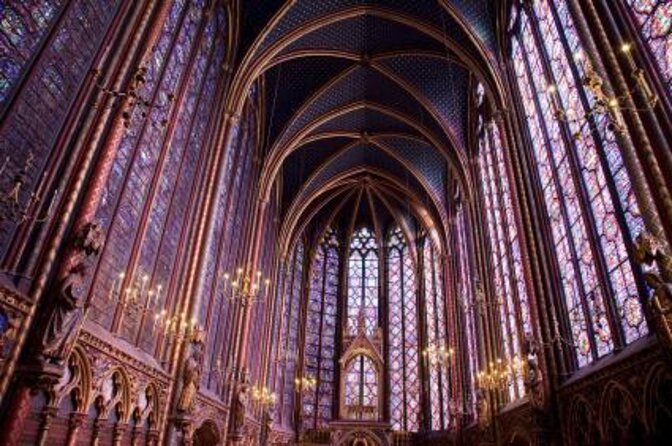
- Sainte-Chapelle stained glass explained so it feels like medieval engineering, not random color
- Conciergerie from palace to prison, with vaulted halls and cells tied to social status
- Marie Antoinette’s last journey context, not just a quick name-drop
- Fast, walkable routing on Île de la Cité, ideal for a first trip to this area
- Backup plan if Conciergerie is closed, with Cluny Middle Ages Museum stepping in
Île de la Cité: the medieval stage before you even enter Notre-Dame
This tour begins on the one island that makes Paris feel old on purpose. The Île de la Cité has been occupied for thousands of years, and it is still the logical center of the story your guide is telling. You meet near Cité 75004, and you begin directly in front of Notre-Dame, so your first “wow” comes before any ticket scan.
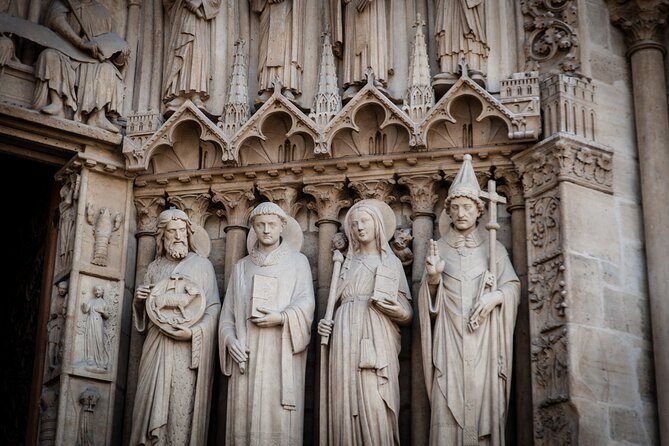
What I like here is the approach. Instead of dumping dates at you, the guide trains your eyes. You’ll spend time deciphering the stonework of the cathedral’s façade and learning the difference between a gargoyle and a grotesque. It is a small lesson, but it changes the whole cathedral: once you can sort the details, you notice everything.
You will also get the big, contemporary context. Notre-Dame suffered a major fire in 2019 that partially damaged the roof and spire, and the guide uses that reality to help you understand what you are seeing today. That matters because Notre-Dame is not frozen in time; it is a living monument under restoration.
Notre-Dame outside first, then in
A lot of tours try to do everything at Notre-Dame at once and end up rushing. This one starts outside on purpose. Your guide points out what you will likely see from the street and on the main frontage, then you circle back to the interior for a newly renovated experience.
The practical part: Notre-Dame cathedral services and entry have their own rules. Interior access is free, but you can book a free time slot on the official website to reduce waiting. You can also walk in without a booking, but peak times can mean long queues. Since your stop is timed, having a plan helps you get the interior moments you actually came for.
Even with a shorter interior window, you can still have a strong visit if you go in ready. Look for how the space feels after restoration, and treat it like a cathedral first and a photo spot second.
A smart photo strategy (without overdoing it)
If your phone roll is already packed with “cathedral shots,” you will still want to photograph this one—just shoot with intention. Use the outside time to capture:
- The façade details your guide points out (especially the carved figures)
- The scale relationships (how the features sit against the façade’s structure)
Then, in the interior, shift your mindset. Instead of chasing one perfect angle, try a few different compositions: one upward, one doorway or nave view, and one detail shot of sculpted or restored elements. The guide’s explanations help you pick what is worth framing.
Sainte-Chapelle: stained glass that feels engineered, not mystical
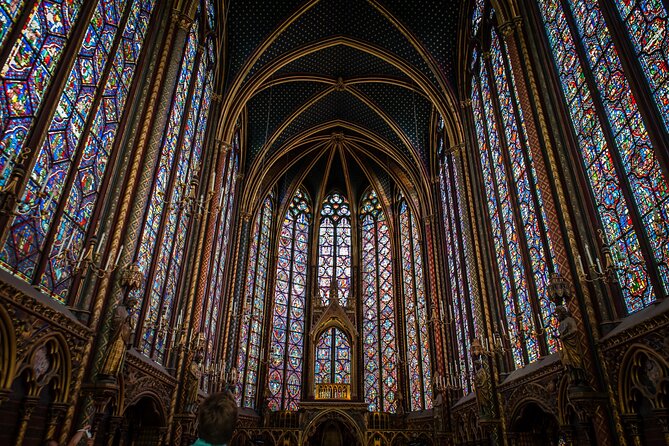
Then the mood changes. Sainte-Chapelle is the kind of place that makes you stop mid-walk and just stare upward. This chapel is built so the walls feel like they are made of light, because the glass does most of the talking. The effect is dramatic, but the tour makes it understandable.
Your guide explains the medieval “why” behind the project. You will learn about the king behind the ambitious plan and the high-profile relic for which the chapel was built. That matters because Sainte-Chapelle is not just decorative. It is political, religious, and symbolic at the same time—and the guide helps you connect that purpose to the architecture.
What you’ll see inside (and how to make the most of 1 hour)
You get a detailed visit inside Sainte-Chapelle, with time to take in what makes the building special. If you like how the building works, ask questions while you are there. The guides in this program encourage that, and the site rewards a bit of curiosity.
You’ll also get context that helps you read the space. One strong takeaway from guides on this route is how they explain the separation between the lower and upper chapel experience. The message is simple: the building’s design supports the idea of different levels of meaning in medieval belief.
Timing and practical advice for photos
Sainte-Chapelle is famous for photos, but it also means you may deal with crowds. Your best move is to stay flexible with angles. If you spot a spot where you can see the glass clearly without blocking other people, grab it. Then let the rest of your energy go into watching how your guide connects the visual details to the story of the relic and the king.
If you have kids, this stop is often where the energy spikes, because it feels like stepping into a medieval light show—just one with a clear reason behind it.
Conciergerie: from vaulted royal halls to prison fear
Next comes one of the most dramatic shifts in European storytelling: the Conciergerie. This place used to be a royal palace and then became an infamous prison. That contrast is the whole point, and the guide keeps it clear from the start: these walls are tied to power, then to punishment.
You’ll see the vaulted ceilings of the Salle des Gens d’Armes, which is described as the world’s largest gothic hall. Even if you do not remember every architectural term, you will feel the scale. It is hard to imagine it as a prison until your guide brings in how the space was used.
Prison cells and the social ladder of fear
The tour also explains that prison life varied depending on social status. Your guide shows how detainees experienced different levels of comfort based on who they were. That adds weight to the visit. You are not just seeing cells; you are understanding why someone might have felt one outcome as more terrifying—or less hopeless—than another.
This is one of the most praised parts of the experience because the guide connects the physical layout to human stories. In a short stop, that is not easy to do. Here it tends to work because the tour gives you a simple framework: palace room, then prison function, then Revolution-era events.
Marie Antoinette’s last journey context
The French Revolution portion turns the Conciergerie into a timeline you can trace. You’ll retrace Marie Antoinette’s fateful trip to the guillotine as part of your storytelling walk-through.
You do not need to be a Revolution expert for this to land. If you know the headline names, the guide fills in what the route and the building mean. If you do not know much yet, it is still a strong way to build a mental picture quickly.
If Conciergerie is closed: the Cluny Middle Ages Museum swap
There is an important detail built into this experience: if Conciergerie is closed, the tour uses the Cluny Middle Ages Museum instead. That is a practical safety net. You still get medieval architecture and a museum-style setting where your guide can make the era feel tangible.
If you care a lot about the prison story specifically, you might want to check what day you are going and how the operator handles timing. But as a concept, the swap keeps your tour from turning into a disappointment.
How the Notre-Dame, Sainte-Chapelle, and Conciergerie route stays easy
A big part of the value here is that these sites sit close together on Île de la Cité. That means your tour time goes toward understanding what you see—not toward repeated street crossings and wasted minutes. For a first visit to this part of Paris, it is a clean intro.
The tour is also private for your group only, capped at up to four people. That small size changes everything:
- You can ask questions mid-sentence.
- You can move at a pace that fits your group.
- Your guide can adjust explanations for adults versus kids.
Your guide is offered in English, and you receive a mobile ticket, so you are not juggling paper confirmations.
Value math: what you are paying for
The price is $718.94 per group (up to four) for about 3 hours. That sounds high until you look at what is included. Tickets are part of the deal, and you get guided access to Notre-Dame, plus a guided inside visit at Sainte-Chapelle and the storytelling stop at Conciergerie (with its included admission). So you are not just booking a walking tour—you are paying for time-efficient entry and interpretation.
If you can travel as a group of two to four, it often pencils out better than piecemeal tickets plus separate guide time. If you are traveling solo, it can still be worth it, but you will probably feel the price more because you are paying for a whole group slot.
What to know before you go so the 3 hours feels worth it
This is a short, focused tour. That is good for momentum, but it means you need to show up ready.
Plan for Notre-Dame queues even though the entry is free
Notre-Dame interior access is free and open to all, but the line is the real factor. The tour gives guided access for your schedule, but queues can still happen during busy seasons. If you can, book a free time slot on the cathedral’s official website ahead of time to reduce uncertainty. Otherwise, walking in is possible—just go in with the expectation that time can stretch.
Dress and shoes matter more than you think
You will spend time outside and inside, with a lot of looking up and stopping for photos and explanations. Wear comfortable shoes. Bring a light layer if the weather is cool; stone and glass can feel colder than you expect, especially early or late in the day.
Use questions as your secret weapon
One of the clearest patterns in the experience is that your guide is happy to answer questions. If something on the façade confuses you, ask. If you want to understand why Sainte-Chapelle was built for a specific relic, ask. If you want to compare how the Conciergerie functioned as palace versus prison, ask. That is where the tour turns from sightseeing into learning you can actually use later.
Should you book this Medieval Paris tour?
Book it if you want a tight medieval hit that covers three of the biggest landmarks on Île de la Cité, with tickets included and a private English guide. It is ideal for history buffs who like real details, and it also works for families because the stories connect across sites: carved monsters, medieval politics, and Revolution-era fate.
Skip it or consider alternatives if you want a slow, wandering cathedral day. Notre-Dame interior time is shorter here, and Sainte-Chapelle and Conciergerie are timed stops. If you like museum-style lingering, you may feel slightly rushed unless you plan extra independent time afterward.
My honest take: if your goal is to understand what makes medieval Paris feel medieval, this route delivers. And because it is structured around the stories behind the architecture, you leave with more than photos—you leave with a way to read the buildings.
FAQ
How long is the tour?
It lasts about 3 hours.
Is this a private tour?
Yes. It is private, and only your group participates.
How many people can be in a group?
The tour is priced for a group up to four people.
What language is the guide?
The tour is offered in English.
Are tickets included in the price?
Yes. Tickets are included for Sainte-Chapelle and the Conciergerie, and the tour includes admission access as described for Notre-Dame.
Do I need to reserve for Notre-Dame if entry is free?
Entry to Notre-Dame is free, and you can book a free time slot on the cathedral’s official website to avoid long queues. You can also walk in without a booking, but queues can be long at peak times.
What happens if the Conciergerie is closed?
If Conciergerie is closed, the tour includes a visit to the Cluny Middle Ages Museum instead.
Is there free cancellation?
Yes, you can cancel for a full refund up to 24 hours in advance of the experience start time.