REVIEW · PARIS
Paris City Sightseeing Half Day Guided Segway Tour with a Local Guide
Book on Viator →Operated by Go Go Tours - Privat Segway Tours In Paris · Bookable on Viator
A Segway tour turns sightseeing into motion, not slog. This one is built for first-timers: you get full instruction and a local guide who helps you move through central Paris while picking up the story behind the landmarks.
I like that it’s genuinely beginner-friendly. After a short training session, riders get to cover a lot of ground without getting blisters or fighting for elbow room on foot. I also like the flexibility: you can choose a 45-min, 90-min, or 3-hour option, and your guide can adjust the pace so you actually enjoy the stops. Guides such as Kensa, Arthur, George, and Eli showed up in real-world ratings as patient, safe, and tuned in to what the group wants.
One drawback to plan for: time is tight at the big photo spots. The tour includes quick stops (often about 5 minutes each, with a longer break near Invalides), so if you want lingering views or lots of time at one monument, you may feel slightly rushed.
In This Review
- Key takeaways before you book
- Paris by Segway: why this feels like a good use of limited time
- The meet-up spot and what happens right before you ride
- How the route shapes the experience (and why the order works)
- Stop 1: Musée de l’Armee des Invalides (Hôtel des Invalides)
- Stop 2: Pont Alexandre III (Seine views with “grand fair” energy)
- Stop 3: Grand Palais (Universal Exhibition architecture in full costume)
- Stop 4: Petit Palais (The smaller cousin that still carries the 1900 story)
- Stop 5: Place de la Concorde (the big square, the big past)
- Stop 6: Louvre Museum (fortress-to-palace to museum shift)
- Stop 7: Musée d’Orsay (a station with a new life)
- Stop 8: Champs-Élysées (history of an avenue, not just shopping)
- Stop 9: Arc de Triomphe (a monument built to remember victories)
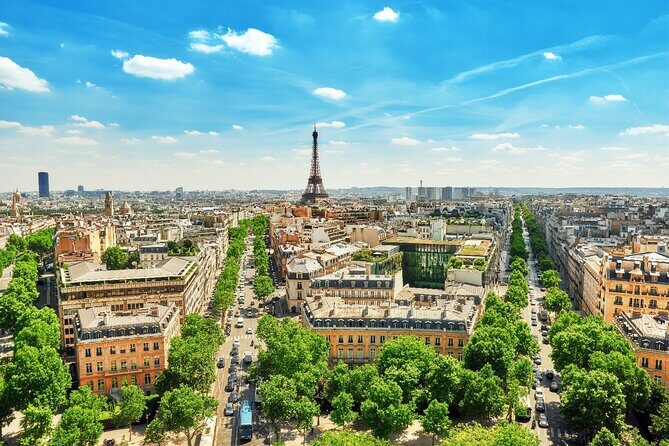
- Stop 10: Eiffel Tower (the finish-line symbol of France)
- Training, safety, and comfort: what makes the ride actually work
- Weather, traffic, and why timing can shift
- Price vs. value: is $60.49 per person worth it?
- Who should book this Segway tour?
- Should you book this Segway tour?
- FAQ
- How long is the Segway tour?
- Is this tour private?
- What landmarks will we stop at?
- Are attraction tickets included?
- What’s included in the price?
- Do beginners ride safely?
- What do I need to know about age and weight limits?
- Can pregnant travelers join?
- What language is the tour offered in?
- Where do we meet?
Key takeaways before you book
- Beginner instruction included so you’re not thrown onto traffic-mode Segways
- Private group experience so the pace stays with your crew, not a big bus crowd
- Central landmarks with quick photo breaks at major sites across the core
- Weather gear is part of the plan (raincoats and hats), plus warm clothing for cold days
- Guides help with confidence and safety; several named guides were praised for patience
- Admission isn’t included at stops like Louvre-area viewpoints, so expect to look from outside
Paris by Segway: why this feels like a good use of limited time
If you have only a half day (or you want to pack in the highlights without adding more walking), this is a smart format. A Segway doesn’t magically make Paris small, but it does change how you experience it. Instead of stopping every few minutes just to catch your breath, you can keep moving and still reach a lineup of famous places.
At $60.49 per person for about 3 hours, the value is in efficiency and guidance. You’re paying for more than the ride. You’re paying for a guide who can translate what you’re seeing into something you’ll remember—plus the equipment and safety setup that make it workable for first-timers.
This is also a private tour. That matters. You’re not guessing how your timing will line up with 20 strangers. Your guide can slow down for new riders, speed up when everyone is comfortable, and help with photo moments along the way. In reviews, guides like George and Eli came up for being calm, friendly, and focused on keeping the group moving smoothly.
You can also read our reviews of more tours and experiences in Paris.



The meet-up spot and what happens right before you ride
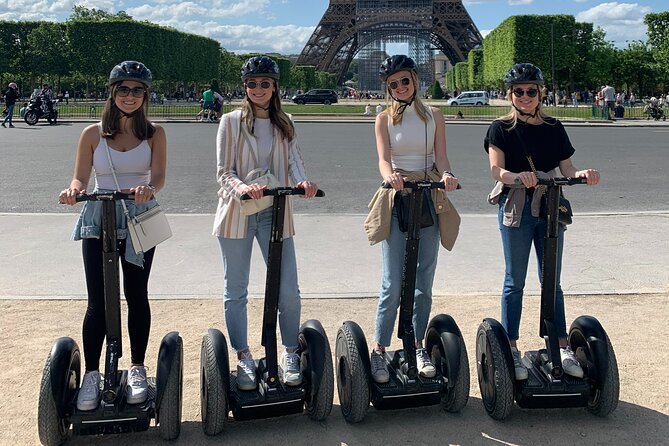
You start at 101 Av. de la Bourdonnais, 75007 Paris. The tour ends back at the same meeting point, which makes planning easier.
Near the start, you’ll get the stuff that makes the ride practical in Paris weather and traffic conditions:
- Helmets for riding safety
- Raincoats and hats if the weather turns
- Warm clothes since the tour runs in all weather
Then comes the key part: instruction. This tour explicitly works for complete beginners, and multiple guides in real feedback were praised for helping riders get comfortable without making it stressful. Even if you’re a little nervous, that early practice is where your confidence usually catches up fast.
A few real-world constraints are worth noting up front so there are no surprises:
- Minimum age is 12, and minors must ride with an adult
- Weight range is 40 kg (88 lb) to 120 kg (260 lb)
- Pregnant women aren’t allowed for health and safety reasons
If you fit those requirements, you’re set up for a fun, low-fuss outing.
How the route shapes the experience (and why the order works)
This tour is structured like a quick “see the spine of Paris” loop. You’ll cover a lot of iconic architecture and riverside scenery in a single morning/afternoon window, without having to think about transit or which neighborhood comes next.
You’ll also see a neat mix of Paris moods:
- military and imperial history (Invalides)
- elegant bridge views over the Seine (Pont Alexandre III)
- big exhibition-era architecture (Grand Palais / Petit Palais)
- a grand public square with serious historical baggage (Place de la Concorde)
- museum exteriors and art-era beauty (Louvre area, then Orsay)
- classic postcard avenues and monuments (Champs-Élysées, Arc de Triomphe)
- the Eiffel Tower as the finish-line landmark
Because most stops are short photo breaks, the route works best when you treat it like orientation plus highlights—not a museum day.
Stop 1: Musée de l’Armee des Invalides (Hôtel des Invalides)
Your first major stop is Les Invalides, the Military Museum and the tomb complex connected with Napoleon. The setting matters here. The Hôtel des Invalides was commissioned in 1670 by Louis XIV to house wounded soldiers, including hospital care—so the building isn’t just pretty. It’s part of a long French story about state power, war, and care.
You’ll get a roughly 10-minute break for pictures and context. That’s enough to take in the exterior and learn what you’re looking at, without turning this into a long museum visit. Admission isn’t included, so if you want to go inside, you’ll need separate plans.
Why it’s a great starting point: it gives you a sense of scale and authority right away. Paris isn’t only cafés and romance. It’s also empire, institutions, and grand buildings meant to last.
Stop 2: Pont Alexandre III (Seine views with “grand fair” energy)
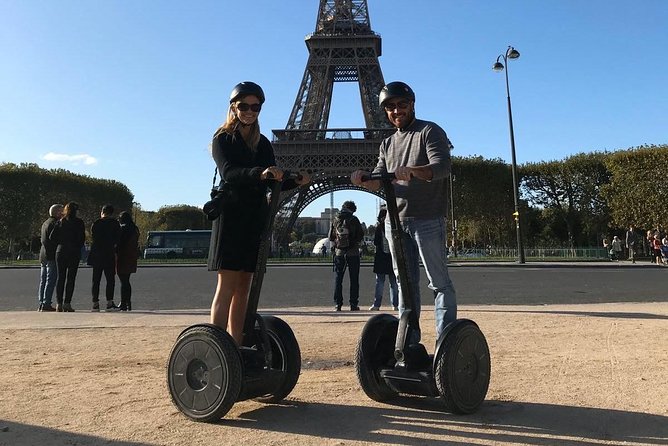
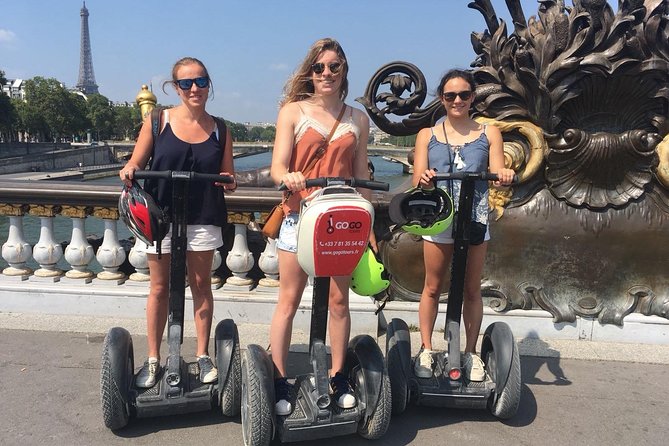
Next up is Pont Alexandre III, one of the showpiece bridges spanning the Seine. You’ll pause for photos and history, and this is where you’ll start connecting the city’s landmarks with world-exhibition ambition. The bridge was built for the World Fair held in Paris, and it’s often described as one of the most beautiful spans in the city.
This stop is short—about 5 minutes—so think of it as: arrive, look, shoot, learn one or two details, then glide on. If you’re hoping for a long riverside stroll, you won’t get it here.
Still, the bridge is a perfect “breathing space” moment. It resets your eyes after the heavy architecture feel around Invalides, and it sets up the next big monuments.



Stop 3: Grand Palais (Universal Exhibition architecture in full costume)
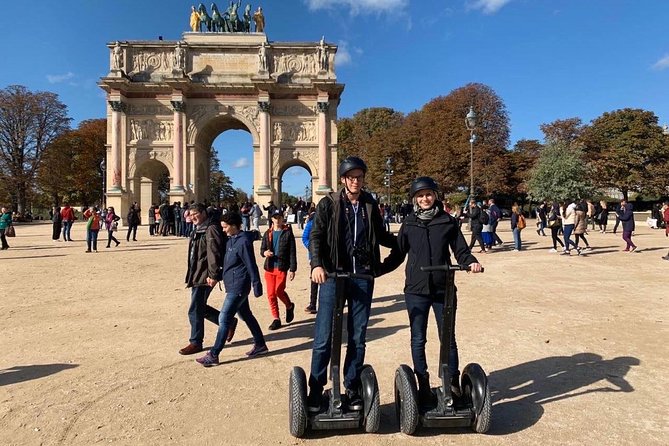
You’ll make a quick stop at Grand Palais, built for the Universal Exhibition in 1900. Even if you don’t plan to enter, the building’s purpose is the point: it was dedicated to the glory of French art, and it still reads like a temple to culture.
You get about 5 minutes here. It’s enough to understand the vibe and capture the façade, but not enough for a full stop-and-stare session.
A practical note: this is one of those places where a guide’s explanation really helps. Without context, it’s just another big structure. With context, it becomes a time capsule of a very specific Paris moment.
Stop 4: Petit Palais (The smaller cousin that still carries the 1900 story)
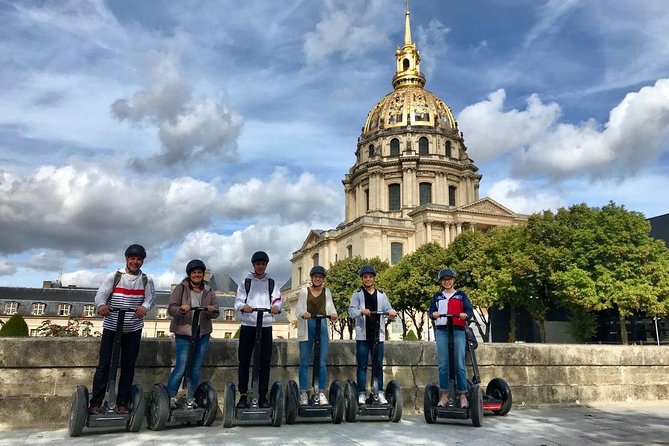
Right beside Grand Palais, you’ll stop at Petit Palais, also tied to the 1900 Universal Exhibition. It later became a museum in 1902.
Another 5-minute photo and history break. If you like architecture, this pair—Grand Palais and Petit Palais—is one of the easiest wins on the whole route. The contrast between the two buildings gives you a quick lesson in how Paris built spectacle at different sizes.
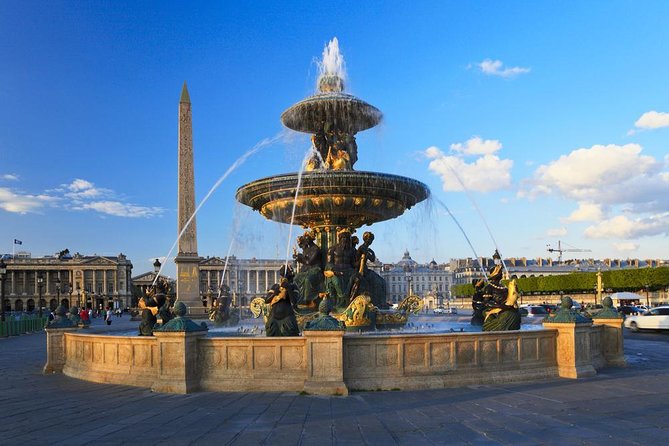
Stop 5: Place de la Concorde (the big square, the big past)
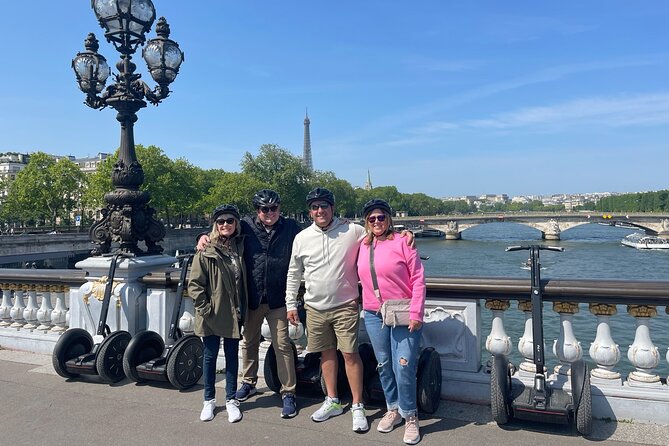
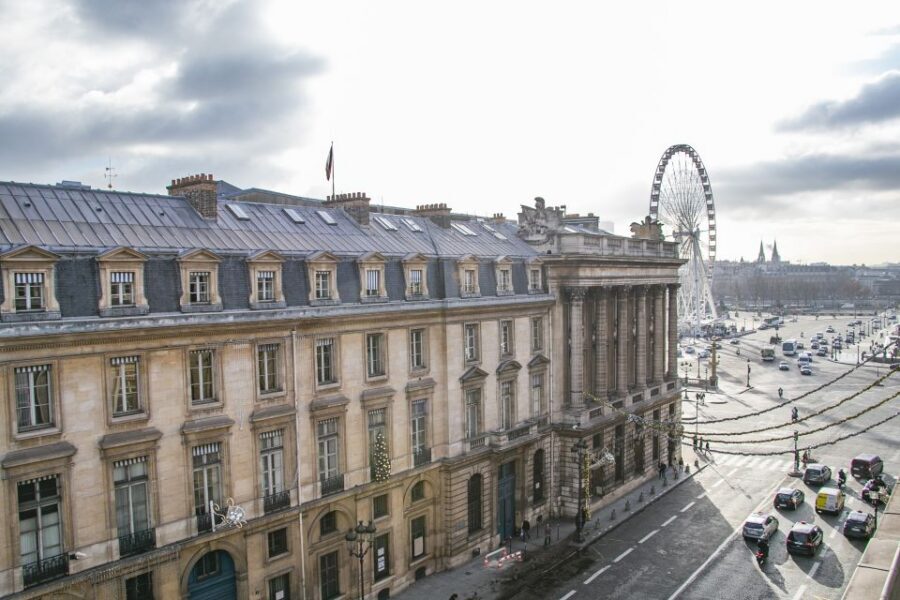
Then you hit Place de la Concorde, the large public square between the Champs-Élysées and the Tuileries Gardens. It’s described as one of Paris’ most evocative spaces, and it also has deep historical meaning—so your guide’s narration matters more than you might expect for what looks like just a giant open area.
This stop is again around 5 minutes. Use it for landmark orientation: identify where major streets lead, so later you can recognize your route when you explore on your own.
If you like to “learn by mapping,” this is a strong moment.
Stop 6: Louvre Museum (fortress-to-palace to museum shift)
The Louvre is the kind of place where you may already have a mental image. But the tour gives you the “what it used to be” angle: originally built as a fortress in 1190, then reconstructed in the 16th century as a royal palace. Buildings in Paris weren’t made once and done. They evolved.
Your stop is about 5 minutes, so you’re not there to tour the museum. Admission isn’t included. You’ll get a look and a story, then you move on.
This is exactly why Segway tours work for many visitors: you get the headline story at a glance, then you decide later if you want the full interior experience.
Stop 7: Musée d’Orsay (a station with a new life)
Next is Musée d’Orsay. Here’s the twist: it used to be a train station built for the 1900 World’s Fair, designed by architect Victor Laloux, with modern features for its time.
You’ll pause for about 5 minutes. Same deal: you’re learning the building’s identity more than you’re doing museum time.
If you plan to visit Orsay later, this stop helps you see it differently. Instead of thinking only about art inside, you’ll notice the structure that shaped how crowds once moved through the space.
Stop 8: Champs-Élysées (history of an avenue, not just shopping)
Now you glide toward the Champs-Élysées, the famous avenue tied to royal planning and imperial conquest. It was commissioned during Louis XIV’s era, and Napoleon ordered construction of the route leading to the famed Arc de Triomphe after European conquests.
Your time here is brief—about 5 minutes—but it’s useful. You’ll recognize the avenue later in the day even if you never revisit it exactly the same way.
Stop 9: Arc de Triomphe (a monument built to remember victories)
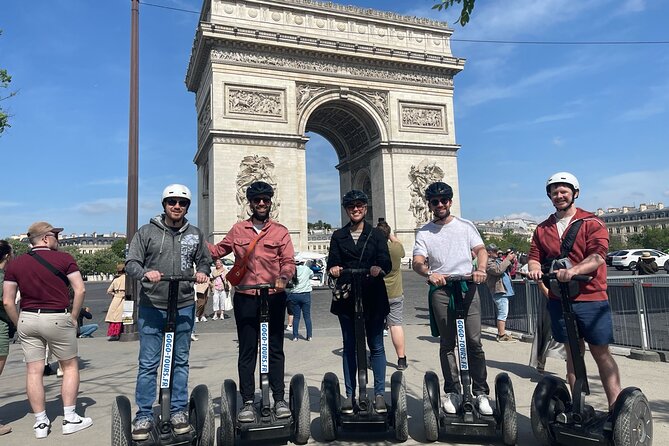
At the Arc de Triomphe, the core idea is memorialization: it was built to perpetuate the memory of French army victories. The first stone was laid on August 15, 1806, and it finished 30 years later.
You’ll have a quick 5-minute stop for photos and context.
One important caution from the overall experience vibe: time at the major stops can feel tight. There’s at least one negative report that the Arc and Eiffel were handled in a rushed way. That doesn’t mean the tour is always like that—traffic, weather, and group skill can affect timing—but it’s why you should treat this outing as a “see it, learn it, photograph it” experience rather than a slow sightseeing day.
Stop 10: Eiffel Tower (the finish-line symbol of France)
Finally, you reach the Eiffel Tower. The tour frames it as a part of national heritage—plus a bit of Paris attitude. When it was completed in 1889, it was meant to be temporary and wasn’t initially the favorite landmark of Parisians.
You’ll get about 5 minutes for pictures and history.
How to handle the last stop: come with realistic expectations. You’ll likely be happy with the photo moment if you’re arriving there excited, not demanding a long viewing break. If you want long balcony or summit time, you’ll need a separate plan after the Segway ride.
Training, safety, and comfort: what makes the ride actually work
Segways aren’t hard once you’re set up right. This tour includes instruction for complete beginners, and several guides were specifically praised for being patient during the learning phase. Older riders in real feedback said it took a little time to find confidence, but the guide support made it click.
Safety is part of the experience, not a footnote. The tour includes helmets, and the guide/driver leads the route. There’s also practical cold-weather help: warm clothes, plus raincoats and hats.
If you’re mobility-limited, this type of sightseeing can be easier than covering huge distances on foot. The point is not that Segways eliminate all walking, but that they reduce the strain of repeated long distances across central Paris.
Weather, traffic, and why timing can shift
Paris weather can change fast. The tour account for that with raincoats and hats, and you’re told to bring warm clothes since it runs in all conditions.
Traffic can shift too. One account described road closures and a late start, and the operator still worked to keep the booking intact. That gives you a clue about how things are handled: if Paris gets in the way, your guide tries to adjust without canceling the whole plan.
That said, keep your own day flexible. If you have a super tight schedule right after the tour, you might feel safer scheduling something that allows a buffer.
Price vs. value: is $60.49 per person worth it?
For many visitors, yes—if your goal is highlights plus context in a short window.
You’re paying for:
- private guiding (not just a generic route)
- equipment and helmets
- beginner training
- short stops with story and photo time
- a route that hits major Paris icons across the core
Where the value can shrink:
- If you want long time inside major attractions (you won’t be doing museum entry here; admissions aren’t included)
- If you prefer slow wandering where each stop is 30 to 60 minutes
- If you’re aiming to spend the entire day at one monument
If your goal is a fast, guided “get your bearings fast” Paris overview, this price often feels reasonable.
Who should book this Segway tour?
I’d point most first-time visitors toward it—especially if you have limited time and want an easy way to see a lot of landmarks without turning your day into a workout.
It also makes sense for:
- families with teenagers (the minimum age is 12)
- people who get tired from walking long distances
- riders who want both photos and a quick history thread
If you’re the type who likes to read every plaque and stay put for a half hour, you’ll probably want to pair this with a separate museum day.
Should you book this Segway tour?
Book it if you want a fun, efficient Paris overview with real guidance and beginner support. You’ll likely love the way the route strings together major icons, and you’ll get a stronger sense of where things are than you would from a bus ride alone.
Skip it or consider a shorter option if:
- you’re chasing long museum visits (this tour keeps stops brief and admission isn’t included)
- you’re very worried about learning a new device, even with instruction
- your schedule can’t handle possible timing shifts from traffic or weather
In short: this is a high-value “half day” move for people who want to see the big names, learn what they’re looking at, and still keep the rest of their trip flexible.
FAQ
How long is the Segway tour?
The tour is about 3 hours, and there are options for 45 minutes, 90 minutes, or a 3-hour private tour.
Is this tour private?
Yes. It’s a private tour/activity, and only your group participates.
What landmarks will we stop at?
You’ll have photo and history stops at Les Invalides, Pont Alexandre III, Grand Palais, Petit Palais, Place de la Concorde, the Louvre area, Musée d’Orsay, Champs-Élysées, Arc de Triomphe, and the Eiffel Tower.
Are attraction tickets included?
No. Admission tickets are not included for the stops mentioned.
What’s included in the price?
The tour includes a local guide, helmet use, a driver/guide, raincoats and hats for bad weather, and private tour service.
Do beginners ride safely?
The tour includes full instruction, and it’s designed to be suitable for complete beginners.
What do I need to know about age and weight limits?
Minimum age is 12, and minors must be accompanied by an adult. Riders must be at least 40 kg and not more than 120 kg.
Can pregnant travelers join?
No. Pregnant women are not allowed on these Segway tours.
What language is the tour offered in?
The tour is offered in English. A guide may be multi-lingual as well.
Where do we meet?
The meeting point is 101 Av. de la Bourdonnais, 75007 Paris, and the tour ends back at the same location.