REVIEW · PARIS
Private Normandy D-Day Live guided Top 6 Sites trip from Paris
Book on Viator →Operated by Clewel Travel · Bookable on Viator
This is a long day that hits the right nerve. I love the door-to-door Mercedes transfer (no renting, no stress on French roads) and I love the tight, efficient lineup of D-Day sites in one go. If you get a guide like Alexandra, Diana, Valerie, Rustam, Jane, or Cyrus, you’re likely to get clear context as the day rolls forward, not just a list of stops.
One possible drawback: it’s a 14-hour whirlwind, so you will not linger everywhere as long as you might want. The payoff is you see the big, meaningful places—Caen through Omaha and Pointe du Hoc—in a single, well-timed day.
In This Review
- Key things to know before you go
- Why this private D-Day day trip works (and where it can feel rushed)
- The 7:30 a.m. start: comfortable pickup, big geography, one clear mission
- Caen Memorial: start with the battle context, not the battlefield photos
- Arromanches-les-Bains lunch hour and the Mulberry Harbour you can still picture
- 360 Circular Cinema and the Arromanches viewpoint: Operation Overlord from a high vantage
- Normandy American Cemetery: the emotional center of the route
- Overlord Museum + Omaha Beach: artifacts, vehicles, and the sense of scale
- Pointe du Hoc: Rangers, cliff fortifications, and surviving concrete
- Timing and pacing: how to make a long day feel manageable
- What you’re likely to learn from the guides (and why it changes the day)
- Practical value vs. the DIY car plan
- Who this day trip suits best
- Should you book this private Normandy D-Day trip?
- FAQ
- What time is pickup?
- How long is the tour?
- What vehicle do we use?
- Is it only for our group?
- Is the tour in English?
- Which sites are included?
- Are meals included?
- Can I cancel for free?
- Can most people participate?
Key things to know before you go
- Mercedes transport keeps you comfortable during a roughly 3.5-hour drive each way.
- Caen Memorial framing first: you start with the battle’s bigger picture before you hit the beaches.
- Arromanches tells the logistics story of D-Day via Mulberry Harbour and the 360 cinema.
- Omaha + cemetery views are built into the schedule, so you get the emotional hit at the right moments.
- Pointe du Hoc adds the hard part: Rangers, cliffs, and Atlantic Wall concrete that’s still there.
Why this private D-Day day trip works (and where it can feel rushed)
You’re paying for two things here: a private logistics setup and a concentrated D-Day route. The value shows up immediately. You get picked up from your hotel reception desk in Paris (and the operator also notes you can start from Caen, Bayeux, or Honfleur), then you roll north in a business-class Mercedes E220/E300 for 2 people or a Mercedes minivan for larger groups. That means no car-share scramble, no parking headaches, and no last-minute navigation panic when you’re already emotionally tired.
The other big value is focus. This isn’t “Normandy sightseeing.” It’s a sequence designed to move from overview (Caen Memorial) to landing support and scale (Arromanches) to remembrance and sacrifice (Normandy American Cemetery) and then to the beach landings and the Rangers’ climb at Pointe du Hoc.
The trade-off is that every site gets a set amount of time. The schedule is built to hit six to seven key stops between about 10:30 and 18:30, then back to Paris around 21:30 to 22:00 depending on traffic. If your ideal day is slow and photo-obsessed, you may feel slightly time-pressed. If your ideal day is “see the essentials with context,” this is a strong match.
You can also read our reviews of more tours and experiences in Paris.



The 7:30 a.m. start: comfortable pickup, big geography, one clear mission
The day starts at 7:30 a.m. with pickup from your hotel reception desk in Paris. From there, the drive to Caen takes about 3 hours (around 240 km). There’s one rest-area stop along the way, so you’re not stuck bouncing for hours with no break.
This matters more than it sounds. Northern France can be a maze of small roads and roundabouts, and D-Day sites are scattered. Doing it with your own car is doable, but it’s also easy to lose half a day just finding parking and getting your timing wrong. The private transfer removes that risk.
You’ll also notice how group size shapes the experience. The tour is private, and the description says it’s live guided from a certain group size. In plain terms: you should expect more explanation with a bigger group, and with fewer people, the experience can lean more toward on-site multimedia plus direction. If you care deeply about continuous live narration, ask when you book how your group size will be handled.
Caen Memorial: start with the battle context, not the battlefield photos
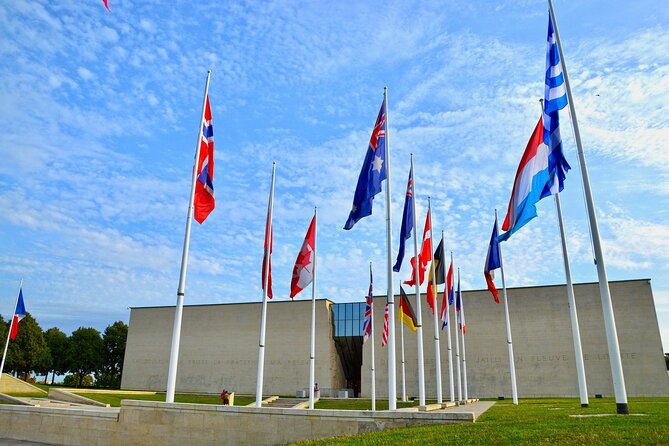
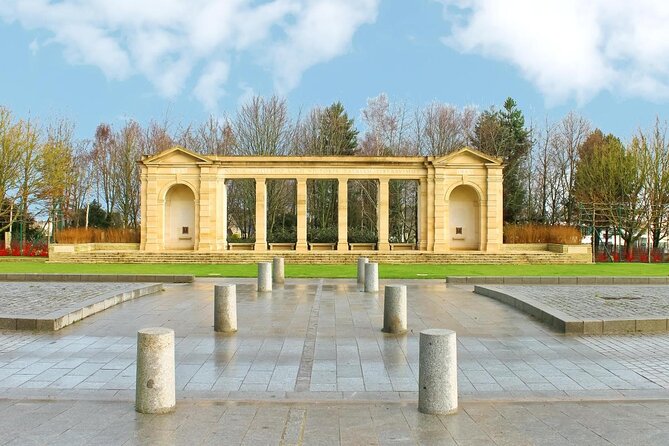
Your first major stop is Memorial de Caen in the British Sword Beach sector, roughly 10:30 a.m. to 12:00. This is a smart place to begin because it gives you the structure behind what you’ll see later. Instead of arriving at Omaha or Pointe du Hoc as random locations, you start with a battle overview and the human scale of the conflict.
At the Caen Memorial and Museum, you’ll watch a short film (about 19 minutes) with historic footage, and you’ll move through exhibits that connect the Normandy campaign to the lives of people who took part. You’ll also have time to explore at your own pace, which is ideal because D-Day is intense. You don’t want someone rushing you through it.
A practical note: this kind of museum visit can be emotionally heavy. I like the way this stop sets your mindset. You’re not just ticking boxes—you’re understanding the timeline, the stakes, and the reason the later stops matter.
Arromanches-les-Bains lunch hour and the Mulberry Harbour you can still picture
Next, you head to Arromanches-les-Bains, about 30 km away, arriving around 12:30. The schedule gives you about one hour for lunch and a town walk. Even if you skip shopping, the town layout helps you understand why Arromanches mattered.
Arromanches is famous for the Mulberry Harbour, an artificial temporary harbor built so the Allies could unload vehicles, materials, and people. The numbers are big—hundreds of thousands of men and vehicles and massive tons of supplies flowing by early June 1944—but what lands in your head is the idea that D-Day was not only about beaches and bravery. It was also about engineering, logistics, and keeping supply lines alive.
This stop is also a good reset. You get a break from museum interiors and you get salt-air views of the bay area. That contrast helps. By the time you’re back in the car, your brain has space to process what you saw at Caen.
360 Circular Cinema and the Arromanches viewpoint: Operation Overlord from a high vantage
After lunch, you go to the Arromanches 360 Circular Cinema, roughly 13:30 to 14:30. This is a very different kind of storytelling than a museum exhibit: you watch a large-format documentary (about 100 days of the Battle of Normandy) tied to Operation Overlord.
Then you get the viewpoint over the bay, which is usually where things click. It’s one thing to learn about an artificial harbor. It’s another to look out over the landscape and see why the location mattered.
One small caution: cinematically guided experiences can be very impactful, but they also add another hour indoors. If you’re sensitive to crowds or prefer more outdoor time, you still need this part. It’s the best way in this day format to connect the numbers and engineering to what you can see around Arromanches.


Normandy American Cemetery: the emotional center of the route
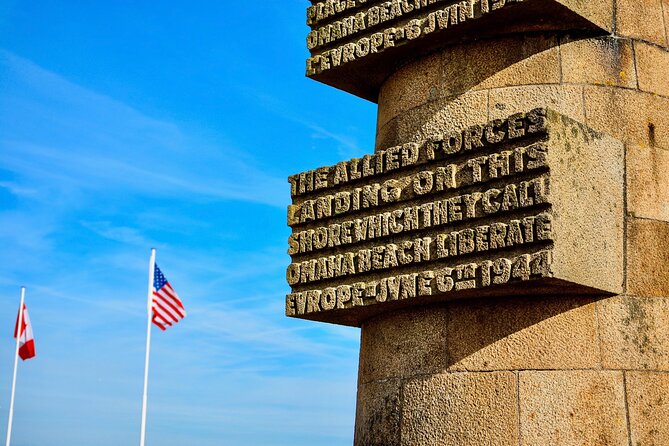
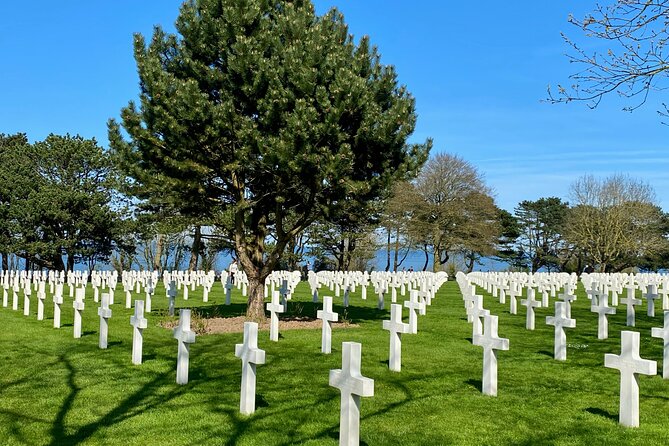
You drive to Normandy American Cemetery & Visitor Center in Colleville-sur-Mer for 15:00 to 16:10, overlooking Omaha Beach. This stop is often the most unforgettable part, and it’s easy to see why.
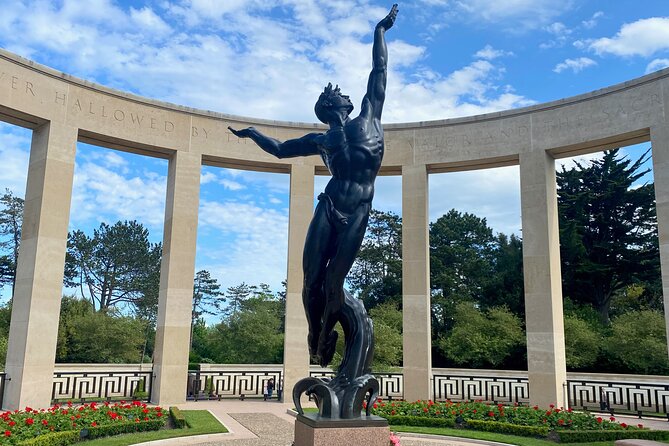
The cemetery contains 9,387 U.S. soldiers, and the Wall of the Missing lists names of 1,557 soldiers missing in action. As you walk, you’ll also notice surviving German defensive remnants in the cliff area below—concrete casemates and memory points that connect the land to the fighting.
The Visitor Center is compact, but it helps. You’ll find a small museum with lots of information, and there are large maps of military operations. There’s also a semicircular memorial colonnade and the sculpture Spirit of American Youth Rising from the Waves.
If you want one practical tip: give yourself a few minutes of quiet before you move on. This cemetery doesn’t need commentary to hit you. It works best when you slow down mentally, even if your feet keep moving.
Overlord Museum + Omaha Beach: artifacts, vehicles, and the sense of scale
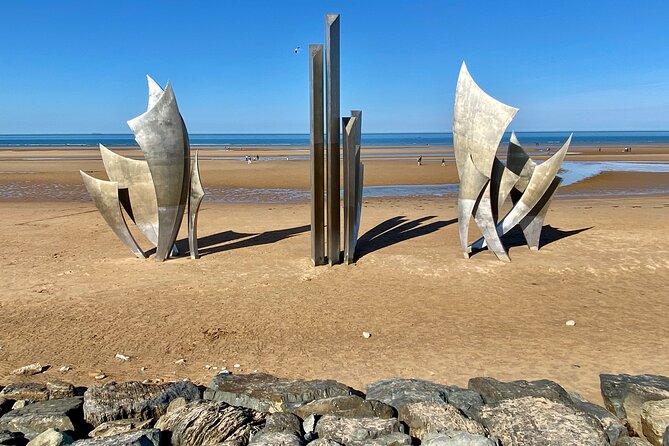
After the cemetery, you go to Overlord Museum for a short visit (about 1 hour 10 minutes including the drive segment to the museum and then onward). Then you move on to the Omaha beaches area, with admission included.
The Overlord Museum experience centers on World War II artifacts and installations—tanks, weapons, guns, military vehicles, a V-1 missile, and personal belongings. This is where the day shifts from “plans and maps” to “stuff and reality.” You’re not imagining what gear looked like; you’re seeing it.
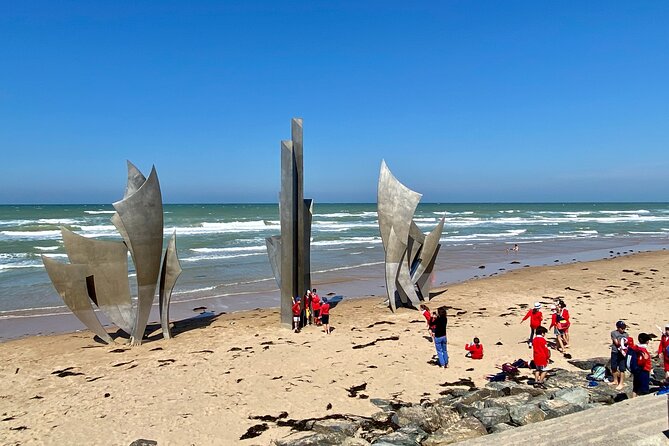
Then it’s a quick hop to Omaha Beach itself (just minutes from the museum area). Omaha is often the most popular D-Day destination, and the schedule reflects that by building in time to walk and absorb. You’ll learn about the massive sacrifice on June 6, with about 34,000 men landing.
This is where the route earns its money: you’re not just driving past. You’re getting the museum context, then stepping onto the beach setting immediately after, which tightens the cause-and-effect in your mind.
Pointe du Hoc: Rangers, cliff fortifications, and surviving concrete
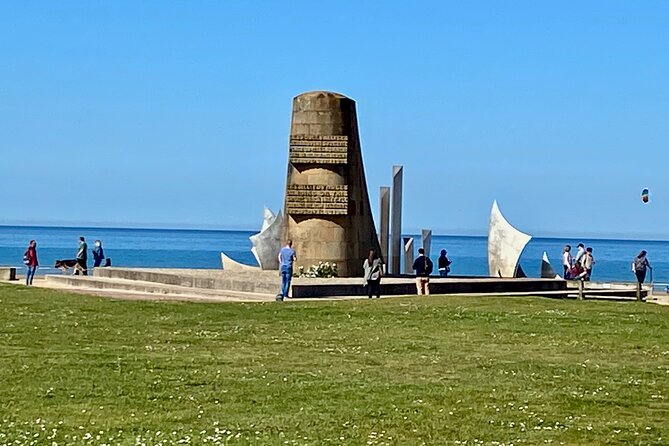
The day closes with Pointe du Hoc around 17:30 to 18:30. This site sits on cliffs between Utah and Omaha beaches and mattered because it was high enough to fire upon both areas.
You’ll learn about the 2nd Ranger Battalion and their role in taking this crucial gun battery. Much of the Atlantic Wall fortification remains: concrete casemates, gun pits, and the fire control casemate area with a monument connected to the Rangers.
This stop is also physically different from the cemetery or the museum. Expect walking on uneven ground and a bit of climbing around viewpoints and bunkers. That’s part of the point. You’re not only seeing history; you’re reading the terrain.
One more practical note: Pointe du Hoc time is shorter than it feels like it should be. The view is huge, the fortifications are detailed, and it’s easy to lose track of minutes. If you’re the type who loves photos, you might want to set priorities: pick two or three angles and don’t try to photograph everything.
Timing and pacing: how to make a long day feel manageable
This is a full day built around efficient travel. You leave Paris at 7:30, you’re at the Memorial de Caen around 10:30, you move through Arromanches by early afternoon, and you reach Omaha and Pointe du Hoc in late afternoon. Return to Paris is typically around 21:30 to 22:00, depending on traffic.
So yes, it’s long. But it’s not just “long because travel.” It’s long because the stops are the right stops. The schedule is structured so you’re rarely sitting in the car with nothing meaningful ahead.
Here’s how to keep it from feeling like a blur:
- Wear comfortable walking shoes. You’ll be on foot at multiple sites.
- Plan for museum time and then beach/cliff time. Bring water and maybe a small snack if you get hungry between the lunch hour and the later stops.
- If live guidance is a big part of your motivation, confirm it at booking based on your group size. The day can include more live explanation in some formats than others.
What you’re likely to learn from the guides (and why it changes the day)
Even with great museums, D-Day is one of those topics where context matters. The best part of this private format is that your guide can help you connect dots while you’re moving from place to place.
Some guides tied to this experience have been described as excellent at building the story before you walk into each site. Names that have come up include Alexandra, Diana, Valerie, Rustam, Jane, and Cyrus. You might also have a driver who plays an important role in keeping timing smooth—people like Vadim and Roman have been mentioned as attentive and helpful.
You’ll still do plenty on your own: you walk the cemetery, you explore museum spaces, and you look out at the bay and cliffs. But with a good guide, the day feels less like memorizing facts and more like understanding why each place is there.
Practical value vs. the DIY car plan
Should you drive yourself? You can, but the real question is stress. Northern France is manageable, but D-Day sites are spread out and timing is everything. If you’re trying to visit multiple locations in one day, you’re likely to spend energy on parking, map-checking, and schedule math instead of on paying attention.
This tour’s value shows up in:
- Round-trip transfers from your hotel to the main sites
- Comfortable vehicle time instead of concentration time
- Admissions included for the major sites and experiences listed
- A route that hits the emotional and geographic anchors of Normandy without requiring you to plan each hop perfectly
It’s not cheap at $738.86 per person, and you shouldn’t ignore that. But for a private day that bundles transport, key admissions, and a guided narrative structure, it’s priced like a premium “make it easy” option.
Who this day trip suits best
This works especially well if you:
- Want a single-day Normandy hit without the hassle of renting a car
- Know you want the big anchors: Caen Memorial, Arromanches, Omaha, and Pointe du Hoc
- Prefer a private setup where your timing and questions can be handled within your group
It’s also a good fit if you’re traveling with people who don’t want to negotiate French driving after a long flight. In practice, the car time can feel like part of the experience—quiet, comfortable, and focused.
If you’re a hardcore history student who wants hours at each site, you might find the pace too tight. For that style of traveler, a multi-day approach usually feels better. This is a sprint, not a marathon.
Should you book this private Normandy D-Day trip?
If your goal is a meaningful highlights route with minimal logistics stress, I’d lean yes. The combination of Memorial de Caen framing, Arromanches’ harbor story, Omaha’s sacrifice, and Pointe du Hoc’s cliff fortifications is a strong storyline for one day. The private Mercedes transfer makes it feel civilized, not chaotic.
I’d think twice if you absolutely need lots of free time at each stop. You’ll get enough time to explore, but this day is built for efficient coverage. Also, if continuous live guidance is your top priority, double-check how guidance works for your specific group size when you book.
If you want Normandy D-Day in one day, with a private, streamlined route, this is a solid way to do it.
FAQ
What time is pickup?
Pickup starts at 7:30 a.m. from the reception desk of your hotel.
How long is the tour?
The full day is about 14 hours.
What vehicle do we use?
For 2 people, you travel in a Mercedes E220 business-class car. For 3 participants and up, you use a Mercedes minivan.
Is it only for our group?
Yes. It is private, so only your group participates.
Is the tour in English?
Yes, it is offered in English.
Which sites are included?
Caen Memorial and Museum, Arromanches-les-Bains (including the 360 Circular Cinema and admissions), Normandy American Cemetery & Visitor Center, Overlord Museum, Omaha Beach, and Pointe du Hoc.
Are meals included?
No. Meals and drinks are not included, though you’ll have a lunch break in Arromanches-les-Bains.
Can I cancel for free?
You can cancel for a full refund if you cancel at least 24 hours before the experience’s start time.
Can most people participate?
Most travelers can participate, but this is a full day with walking at multiple sites.