REVIEW · PARIS
Private Paris City Night Sightseeing Tour
Book on Viator →Operated by Tour Up in Europe · Bookable on Viator
Paris at night works better with a plan.
This private city night tour is built for seeing a lot without rushing you: you ride in an air-conditioned vehicle, stop when it matters for photos, and set the pace with your guide. I love that it mixes landmark power (Arc de Triomphe, Notre-Dame area, Eiffel Tower views) with real context you can actually use while you’re standing there. I also like the convenience of hotel pickup, so you’re not juggling buses after dark. One thing to consider: since it’s private, you’ll want to coordinate pickup timing well—there have been reports of no-shows tied to last-minute arrangements, and the provider notes they need 24–48 hours to organize private tours smoothly.
In about 3 hours, you’ll “cover the map” fast—Champs-Élysées down to the Seine and back toward the Eiffel Tower angle—so you get the lights and the points of interest without spending the whole evening in transit. The stops are mostly exterior and viewpoint-focused, so if you’re hoping to go inside the big attractions, plan for that separately (and remember: Eiffel Tower tickets aren’t included).
In This Review
- Key things to know before you go
- What a Private Paris Night Tour Really Solves
- Price and Logistics: What You’re Paying $540.69 For
- Pickup, Mobile Tickets, and Staying On Schedule
- Champs-Élysées at Night: Postcard Avenue, Real-World Photos
- Arc de Triomphe and the Tomb of the Unknown Soldier
- Place de la Concorde: The Largest Square in Paris
- Napoleon’s Temple of Glory Plan: A Stop That Explains the Surprise
- Moulin Rouge to Sacré-Cœur: Cabaret Glamour and a 130-Metre View
- Louvre and the Île de la Cité: Two Major “Old Paris” Anchors
- Notre-Dame de Paris and Viollet-le-Duc’s Restoration Role
- Panthéon Connection: From Saint Genevieve to Mausoleum
- Luxembourg Gardens and St-Germain: Slower Paris Energy, Without the Long Walk
- Invalides, Pont Alexandre III, and the 1900 World Fair Legacy
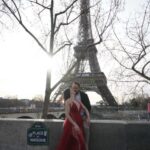
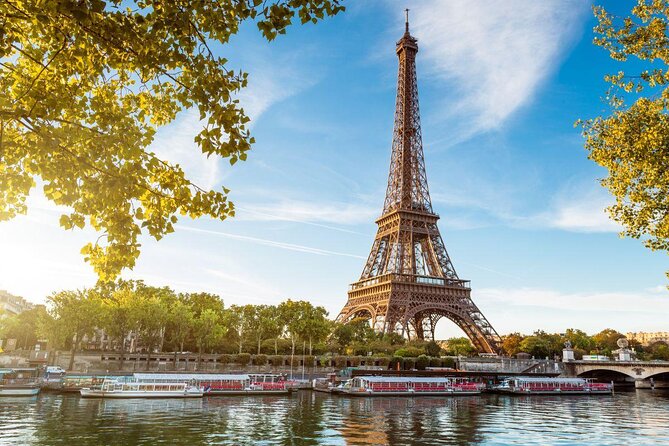
- Eiffel Tower Without the Ticket: Trocadéro’s Best Angle
- What You’ll Be Doing During the Stops (So Expectations Match Reality)
- Who This Tour Suits Best
- Should You Book This Private Paris Night Sightseeing Tour?
- FAQ
- How long is the Private Paris City Night Sightseeing Tour?
- What’s the price, and how many people can be in the group?
- Is hotel pickup included?
- Is the tour in English?
- Are Eiffel Tower tickets included?
- What’s included in the tour?
Key things to know before you go
- Private, not crowded: only your group rides and sets the tempo
- Hotel pickup: you start from your lobby, not a meeting-time scramble
- Air-conditioned comfort + WiFi: handy when you’re moving between wide streets at night
- Trocadéro photo setup: a quick stop with a free admission angle for Eiffel Tower views
- Stops mix icons + meaning: Arc de Triomphe, Notre-Dame area, Grand Palais, and more, with story points
- Eiffel Tower access is a separate decision: you can see it, but you buy the ticket if you want to go up
What a Private Paris Night Tour Really Solves
At night, Paris can feel like two cities at once: gorgeous lights outside, and frustrating lines and slow walking inside the busiest areas. This tour tackles the problem by moving you in a vehicle and adding short, purposeful stops. You’re not trying to “power-walk” between far-apart landmarks in the dark. Instead, you ride, look, take photos, and get the story you’d otherwise read later.
Because it’s private, you can also match your energy level. If you’re a history person, you’ll likely linger at places with names and dates. If you’re more about scenery and snapshots, you’ll move faster. That flexibility matters on a short 3-hour evening schedule.
You can also read our reviews of more tours and experiences in Paris.

Price and Logistics: What You’re Paying $540.69 For
The price is $540.69 per group (up to 2 people). In plain terms, you’re paying for a guide + private vehicle for a compact route, not for museum entry or skip-the-line access.
That’s good value if:
- you want a calmer way to see a lot in one night,
- you’re traveling as a pair (so per-person cost stays reasonable),
- you’d rather spend your time looking at Paris than figuring out routes.
It’s less of a deal if:
- you want to enter multiple attractions during the tour (most stops are exterior or viewpoint-style),
- you’re hoping the Eiffel Tower ticket is included (it’s not).
Your best “value move” is to decide up front whether you want Eiffel Tower access during your stay. The tour helps you line up a great viewing moment near the end, but you’ll need a separate ticket if you want to go up.
Pickup, Mobile Tickets, and Staying On Schedule
Pickup is offered, and your instructions are straightforward: pick-up at the hotel lobby. You’ll also receive a mobile ticket. The “practical” part here is making sure your meeting point is easy for the driver to find—especially at night.
One more scheduling tip: the provider states they need 24–48 hours to organize private tours. So if you’re booking near the day of travel, I strongly recommend you contact them promptly to confirm pickup timing and details. Keep your phone accessible around the start window so you can respond quickly if they need coordination.
Champs-Élysées at Night: Postcard Avenue, Real-World Photos
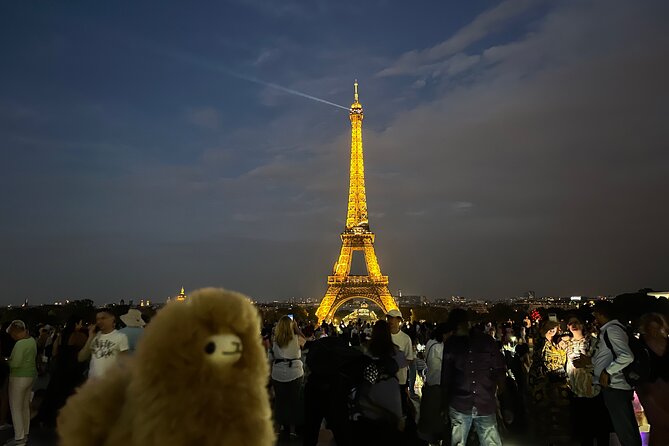
Your evening begins on the Champs-Élysées, a nearly 2-kilometre avenue that runs between Place de la Concorde and the Arc de Triomphe. At night, it’s all about contrast: bright storefronts and streetlights against long sightlines. From the vehicle and short stops, you’ll get a sense of why it’s such a classic walk—even if you’re not walking it all.
Why this stop works:
- you get the big “Paris boulevard” feeling fast,
- you get orientation for the rest of the landmarks,
- you can line up photos without spending time crossing major intersections on foot.
Quick consideration: it’s a long stretch, so you won’t be “doing it all” like a day walk. You’re using it as a launchpad for the night route.
Arc de Triomphe and the Tomb of the Unknown Soldier
Next up is the Arc de Triomphe, honored for those who fought and died for France during the French Revolution and the Napoleonic Wars. It also has names of French victories and generals inscribed on inner and outer surfaces. Under its vault lies the Tomb of the Unknown Soldier from the First World War.
At night, the Arc hits differently. It’s not just a monument behind you—it becomes a framing device for the avenues radiating out. Even if you don’t spend long on steps, the vehicle-based viewing plus a guide’s explanation makes it feel less like a photo spot and more like a memorial you understand.
If you’re the type who likes reading the stone: this is a great place to pause and absorb the meaning. If you want pure views, you’ll still leave with better context for what you’re seeing.

Place de la Concorde: The Largest Square in Paris
Then comes Place de la Concorde, noted as the largest square in Paris. The square ties directly to major turning points: it was intended to glorify King Louis XV, but during the French Revolution, royals including Louis XVI were executed there.
At night, this kind of landmark can feel almost cinematic—wide open space, powerful architecture, and fewer walkers than daytime. It’s also a key “map node.” Seeing it early in the route helps everything else make sense later when you’re looking at the Seine and the major bridges.
Napoleon’s Temple of Glory Plan: A Stop That Explains the Surprise
One of the stops focuses on Napoleon’s decision to build a Temple of Glory for his Grande Armée, with plans authorized by Pierre-Alexandre Vignon. The story includes that construction began after remaining efforts from 1790, aiming for a Greek-temple style.
I like this stop because it turns a building you might barely notice into something with an origin story. When you know what the plan was meant to accomplish, Paris architecture starts feeling less random and more connected.
Just a note: since this is a night-drive format with limited time, you’ll likely get the explanation and best exterior viewing rather than a long study session.
Moulin Rouge to Sacré-Cœur: Cabaret Glamour and a 130-Metre View
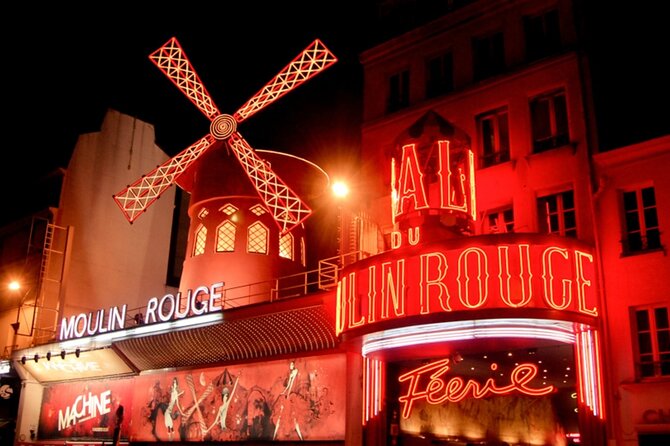
Your route then heads into the famous nightlife orbit with Moulin Rouge. The tour explains that it became the most famous cabaret in the world, opened on October 6, 1889, founded by Charles Zidler and Joseph Oller. That “who started it” detail matters because Moulin Rouge isn’t just a neon sign—you’re seeing the result of a deliberate gamble to create something daring and extravagant.
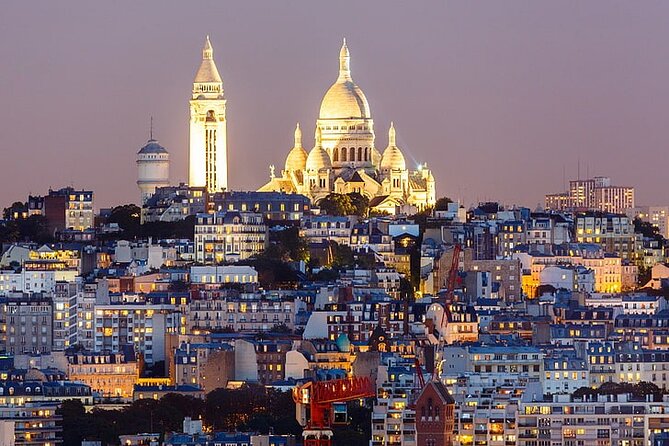
From there, you’ll reach Sacré-Cœur on Butte Montmartre. You get a panoramic vantage point from 130 metres above ground, and the basilica’s white appearance is described in a Roman-Byzantine style. Inside, the ceiling is decorated with the largest mosaic in France at about 480 m².
At night, this is one of the best “per minute” stops. You’ll likely trade some street-level crowds for cleaner photo angles and a wider view of lights across the city. If your feet are tired, this still feels rewarding.
Louvre and the Île de la Cité: Two Major “Old Paris” Anchors
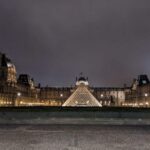
The tour includes the Louvre, described here as the world’s most-visited art museum with a collection spanning from ancient civilizations to the mid-19th century. Even if you don’t go inside, viewing it at night gives you a sense of scale—this is the “gravity” point of central Paris.
Then you’ll move to the Île de la Cité, where you get a tight cluster of stories:
- In 508, Clovis I established his palace here.
- In the 12th century it became a religious center, linked to Notre-Dame and Sainte-Chapelle, and also the city’s first hospital, Hôtel-Dieu.
- It also includes Pont Neuf, the city’s oldest surviving bridge.
That’s a lot of layers for one small island. A night tour format is ideal here because you can get orientation quickly: you’re seeing how Paris grew around this core.
Notre-Dame de Paris and Viollet-le-Duc’s Restoration Role
Next is Notre-Dame de Paris, described as a Gothic masterpiece built in the Middle Ages at the far end of Île de la Cité. Work started in the 13th century and finished in the 15th century. The tour also notes it was badly damaged during the French Revolution and later restored in the 19th century by architect Viollet-le-Duc.
Even if you don’t enter, this stop can be the emotional center of an evening. It helps to have a guide point out what you’re looking at: age, style, and the restoration story. At night, the exterior becomes more dramatic, and understanding the timeline makes it feel less like a landmark and more like a living chapter.
Panthéon Connection: From Saint Genevieve to Mausoleum
Another historic thread in the route explains how the French Revolution changed plans for a church site. By the time construction was finished, the National Constituent Assembly voted in 1791 to transform the Church of Saint Genevieve into a mausoleum for the remains of distinguished French citizens—modeled on the Roman Pantheon.
This is the kind of stop where a short explanation can dramatically improve your understanding. If you’ve ever looked at Paris monuments and wondered why so many roles changed over time, this is a clean example.
Luxembourg Gardens and St-Germain: Slower Paris Energy, Without the Long Walk
The tour then shifts from grand monuments to a more gentle Paris feel with the Luxembourg Palace garden. Here you get a garden story tied to Marie de’ Medici, who began creation in 1612 as part of her new residence after Henry IV. Today, the garden is owned by the French Senate and covers 23 hectares.
The details are fun and very “real life,” not just theory: lawns, tree-lined promenades, tennis courts, flowerbeds, model sailboats on the octagonal Grand Bassin, and the Medici Fountain built in 1620.
After that, you’ll head toward the Left Bank, specifically Saint-Germain-des-Prés, described as a longtime magnet for intellectuals and visitors drawn by historic monuments and boutiques.
At night, this area can feel calmer than the major tourist belts. If you like walking markets and side streets in daylight, this stop still gives you a feel for why people linger here.
Invalides, Pont Alexandre III, and the 1900 World Fair Legacy
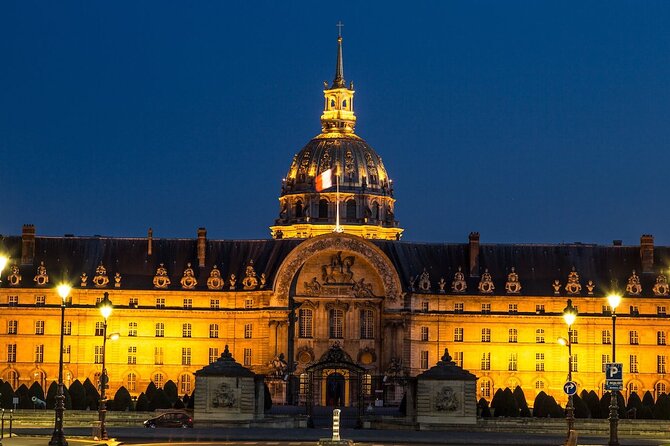
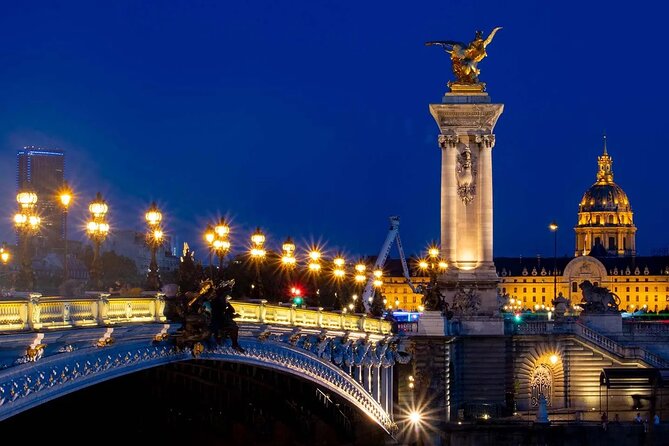
Next: Les Invalides (via Hôtel Royal des Invalides). The tour explains it was built by Louis XIV to house wounded and homeless veterans after campaigns. It mentions the complex was inaugurated for the 1900 Universal Exhibition and is classified as a historic monument.
From there, you’ll see Pont Alexandre III, described as one of the most emblematic bridges because of its architecture and location.
Then come the fair-era monuments: the Grand Palais and Petit Palais.
- The Grand Palais was built for the Universal Exhibition in 1900 and dedicated by the French Republic to the glory of French art. It became a historic monument in 2000.
- The Petit Palais was built as a permanent fine arts museum after the exhibition.
Why I like this cluster for a night tour: it’s about design. You see how Paris wasn’t only built for kings and churches. It was also built for grand public events—and those event buildings are now some of the most photogenic backdrops in the city.
Eiffel Tower Without the Ticket: Trocadéro’s Best Angle
Your photo stage gets set at Palais du Trocadéro (Trocadero). The tour notes it’s inverse the Eiffel Tower on the Seine, and the engineering implies you get one of the ideal Eiffel Tower shots. This stop is listed as about 20 minutes, with free admission.
This is one of the most practical moments of the whole tour. From Trocadéro, you’re positioned for classic Eiffel views without having to climb or fight for prime spots inside the tower area.
Then you’ll head to the Eiffel Tower itself. Here’s the key point for planning: the tour includes touring-style viewing, but tickets to the Eiffel Tower are not included. So if you want to go up, you’ll need to purchase separately. If you don’t, you can still enjoy the tower as a night landmark—big, lit, and unmistakable.
What You’ll Be Doing During the Stops (So Expectations Match Reality)
This tour is timed for coverage, not long museum time. You should expect a rhythm like:
- ride to the next major area,
- short viewpoints or exterior photo stops,
- a guide explanation that helps you recognize what you’re seeing,
- then back into the vehicle to keep momentum.
That pacing is a big reason night tours work so well for first-time visits. You get the “greatest hits,” and you get enough context to decide what you want to return to in daylight.
Also, keep in mind it’s private. That means your guide can adjust the pacing to your interests, but it also means you don’t have the same free structure as a big group tour. If you care a lot about one specific area, speak up early in the ride so it can shape how the evening unfolds.
Who This Tour Suits Best
This is a strong fit if:
- you’re visiting Paris for the first time and want a fast overview with meaning,
- you’re traveling as a couple (price is per group up to 2),
- you want comfortable transport after dark (air-conditioned vehicle),
- you prefer guided context over wandering alone.
It may be less ideal if:
- you want heavy interior access and long time in museums during the same evening,
- you only care about one monument and don’t want a route packed with others.
If you’re the kind of traveler who likes to learn why things are the way they are, you’ll get a lot from the stop-by-stop explanations. If you prefer pure sightseeing with minimal talk, you can still enjoy it, but you’ll want to communicate your preference so the pace matches you.
Should You Book This Private Paris Night Sightseeing Tour?
I think this tour is worth booking if your goal is a compact, comfortable night overview with smart stops. The private format plus hotel pickup and air-conditioned transport make it feel low-stress. The route hits the kind of places you’ll still be talking about when you wake up the next day—Arc de Triomphe, Notre-Dame area, Sacré-Cœur views, Grand Palais, and the Trocadéro Eiffel angle.
I’d be cautious if you’re booking very close to the start time, because private tours still depend on confirmed pickup timing. If you do book last-minute, contact the operator directly to coordinate pick-up and keep your schedule tight.
My practical “decision rule”:
- If you want an evening that helps you see Paris clearly and decide what to revisit later, book it.
- If you want guaranteed ticketed access for indoor sights on the same night, look for a different option.
FAQ
How long is the Private Paris City Night Sightseeing Tour?
It’s about 3 hours.
What’s the price, and how many people can be in the group?
The price is $540.69 per group (up to 2).
Is hotel pickup included?
Yes. Pickup is from your hotel lobby, and you coordinate details by contacting the provider directly.
Is the tour in English?
Yes, it’s offered in English.
Are Eiffel Tower tickets included?
No. Tickets to the Eiffel Tower are not included.
What’s included in the tour?
It includes private transportation, WiFi on board, an air-conditioned vehicle, all fees and taxes, and bottled water.