REVIEW · PARIS
WW1 Somme Battlefield – Thiepval, Beaumont Hamel – Day trip from Paris (3/7 pax)
Book on Viator →Operated by ADRIAN ROADS · Bookable on Viator
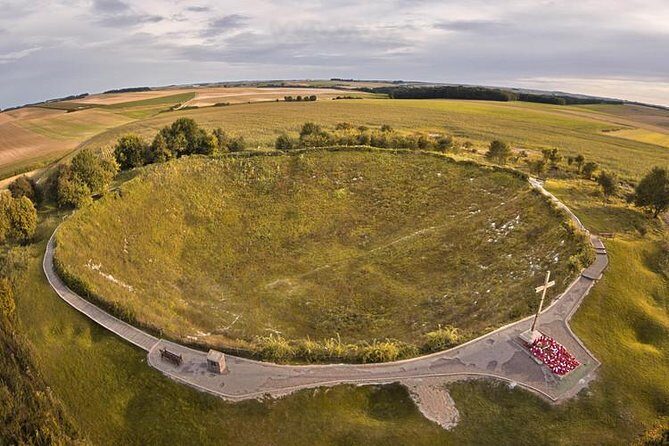
A crater shows the Somme’s hidden weapon.
What makes this day trip from Paris work is the tight focus: you go straight into the stories of 1916, with a small group (max 8) and a driver guide who can explain what you’re seeing. I also like that key entry fees are handled for you, so you spend the morning learning at Thiepval instead of hunting down tickets.
The one thing to weigh up is time and comfort. You start at 6:30am and you’re out for about 12 to 13 hours, and lunch isn’t included, so you’ll want to plan for a long stretch of daylight. If the weather is poor, the tour can be adjusted or refunded, because this is very much an outdoors-and-walking day.
In This Review
- Key things to know before you go
- Why this Somme day trip starts so early
- Small-group pacing: what max 8 means on battlefields
- Lochnagar Crater: the mine you can still stand beside
- Thiepval Memorial: visiting the missing without known graves
- Historial de la Grande Guerre in Thiepval: when the museum uses time as a weapon
- Ulster Memorial Tower and Thiepval Wood: understanding the ridge and the charge
- Beaumont-Hamel Newfoundland Memorial: preserved trenches and a brutal morning
- What’s included in the price, and why it’s not just a sightseeing bargain
- Timing and stamina: how to plan your own day around it
- Who this tour is best for
- Should you book this Somme battlefield day trip from Paris?
- FAQ
- How long is the day trip from Paris?
- What time does the tour start, and where is the meeting point?
- How big is the group?
- What’s included in the price?
- Is lunch included?
- Is admission to the major sights included?
Key things to know before you go
- The group stays small (8 max), so your questions about the trench lines and the timeline actually get answered.
- Lochnagar Crater is explained with specific engineering details, including the depth, distance, and explosive charge used in 1916.
- Thiepval Memorial is for the missing with no known graves, so the visit hits differently than a cemetery stop.
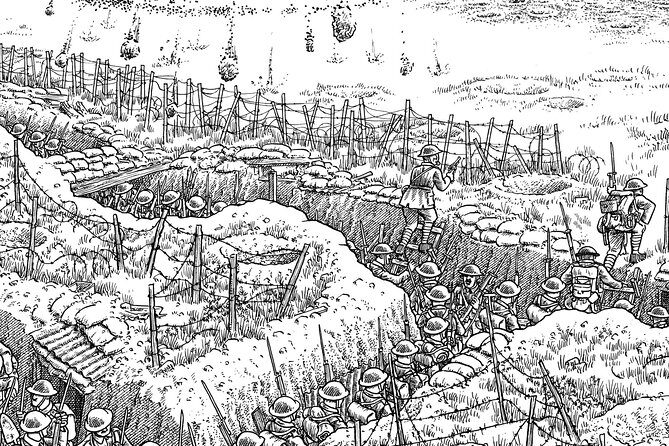
- The museum uses a panoramic mural approach (Joe Sacco artwork plus a glass-topped display pit) to make the Battle of the Somme feel chronological.
- Ulster sites connect ridge, redoubt, and the 1 July charge in a way that’s easier than reading alone.
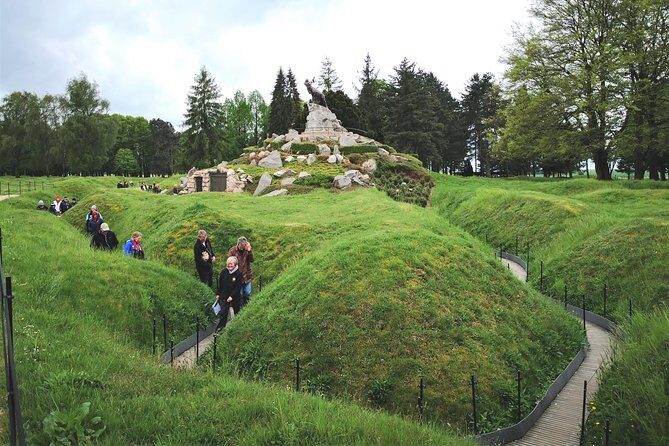
- Beaumont-Hamel includes preserved trenches, not just monuments, which helps you understand what “ground” meant in 1916.
Why this Somme day trip starts so early
A 6:30am departure from Paris is early, but it’s also the whole point of the format. You’re doing a long day for one major region of WWI history: Picardy’s Somme battlefields. Starting early gives you enough daylight for the outdoor stops, and it keeps the museum time from feeling rushed.
Also, the meeting point is right in the heart of Paris, near the Champs-Élysées area at Théâtre du Lido, 116 Av. des Champs-Élysées (1st Arrondissement). That matters because you’re not wasting the morning transferring between stations or negotiating local transit with a tight schedule.
And yes, you should treat this like a full day outing. Expect a lot of standing and walking across memorial grounds and preserved sites. If you’re traveling with anyone who gets tired quickly, plan on breaks being built around the stop times, not in between them.
You can also read our reviews of more tours and experiences in Paris



Small-group pacing: what max 8 means on battlefields
With a maximum group size of 8, the experience feels more controlled and personal than the bigger-bus tours. You’re not packed into a crowd where you hear only fragments. Instead, you can actually look at what’s in front of you and then ask the obvious follow-up: Why was this point targeted? What made it hard to take? What changed later in the campaign?
This is also where the driver guide matters. You’re not just visiting names on stones; you’re getting a guided sequence from crater to memorial to museum galleries. The one hint from past participants is that the guide’s historical background really improves the day, especially when you’re comparing different parts of the same battle line.
If you’re traveling with teens, adults who like military history, or anyone who learns best by connecting facts to physical locations, this small-group approach is a big value.
Lochnagar Crater: the mine you can still stand beside

Your first major stop is Lochnagar Crater in the La Boisselle area. This is not a simple “look at a hole” moment. The crater exists because the British used tunneling under the German front lines on the opening day of the Somme.
Here’s the kind of detail you get at this stop: the tunneling crews dug a shaft about 90 feet deep, then excavated roughly 300 yards toward the German lines. The charge was huge—about 60,000 lbs (27 tons) of ammonal explosive placed in two adjacent underground chambers, about 60 feet apart. The goal wasn’t symbolic. It was to destroy a strong point known as Schwaben Höhe, south of La Boisselle.
Why this stop feels powerful is that it shows the battle wasn’t only rifles and artillery. It was also engineering and underground warfare—trying to rewrite the battlefield by changing the ground itself.
Practical tip: wear shoes with solid grip. The sites are outdoor, and early in the day the ground can feel harder than expected. Also, give yourself a minute before you take photos. The scale hits faster when you pause and study how the crater sits in relation to the surrounding terrain.
Thiepval Memorial: visiting the missing without known graves
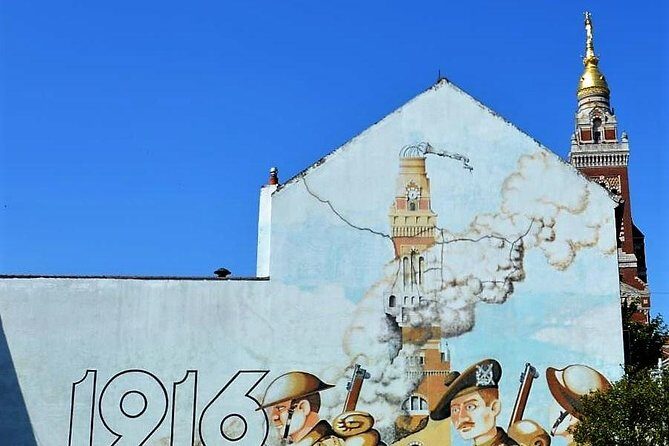
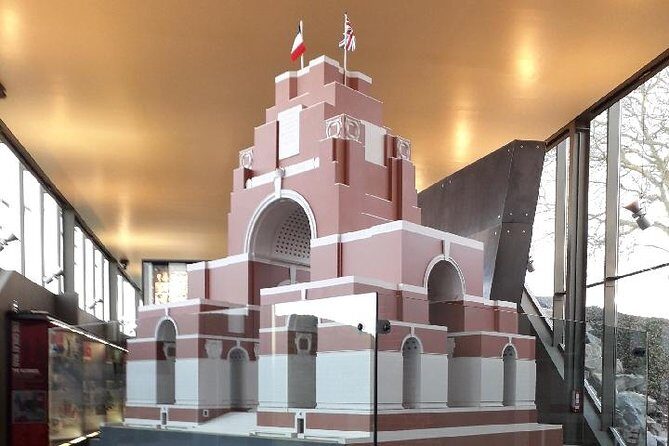
Next up is Memorial de Thiepval, the “Memorial of the Missing.” This is one of the emotional cores of the Somme because it commemorates those with no known graves.
The memorial was unveiled in 1932 by the Prince of Wales and French President Albert Lebrun. It honors more than 72,000 soldiers from the UK and Commonwealth countries who were missing after the Battle of the Somme and had no identified burial locations.
This is also where you’ll understand how overwhelming the casualty numbers were. The memorial is maintained by the Commonwealth War Graves Commission, and it reflects the Somme’s massive toll—about 1,200,000 casualties between 1 July and 18 November 1916.
What I like about this stop for first-time visitors is that it avoids turning into a generic war monument visit. You see how the absence of a grave shaped remembrance. In practical terms, you’ll likely spend about 30 minutes here, with time to read and reflect at your own pace.
Practical tip: if you’re tempted to rush, don’t. The names and the idea of the missing are the point, and speed makes it harder to absorb.
Historial de la Grande Guerre in Thiepval: when the museum uses time as a weapon
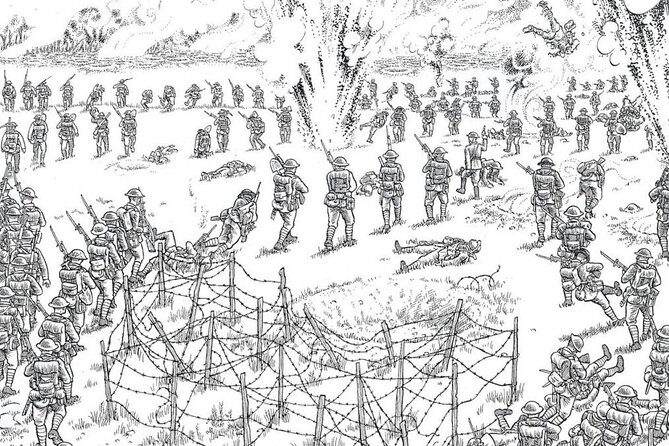
The museum stop is Historial de la Grande Guerre – Musée de Thiepval, and it’s included in the tour entry. This is the part of the day where the visuals do a lot of heavy lifting.
You’ll start with an animated map built around period photographs and film. It gives you bearings fast, so later scenes make sense. Then the museum opens onto a panoramic mural by illustrator Joe Sacco. The installation stretches about 60 meters and uses back-lit glass to show the day of 1 July 1916, moving hour after hour.
That timeline approach is exactly what you want on a battlefield trip. When you can visualize the sequence, you stop thinking of the Somme as one giant event and start seeing it as decisions, movements, and missed chances.
In the middle of the hall there’s also a glass-covered display pit with collection pieces and archaeological remains. The point isn’t shock value—it’s evidence. Short videos add context, including archive footage and explanatory animations.
Then you move into a gallery area that includes a Maxim machine gun captured by a British regiment at Thiepval. That detail helps explain why Thiepval Ridge was an Allied objective on 1 July, yet it wasn’t taken until the end of September.
Finally, the museum touches on aviation and heroic figures, including a life-size replica connected to Georges Guynemer and portraits of WWI aviators. It’s a reminder that the war kept changing, even when the ground war felt locked in.
Time-wise, you’ll have about 45 minutes, which is enough for a thoughtful visit without turning it into a multi-hour museum marathon.





Ulster Memorial Tower and Thiepval Wood: understanding the ridge and the charge
After the museum, you’ll head to the Ulster Memorial Tower and Thiepval Wood area. This stop is free and short—around 15 minutes—but it’s a useful puzzle piece.
The tower sits on what was the German front line during the Somme from July to November 1916. It was erected on the site of the Schwaben Redoubt, a strongly fortified position that the Ulster Division eventually captured.
The location is also positioned opposite Thiepval Wood, where the 36th (Ulster) Division made its historic charge on 1 July 1916. Standing in this zone, you can connect the idea of “front line” with the physical reality of where attacks had to cross open ground and where defenders could hold.
The tower itself provides an orientation point. Even if you don’t absorb every detail of the broader battle plan, this stop makes the day feel more anchored. You’re not only looking at what happened; you’re also seeing how people tried to win by taking specific pieces of terrain.
Beaumont-Hamel Newfoundland Memorial: preserved trenches and a brutal morning
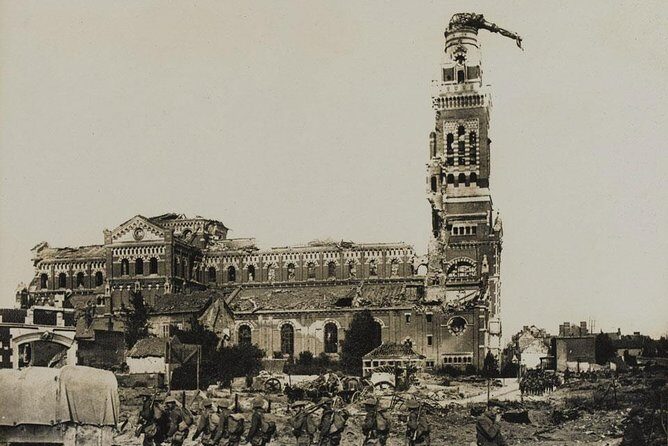
The final major stop is the Newfoundland Memorial Park at Beaumont-Hamel. You’ll spend about 1 hour here, and it’s free to visit.
This is a preserved battlefield park—about 74 acres—so you walk through a portion of the original trench network. That matters because trenches are three-dimensional. You can’t fully understand them from photos or museum panels. On the ground, you feel how narrow choices were and how quickly positions could become deadly.
The site commemorates Dominion of Newfoundland forces members killed during WWI. The park marks the ground where the Newfoundland Regiment launched an unsuccessful attack on 1 July 1916 during the first day of the Somme.
The story is specific and hard to read: at 8:45am, orders were given for the Newfoundland Regiment and the 1st Battalion of the Essex Regiment to move forward. Of 780 men who went, only around 110 survived unscathed, and only 68 were available for roll call the next day.
This kind of detail is exactly why Beaumont-Hamel often leaves people quiet. It isn’t only remembrance. It’s a physical reminder of how quickly a plan collapsed when the defenders were ready and the battlefield didn’t cooperate.
Practical tip: expect uneven ground in preserved trench areas. Keep an eye on footing, especially if the weather turns.
What’s included in the price, and why it’s not just a sightseeing bargain
At $289.82 per person, it’s not a budget day trip. But this price buys you several things that add up for a DIY plan:
- Air-conditioned vehicle for the round trip from central Paris
- A driver guide in English
- Admission included for the key museum experience (Historial de la Grande Guerre in Thiepval)
- Admission included for the Thiepval Memorial Museum stop
- Mobile ticket access, which reduces day-of friction
Then there are the stops where entry is free: the Thiepval Memorial, Lochnagar Crater, and the Ulster Memorial Tower. Even if those are free, your tour still saves you time and mental effort by bundling everything into one schedule with transportation.
Where the price doesn’t include extras is equally important. Lunch isn’t included, and gratuities are optional. In practice, you’ll want to plan snacks or a meal strategy before you go, especially since you’re out from early morning to evening.
For value, I’d frame it like this: you’re paying mostly for guided sequencing plus transportation plus museum entry. If you want a clean, guided learning day without transportation headaches, it makes sense.
Timing and stamina: how to plan your own day around it
You’ll be on the go for about 12 to 13 hours, starting 6:30am. That means you’ll likely want to eat something before departure, and you should treat the day as a “one activity day,” not a day to squeeze in additional sightseeing after.
The itinerary is structured around short museum time and longer meaning at the memorial sites. That balance works well if you prefer fewer stops with real context. It also works for families who want education without spending the entire day indoors.
Good weather is required. That’s not a small footnote here; most of the day is outdoors (crater, memorial grounds, preserved trenches). If you show up prepared with a layer and rain gear, you’ll stay comfortable and protect your energy.
Who this tour is best for
This is a strong fit if you:
- Want to understand the Somme through a guided story tied to key physical sites
- Prefer small-group pacing over a fast, crowded sweep
- Appreciate WWI history that connects trenches, engineering, and how battles progressed
- Are traveling with teens or adults who can handle a serious subject with context
It may be less ideal if you:
- Hate early mornings or long travel days
- Want lots of free time to wander independently without a fixed flow
- Need a highly flexible schedule (the stops have time windows)
If your priority is a full-on military history lecture, you’ll likely enjoy the guide-led context—especially if you happen to get a guide with a deep historian style like Regis, who has been highlighted as both informative and engaging.
Should you book this Somme battlefield day trip from Paris?
I’d book it if you want a focused, respectful day that teaches you where to look and what matters. The combination of Lochnagar Crater, Thiepval Memorial, and the Thiepval museum gives you both the physical and the historical sides of the story. Adding Ulster Memorial Tower and Beaumont-Hamel turns it into a complete view of how the battle line and the casualties came from specific, grounded places—not abstract facts.
Skip it (or rethink it) if a 6:30am start and a long day with limited flexibility sounds exhausting. Also, pack for weather and bring a lunch plan, because the tour won’t fill that gap for you.
If you want a high-value guided way to see the Somme from Paris, this hits the sweet spot.
FAQ
How long is the day trip from Paris?
The tour runs about 12 to 13 hours.
What time does the tour start, and where is the meeting point?
It starts at 6:30am at Théâtre du Lido, 116 Av. des Champs-Élysées, 75008 Paris. The tour ends back at the meeting point.
How big is the group?
The tour has a maximum of 8 travelers.
What’s included in the price?
Round-trip travel by air-conditioned vehicle, a driver guide in English, and admission to the Historial of the Somme 1916 Museum in Albert (as listed), plus admission to the Thiepval Museum in Thiepval.
Is lunch included?
No. Lunch is not included.
Is admission to the major sights included?
Admission to the Historial de la Grande Guerre (Thiepval) and the Thiepval Museum is included. Other stops listed have free admission, such as the Thiepval Memorial, Lochnagar Crater, and the Ulster Memorial area.