REVIEW · PARIS
Escape game Time machine
Book on Viator →Operated by L'Antichambre Escape Games Blondel · Bookable on Viator
Paris has a talent for turning games into stories. Here, the Time Machine setup pulls you into a sci‑fi mess right in the heart of the city. You’re dealing with Professor Laurentius Abe Sterling’s time-travel contraption, and the whole premise is built around a spatio-temporal gap that won’t let you leave until you figure out the machine.
I especially like the way the experience balances brainwork with hands-on puzzle solving—there’s a solid mix of puzzles, manipulation, and search. And I like that the staff run it like a real group moment, with a briefing before you start and time after to talk it through. One thing to consider: the game’s decor and challenge style can feel more functional than cinematic, and the difficulty may be a bit tough for true beginners depending on your group.
In This Review
- Key highlights to know before you go
- Arriving at 10 Rue Blondel: your Paris start point
- The Time Machine story: what you’re really trying to fix
- The 15-minute briefing: how your hour actually begins
- Inside the room: the mix of thinking and doing
- Difficulty level: good for beginners, or not?
- The after-game debrief and team photo (don’t skip this part)
- Price and value: is $26.52 per person a fair deal?
- Who should book this escape game in Paris?
- Small practical tips that make a difference
- Quick reality check: timing and what to fit around it
- Should you book Time Machine at L’Antichambre Escape Games Blondel?
- FAQ
- Where is the Escape Game Time Machine located?
- How long does the Time Machine escape game take?
- Is there a briefing before the game?
- Is there time after the game to discuss what happened?
- What does it cost?
- Is this a private activity?
- Do they offer group discounts?
- Do I need to use a mobile ticket?
- Can children participate?
- What is the cancellation policy?
Key highlights to know before you go
- Professor Laurentius Abe Sterling’s time-travel premise sets the tone from minute one
- 15-minute pre-game briefing helps you get moving fast
- About 60 minutes inside the room to solve puzzles and escape
- Hints are part of the process, so you’re not left totally stranded
- Debrief plus a team photo after the game adds a fun wrap-up
- Private group format means it’s just your team, not a mixed crowd
Arriving at 10 Rue Blondel: your Paris start point
Your adventure starts at 10 Rue Blondel, 75003 Paris, and it ends back at the same place. That matters more than it sounds, because escape rooms often involve extra backtracking. Here, you get a clean “show up, play, walk out” flow.
The venue is also described as near public transportation, which is a big deal in Paris. You don’t want to waste your puzzle-solving energy hunting for the last metro exit. If you’re planning your day around this, I’d place it late afternoon or early evening so you’re not rushed by dinner timing.
Also note the practical ticket detail: you’ll use a mobile ticket. That’s usually faster than rummaging for printouts, and it reduces last-minute stress when you’re trying to find the door and meet the group.
You can also read our reviews of more tours and experiences in Paris.



The Time Machine story: what you’re really trying to fix
The game is built around a simple, fun problem: Professor Laurentius Abe Sterling built a machine to travel back in time, but a calculation error trapped him in a spatio-temporal gap. Your job as a team is to take control of the situation inside the room, solve what you need, and get the machine working so you can escape within the hour.
That kind of story is useful because it prevents that common escape-room problem: puzzles that feel random. Here, the premise frames the whole session. You’re not just clicking locks—you’re operating inside a narrative logic where time has gone weird and the machine is the answer.
The vibe is also explicitly geared toward group fun—think friends, family, or colleagues. If you like games where teamwork feels purposeful (and not just chaotic), this setup fits well.
The 15-minute briefing: how your hour actually begins
Plan to arrive so you get in for the 15 minutes before your escape time. That briefing is where you learn the rules, how to interact with the space, and what the game master expects from you as a team.
Why this matters: escape-room success isn’t only about puzzle skill. It’s also about communication. A good briefing helps you avoid wasting the first ten minutes on basic uncertainty—like whether you should be moving items, looking for specific clues, or waiting for a hint. With this schedule, you’re set up to start the hour with momentum.
It also means you can calm your brain. Even if your group is competitive, the briefing gives you a common starting point. You’ll spend your puzzle time doing the work, not guessing how the game works.
Inside the room: the mix of thinking and doing
Once you’re enclosed as a team, you have roughly one hour to solve and escape. What you’ll likely feel (in a good way) is that the room isn’t just about reading your way through it. The puzzles are described as having a strong ratio between solving, manipulation, and searching.
In plain terms, that usually translates to two types of engagement:
- People who like to reason and pattern-match can work on clue chains.
- People who like to physically try things can contribute by testing mechanisms, checking hidden elements, or interacting with puzzle components.
One review described the puzzles as complex but still doable, which is the sweet spot. Too easy feels like busywork. Too hard turns into stress. The best escape rooms aim for “we can figure this out, but we have to work.”
If your group tends to split roles naturally—someone searches, someone handles devices, someone keeps notes—this format is a strong match.
Difficulty level: good for beginners, or not?
Here’s the honest take: the challenge level seems medium, and it may be a little difficult for true beginners. One account described it as not for the easiest start, even though indices/hints are provided regularly.
So if your group is mostly new to escape rooms, don’t go in expecting everything to click instantly. Go in expecting to work. And if you’re bringing kids (more on that soon), choose your team structure so the adult can help keep everyone oriented.
Also, escape games can hinge on coaching style. Most people reported warm, welcoming game masters and lots of laughter. But one unhappy report mentioned an experience that became unpleasant due to how the game master handled the situation. That doesn’t mean your session will go that way. It just means this is human-powered entertainment: staff interaction is part of the product. If your group is sensitive to tone, it may be smart to treat this as a playful team challenge, not a test of who’s smartest.



The after-game debrief and team photo (don’t skip this part)
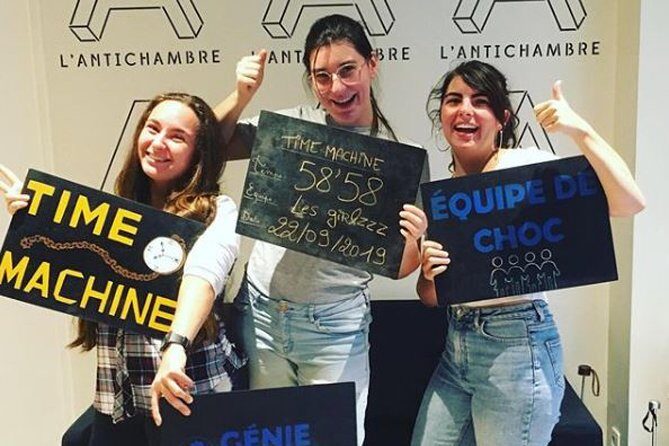
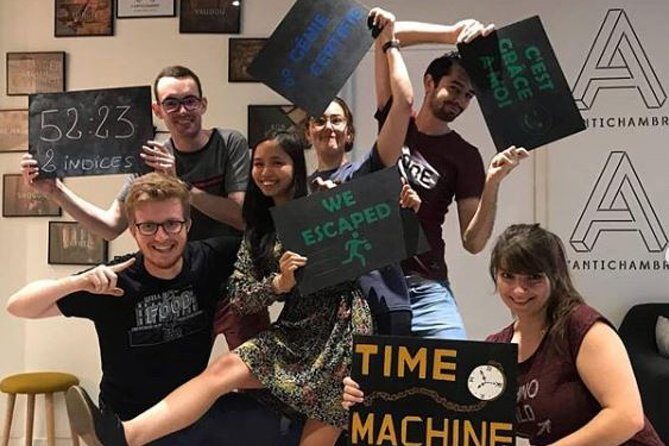
After the one-hour game, plan about 15 minutes for the debrief and team photo. This is where the experience becomes more than just a “we escaped” event.
Why it’s valuable:
- You get a chance to understand what you missed and why.
- You can compare puzzle notes and fill in gaps together.
- The photo locks in the memory, especially for family groups or friend trips.
It also changes the pacing of the whole outing. A 60-minute escape room can otherwise feel like a quick hit. With the scheduled wrap-up, it feels more like a proper activity on your day.
Price and value: is $26.52 per person a fair deal?
The price is listed as $26.52 per person for Time machine at L’Antichambre Escape Games Blondel. That’s a pretty approachable price point for a structured, 60-minute group activity in central Paris.
Here’s how I’d judge value beyond the sticker:
- You get a full experience arc: briefing before, an hour inside, then a debrief and photo after.
- It’s private for your group, which can matter a lot if you’re traveling with friends, family, or colleagues who want to keep things together rather than competing for space.
- Group discounts are offered, which can improve value quickly if you’re booking as a larger team.
So if you’re looking for something that’s fun, social, and not tied to museum hours, this price-to-time ratio can be a win—especially in a city where many activities are expensive per person.
Who should book this escape game in Paris?
This is a strong fit if you want:
- A team challenge you can do with friends and family without needing technical skills.
- A guided game with a structured start (the briefing) and a clean end (debrief + photo).
- A puzzle room where the problem-solving isn’t just one style. The room is described as using a mix of search, manipulation, and puzzle reasoning.
It’s also a good choice for colleagues because the “operate as a team” format feels natural, and it ends with a shared recap.
Who might like it less:
- If your group hates physical interaction or prefers only quiet, reading-style clues, the manipulation/search parts could feel annoying.
- If you want high-end movie-level set design above all else, know that decor quality seems mixed—some people loved the work on the room, while others felt it wasn’t immersive enough for their tastes.
Small practical tips that make a difference
- Arrive a few minutes early for the pre-game briefing. You’ll start calmer, and you’ll waste less time figuring out basics.
- In your group, assign roles before you start. One person can handle searching, one can try mechanisms, and one can keep track of what you’ve already tested.
- If you’re bringing younger teens, remember the rule: children between 12 and 15 must be accompanied by an adult in the escape game.
- Use this as an “act together” activity. Even if one person spots a clue, the fastest teams usually communicate the next step clearly.
And yes, there can be a social element. One group mentioned being offered drinks with plenty of choice, which is a nice extra for a group outing. Don’t count on it every time, but it’s a pleasant detail when it’s available.
Quick reality check: timing and what to fit around it
The session is listed as about 1 hour for the game itself, plus the 15 minutes before and 15 minutes after. In real life, plan roughly for a 90-minute window from arrival to finish, especially if you’re syncing with a group schedule.
This timing is actually helpful. It works well for:
- a mid-evening plan,
- a day with museums that doesn’t need to end late,
- or a rainy-day activity when you still want something active and social.
Should you book Time Machine at L’Antichambre Escape Games Blondel?
I’d book it if you want a central Paris group activity that mixes story, hands-on puzzles, and a proper wrap-up. The premise is fun, the game format supports teamwork, and the price is reasonable for what you get in time and structure.
I’d think twice if your group needs very beginner-friendly puzzles or you’re picky about set design. Difficulty seems medium, and decor reactions aren’t unanimous. Also remember: because game masters run the experience, the tone and guidance can affect your mood.
If you’re traveling with a group that likes puzzles and laughs, Time Machine is an easy “yes” for your Paris itinerary.
FAQ
Where is the Escape Game Time Machine located?
It starts at 10 Rue Blondel, 75003 Paris, France, and it ends back at the same meeting point.
How long does the Time Machine escape game take?
The experience is listed at about 1 hour.
Is there a briefing before the game?
Yes. You should plan for 15 minutes of briefing before your escape game time.
Is there time after the game to discuss what happened?
Yes. You’ll have about 15 minutes after to debrief and take a team photo.
What does it cost?
The price is $26.52 per person.
Is this a private activity?
Yes. It’s described as a private tour/activity, and only your group will participate.
Do they offer group discounts?
Yes. Group discounts are listed as a feature.
Do I need to use a mobile ticket?
Yes. The experience includes a mobile ticket.
Can children participate?
Children aged 12 to 15 must be accompanied by an adult in the escape game.
What is the cancellation policy?
This experience is non-refundable and cannot be changed. If you cancel or request an amendment, the amount you paid will not be refunded.