REVIEW · PARIS
Pointe du Hoc,Omaha Beach, American Cemetery – Day trip from Paris to Normandy
Book on Viator →Operated by ADRIAN ROADS · Bookable on Viator
Normandy doesn’t feel like a textbook here. In a single packed day, you’ll hit the cliff guns at Pointe du Hoc, the shifting lines of Omaha Beach, and the still-silent rows of the American Cemetery.
I like how this trip keeps things practical: you travel in a climate-controlled vehicle, you’re guided at a human pace, and you get museum time without figuring out tickets. I also love the small-group setup (max 7 people) and the fact that Overlord Museum admission is included. The only real drawback: it’s a long day from Paris—plan for early mornings, a lot of driving, and lunch that’s not included.
In This Review
- Key highlights that matter on the ground
- Why This Normandy Day Trip Makes Sense From Paris
- Price and Logistics: Paying for Time (and a Driver Who Handles the Rest)
- Pointe du Hoc: The Cliff Guns and the Feels-Like-You-Are-There View
- National Guard Monument: A Smaller Stop With Big Context
- Omaha Beach Photo Stops: Signal of the Liberation and The Braves
- WN62 and the 1st US Infantry Division Obelisk: Learn the Beach Sectors
- Overlord Museum: The Bridge Between “Seeing” and “Understanding”
- American Cemetery at Colleville-sur-Mer: The Moving Part That Stays With You
- Arromanches and the Mulberry Harbour Remains: Logistics You Can Still See
- Pace, Weather, and What You Should Pack
- The Guide Factor: When the Story Gets Specific
- Should You Book This Normandy Tour?
- FAQ
- How long is the Normandy day trip from Paris?
- What time does the tour start and where does it meet?
- How big is the group?
- Is the tour offered in English?
- What’s included in the price?
- Is lunch included?
- What if weather is poor or I cancel?
Key highlights that matter on the ground
- Max 7 people means more questions and less “herding cats.”
- Pointe du Hoc timing helps you see the site before it gets swarmed.
- Omaha Beach monuments + WN62 give you a clearer map of what you’re looking at.
- Overlord Museum included so the morning stops make more sense.
- American Cemetery orientation views let you understand the landings from the burial site.
- Mulberry Harbour remains at Arromanches show how logistics won the landing.
Why This Normandy Day Trip Makes Sense From Paris
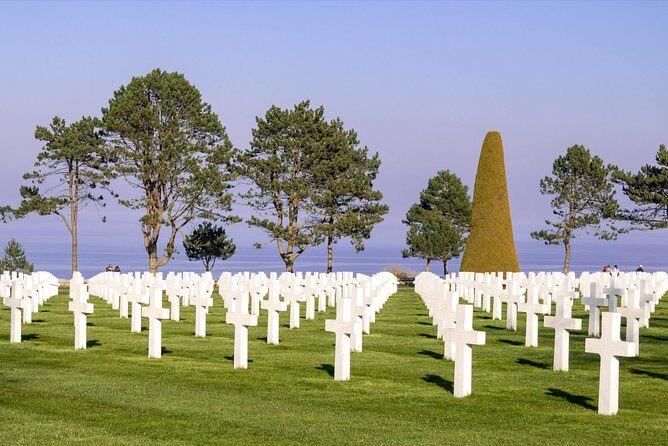
This is the kind of Normandy day trip that actually works if you’re short on time. You’re not trying to “fit Normandy into a couple hours.” You’re doing the key D-Day zones—Pointe du Hoc, Omaha Beach, the cemetery—then adding the story of how the Allies kept supplies flowing at Arromanches.
What makes it interesting is the sequence. You start with the cliff position that Rangers had to attack. Then you move to Omaha’s beach sectors and the units tied to those areas. Later, you step into a place that turns battle dates into names, and then you finish with the harbor engineering that made the invasion possible long after the first day.
The long drive (typically 13 to 14 hours total) is real. But the early start and tight routing are part of the value. If you’re going to spend a day on the road, this itinerary aims to squeeze out meaning, not just photos.
You can also read our reviews of more tours and experiences in Paris



Price and Logistics: Paying for Time (and a Driver Who Handles the Rest)
At $326.53 per person, the price isn’t cheap—but you are buying a full-day service. You get a driver-guide, a private air-conditioned vehicle, and guided stops that would be hard to organize yourself if you want the context at each location.
One detail that makes a difference: the group size. With a maximum of 7 travelers, you’re less likely to feel lost in a crowd. The pace also tends to stay workable for asking questions at monuments and overlook points, not just rushing from one parking lot to the next.
About getting there: the meeting point is at Théâtre du Lido, 116 bis Av. des Champs-Élysées. The tour starts at 6:30 am. Ends back at the meeting point. Some people have mentioned hotel pickup arrangements on the ground with their guide, but the dependable, written meeting spot is the theater on the Champs-Élysées.
Also remember: lunch and drinks aren’t included. The trip is built around sightseeing and timing, so you’ll want to plan to buy or pack something ahead of the day.
Pointe du Hoc: The Cliff Guns and the Feels-Like-You-Are-There View
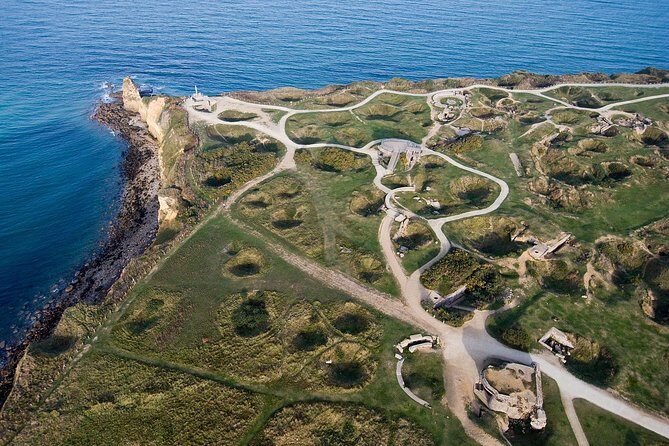
Pointe du Hoc is the stop that changes your brain from “history” to “problem-solving under fire.” These are 100-foot cliffs between Omaha and Utah beaches. Above the channel, German long-range artillery guns were placed in concrete bunkers as part of the Atlantic Wall defense system.
From the ridge, your guide’s job becomes important. You’re not just seeing old concrete. You’re seeing a specific mission target: the guns emplaced for coastal defense, hidden in the kind of fortifications that forced the Allies into dangerous, close-in assaults.
On June 6, 1944 at 07:10 am, US Rangers landed below the cliffs and scaled them using ropes to storm the emplacement and destroy the guns. Even with time passed, the site still shows the scars: damaged bunkers, bomb craters, and visible traces of the battle.
You’ll have about 40 minutes here, plus the walking you need to get good angles. This isn’t a museum stop—it’s an out-in-the-wind stop. Dress for cold or rain. One practical tip: if the weather is rough, don’t skip layers. The site doesn’t care if you’re cold.
National Guard Monument: A Smaller Stop With Big Context
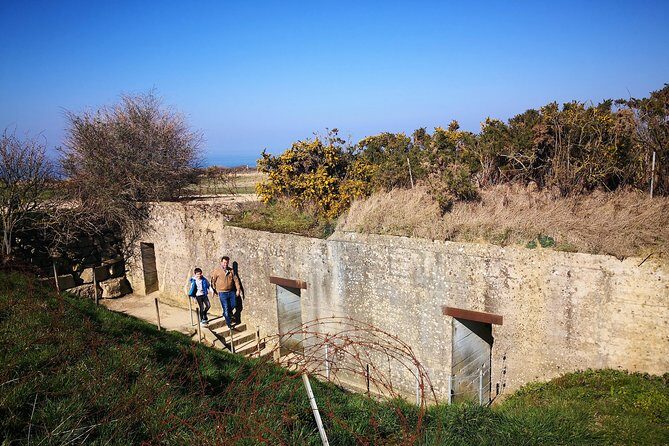
After the cliff attack, the trip flows to a spot that keeps the story grounded in movement. The National Guard Monument is located at WN72, where the 29th National Guard Division broke through German defenses on D-Day.
This stop is brief—around 20 minutes—but it’s useful. It helps you connect the battle map to something you can stand in front of. You also learn how certain defensive structures were anchored to specific ground points, not just vague “enemy lines.”
One nice thing here: the monument and the original bunker it sits on are preserved to honor the soldiers and keep the area from turning into just another scenic overlook.
Omaha Beach Photo Stops: Signal of the Liberation and The Braves
Omaha Beach is wide and dramatic, so it’s easy to lose your place. That’s why the small monument stops matter. You’ll stop in the Easy Green sector and see two monuments that frame the landing and the human cost.
First is the Signal of the Liberation. It marks the Allied landing on June 6, 1944 and the liberation of Europe. There are frescoes on either side—one tied to the 1st US Infantry Division, the other to the 116th Regimental Combat Team of the 29th US Infantry Division. Your guide can point you to what you’re looking at so the beach doesn’t become one big blur.
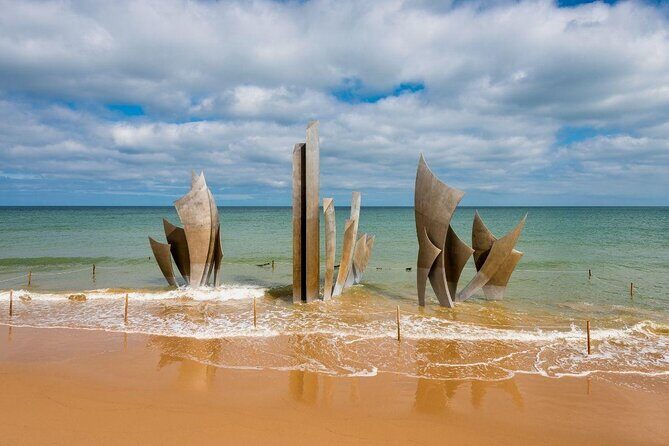
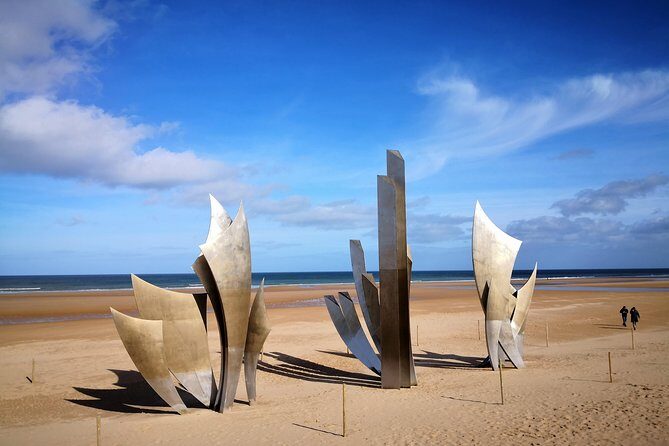
Second is The Braves, a large sculpture by sculptor Anilore Banon. It’s more emotional than informational. It’s meant to stop you for a minute and recognize that this wasn’t abstract “history.” It was people.
You also get a short window to walk along the beach—enough for perspective, not enough to get lost. There’s even a mention of collecting a bit of sand into a small container as a souvenir. Keep it respectful and follow any on-site rules.





WN62 and the 1st US Infantry Division Obelisk: Learn the Beach Sectors
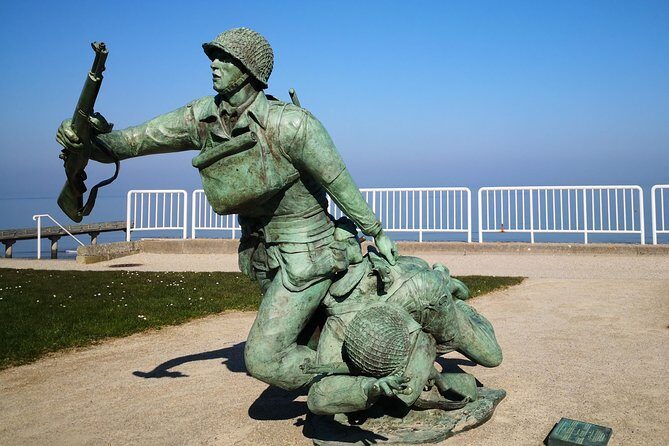
This is where the tour earns its keep: you’re not only seeing Omaha Beach; you’re learning where you are in it. The Memorial of the 1st US Infantry Division (Easy, also described as Red Sector / Easy) is shaped like a commemoration-obelisk.
It stands in the area of Widerstandsnest (Resistance Nest) 62, or WN62. This matters because WN62 is described as one of the strongest defending positions on the Omaha coastline stretch you’re visiting.
From that vantage, the guide can link what you see—sectors like Easy Red and Fox Green—to what happened. It helps you understand why certain areas were so hard to break. It also explains why so many monuments were placed in specific spots: they preserve the “where” of the battle.
Plan for about 30 minutes here. It doesn’t sound long, but it’s enough time to orient yourself and take in the view without feeling rushed.
Overlord Museum: The Bridge Between “Seeing” and “Understanding”
Between beach stops and the cemetery, the schedule includes Overlord Museum for about 1 hour, with admission included.
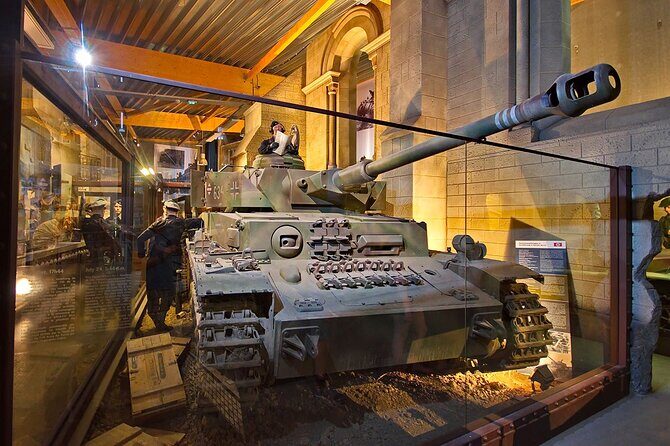
This is the mental reset. Outdoors, you’re staring at terrain and concrete remnants. Indoors, you get the story stitched together. The museum covers the Allied landing period through the liberation of Paris, and the display approach is built around reconstructions tied to the conflict and reconstruction period.
You’ll see personal items from individual soldiers and armored vehicles from the six armies in Normandy. The museum organizes vehicles—tanks and guns—across a set of more than 35 reconstructions. Even if you aren’t a military gear person, it helps you see the scale of what arrived and why.
A practical note: museum time is valuable because you get to sit for a bit. If you’ve walked through damp wind at Pointe du Hoc, that hour can feel like a breather while still staying meaningful.
American Cemetery at Colleville-sur-Mer: The Moving Part That Stays With You
Then comes the stop that people remember hardest for a reason. The American Cemetery in Colleville-sur-Mer covers about 180 acres, overlooking Omaha Beach.
This is where the war becomes personal. You’ll walk rows of 9,387 aligned white crosses and see the memorial chapel. The cemetery includes 1,557 names on the Walls of the Missing, with rosettes marking those recovered and identified. At the center is the bronze statue Spirit of American Youth Rising from the Waves.
What I like about this stop is the layout. It’s designed for reflection, and it gives you reference points for orientation: an orientation table looks out over the landings, and the burial area connects to a circular chapel and granite statues representing the United States and France.
Your guide shares stories about soldiers who fought nearby and were awarded for gallantry. That’s the emotional spine of the visit, and it’s done in a way that turns geography into individual lives.
You’ll get about 1 hour here. That’s a good amount of time: long enough to walk rows, read some names, and find a quiet spot without feeling like you’re on a deadline.
If you go on a cold morning, bring something warmer than you think. Cemeteries make weather feel sharper.
Arromanches and the Mulberry Harbour Remains: Logistics You Can Still See
To finish, you’ll visit Vestiges du Port de Mulberry, connected with Arromanches and the artificial harbor built after D-Day. This is the “how did they keep the invasion supplied?” part.
The Allied engineers installed an artificial temporary port so heavy equipment could be unloaded without waiting for deep-water ports like Le Havre or Cherbourg. The harbor commissioned on 14 June 1944. The key detail: the Mulberry harbor was built using British floating concrete caissons, towed from England and assembled into walls and piers on pontoons linked by floating roadways to the shore.
By 12 June 1944, the scale is given as landing more than 300,000 men, 54,000 vehicles, and 104,000 tons of supplies. It’s hard to picture that magnitude until you’re looking at remnants.
Even today, sections of the Mulberry harbor remain—huge concrete blocks sitting on the sand, plus more visible offshore.
This stop is short—about 20 minutes—so treat it like a final chapter rather than another deep dive. It’s also a nice contrast after the solemn cemetery. Not cheerful. Just practical.
Pace, Weather, and What You Should Pack
This tour is a full-day commitment. You’re typically out from 6:30 am and back around 7:30 pm in practice, even though the official duration is listed as 13 to 14 hours.
That means you’ll want to manage comfort like it’s part of the itinerary. Here’s what I’d pack, based on what matters for these sites:
- A rain jacket or poncho. Weather can shift fast in coastal Normandy.
- Warm layers, even in mild seasons, because wind off the Channel is real.
- Comfortable shoes with grip for short walks and uneven ground.
- A small snack or water plan for the ride. Lunch isn’t included.
Also, don’t underestimate how tiring it is to absorb heavy material all day. The best way to get value is to let moments land. Take photos if you want, but don’t treat it like a checklist.
The Guide Factor: When the Story Gets Specific
One reason people rate this tour so highly is the guide experience. In multiple accounts, the driver-guide Regis has been called out for deep passion and strong storytelling, plus the ability to switch smoothly between topics while keeping timing under control.
That matters because Normandy stops are packed with references. Knowing which sector you’re in, why a bunker mattered, and how a monument connects to a unit turns passive sightseeing into understanding. Your guide can also help you spot details you’d likely miss if you were driving yourself.
If you care about D-Day beyond the headline, this is where the value shows.
Should You Book This Normandy Tour?
Book it if:
- You want a WWII Normandy day from Paris without the hassle of planning logistics and timing.
- You want more than beaches—you want cliff defense, Omaha sectors, a museum, and the cemetery in one trip.
- You prefer a small group where you can ask questions and get straight answers.
Skip it (or choose another format) if:
- You dislike long travel days. This is a 6:30 am start and a late return.
- You need lots of free time at each site. Most stops are short and structured.
For most first-timers, this is a strong way to do Normandy in limited time, because it balances the emotional weight (American Cemetery) with the tactical context (Pointe du Hoc, WN62) and the practical “how it worked” piece (Mulberry Harbour).
FAQ
How long is the Normandy day trip from Paris?
The tour runs about 13 to 14 hours, starting at 6:30 am and ending back at the meeting point in Paris.
What time does the tour start and where does it meet?
The meeting point is Théâtre du Lido, 116 bis Av. des Champs-Élysées, 75008 Paris, and the start time is 6:30 am.
How big is the group?
The tour is a maximum of 7 travelers.
Is the tour offered in English?
Yes. The tour is offered in English.
What’s included in the price?
You get an air-conditioned vehicle, a driver-guide, and admission tickets to the Overlord Museum. The tour summary also notes memorial-museum admission as part of the package.
Is lunch included?
No. Lunch, food, and drinks are not included.
What if weather is poor or I cancel?
The tour requires good weather. If it’s canceled due to poor weather, you’ll be offered a different date or a full refund. You can cancel up to 24 hours in advance for a full refund.