REVIEW · PARIS
Private Tour with Tickets to the Louvre Museum & Crepes
Book on Viator →Operated by Bonjour Local Tours · Bookable on Viator
Paris, powered by a private guide. This 4-hour experience strings together big sights in a smart order, then gets you into the Louvre with timed-entry tickets so you spend more time looking and less time waiting.
I especially like the balance: you get a private guide for the walking portion, then you follow your own pace inside the Louvre with an audioguide. The crepe stop also feels like a very Parisian payoff, not an afterthought.
One consideration: the guide is not inside the Louvre Museum, so if you want someone talking the whole time inside galleries, this format may feel limiting.
In This Review
- Key highlights to know before you go
- Why this private Louvre-and-crepes combo works
- The morning route: Pont Neuf, Place Dauphine, and the Île de la Cité focus
- Conciergerie and Sainte-Chapelle: two ways Paris tells its story
- Left Bank detours: Saint-Séverin, Rue de la Huchette, and Shakespeare and Company
- Notre-Dame, Hôtel de Ville, and the city’s portrait from squares and towers
- Fontaine Stravinsky and Paris refuel: crepes with a view of the funky side
- From Palais Royal to the Louvre Pyramid: walking into the museum zone
- Entering the Louvre: timed entry tickets plus audioguide time
- Price and logistics: what $174.60 is really buying
- Should you book this private Louvre + crepes tour?
- FAQ
- How long is the private tour?
- What’s included with Louvre entry?
- Do you get crepes on this tour?
- Is this a private experience?
- Where does the tour start and end?
- Can I cancel and get a full refund?
Key highlights to know before you go
- Timed-entry Louvre tickets help you dodge a big chunk of the line pressure.
- Crepes plus a drink at a planned stop keep energy up during a packed walk.
- A private guide outside the museum means you get context fast, without waiting in a group.
- You cover classic photo spots on the Île de la Cité and Left Bank, then angle into the Louvre area.
- The Louvre Pyramid is your visual anchor: you’ll arrive right at the museum’s main entrance setup.
Why this private Louvre-and-crepes combo works
This tour is built for people who want the headline sights of Paris without turning their day into one long logistical puzzle. You get a tight route that hits the historical core first, then flows toward the Louvre through some of the city’s most “wandering-worthy” streets and passages.
The value, for me, is in the mix. Timed entry to the Louvre is the big time-saver, and you’re not left to figure out how the museum entrance system works while you’re also trying to enjoy the views. Then the crepes give you a real break in the middle of a day that would otherwise be only stone, history, and stairs.
Price-wise, $174.60 per person is not cheap, but it is understandable for a private format that bundles museum entry, an audioguide, and food. If you’re the kind of traveler who hates standing around, this is the kind of plan that can feel worth it quickly.
You can also read our reviews of more tours and experiences in Paris.



The morning route: Pont Neuf, Place Dauphine, and the Île de la Cité focus
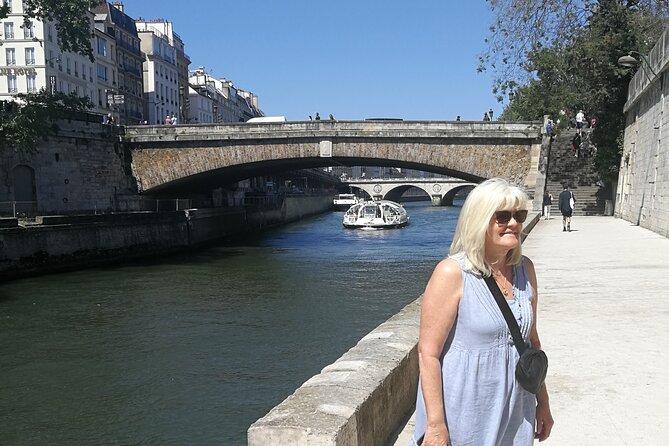
You start in the heart of Paris, near the area where the Seine does its oldest-city magic. Your first stop, Pont Neuf, is famous for being the oldest bridge still standing across the Seine. It’s not just a bridge; it’s a framing device. From here, you see how the Île de la Cité sits in the middle of it all, historically the place where Paris began as Lutetia.
Next comes Place Dauphine, a triangular square near the western end of the Île de la Cité. This is a good spot for a short orientation pause. It ties Henri IV’s 1607 plans to the way the city looks today, and it gives you an easy connection back toward Pont Neuf so photos don’t feel random.
Then you shift into a darker, Revolution-era thread with a stop at the Conciergerie. This former courthouse and prison sits below the Palais de Justice and was where prisoners were held during the French Revolution, including Marie-Antoinette before she was sent onward. If you want Paris to make more sense as more than postcard scenery, this kind of stop does it fast.
After that, Sainte-Chapelle keeps the mood uplifted—still in the same island-area zone, but now in pure Gothic drama. Construction began after 1238, and it was consecrated in 1248, commissioned by King Louis IX to house Passion relics, including Christ’s Crown of Thorns. Even if you’re not a church architecture nerd, the stained-glass glow here is the kind of thing that makes you understand why people line up.
Practical tip: this part of the tour is short on purpose. You’re getting quick, guided context on the outside and nearby, which helps you enjoy later stops without needing to cram in separate museum trips.
Conciergerie and Sainte-Chapelle: two ways Paris tells its story
These two stops are a smart pairing. The Conciergerie is about power, trial, and consequence. Sainte-Chapelle is about devotion, royalty, and art made into a spiritual statement.
The Conciergerie also adds an edge to the way you’ll read the city. Once you’ve stood in this area, you notice how many famous landmarks connect back to government and court life. It’s a reminder that Paris wasn’t only art and fashion—there’s always political history under the surface.
Sainte-Chapelle, meanwhile, is the visual reset button. This chapel is known as one of the highest achievements of Rayonnant Gothic architecture. It survived the 2019 Notre-Dame fire, and it’s tied to the Passion relics collection. That means you’re not just looking at pretty windows—you’re seeing a space designed to hold something believed to be central to medieval Christian life.
For many visitors, this is where the tour stops feeling like a checklist and starts feeling like a narrative.
Left Bank detours: Saint-Séverin, Rue de la Huchette, and Shakespeare and Company
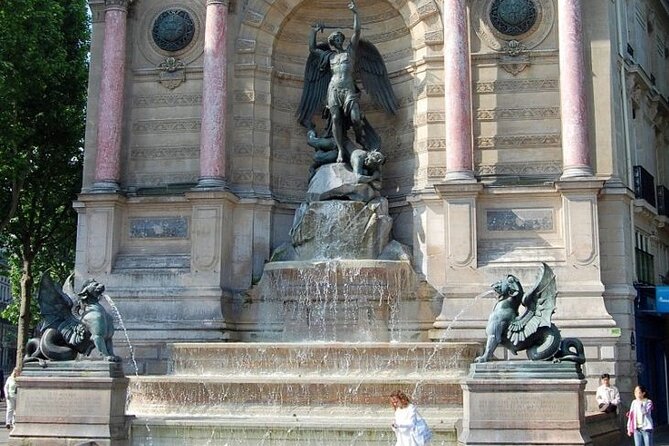
From there, the route shifts you to the Left Bank vibe—still very central, but with a different feel underfoot. Fontaine Saint-Michel is next, a monumental fountain built during the French Second Empire (1858–1860). It’s the kind of landmark that anchors the streets around it, and it naturally sets you up for Rue de la Huchette.
Rue de la Huchette is a long, famous pedestrian street below the Seine in the Latin Quarter. It’s well known for its concentration of restaurants—Greek specialties are especially common—and for lively nightlife with pubs and bars. Guidebooks sometimes give it a nickname, but if you’re curious, it’s exactly the sort of street where you can feel the city’s student-energy current.
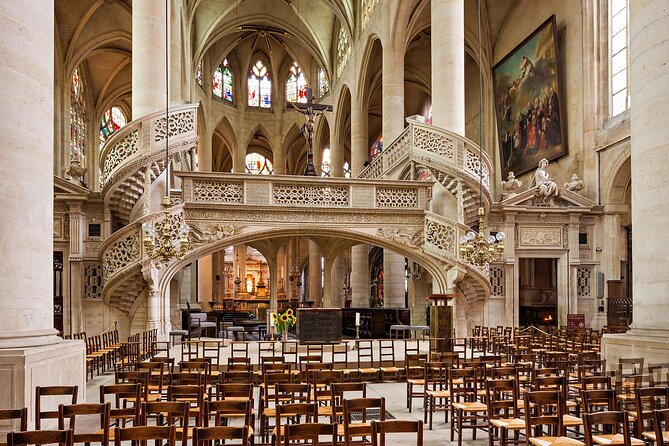
Then you head to Église Saint-Séverin, an older church on Rue Saint-Séverin. It began in 1230, then was rebuilt and enlarged after fires in later centuries, ending up in Flamboyant Gothic style in parts. It also served as a parish church for students at the University of Paris. That connection matters here because it places the Latin Quarter’s everyday culture into a longer timeline.
After that, you get a literary moment at Shakespeare and Company, the English-language bookstore opened by George Whitman in 1951. It’s named after the earlier bookstore run by Sylvia Beach, and it continues with a free reading library open to the public. Even if you only spend a few minutes, it’s one of those stops that changes your mood from sight-seeing to story-feeling.
Small reality check: most of these stops are brief. If you want to sit inside churches longer or browse every shelf, you might want to add extra free time later—but the tour gives you great starting points.
Notre-Dame, Hôtel de Ville, and the city’s portrait from squares and towers
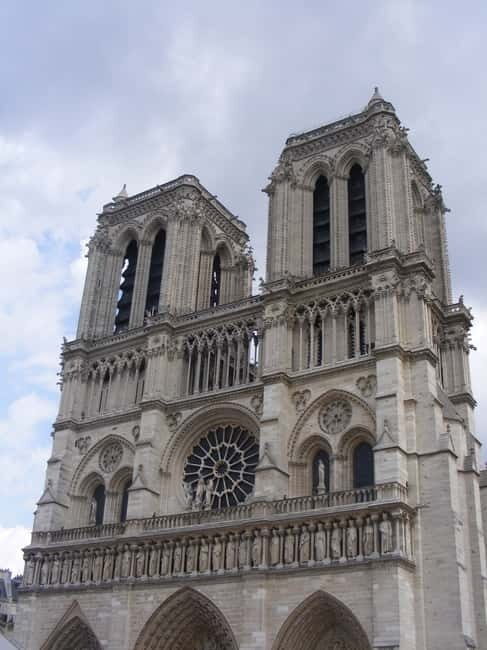
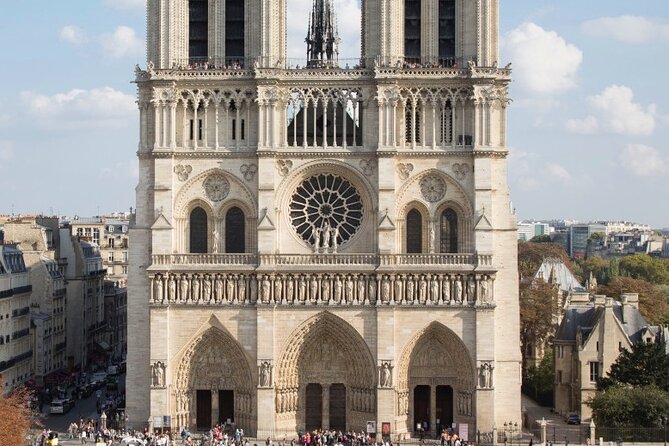
Notre-Dame de Paris is the next big landmark. You’re not just passing it—you’re getting the key architectural idea points: it’s a medieval Gothic cathedral on the Île de la Cité, with rib vaults and flying buttresses, plus enormous rose windows and lots of sculptural decoration. It also has three pipe organs and huge bells. This kind of “what to look for” is what turns a photo stop into a meaningful stop.
Then you move through the area’s public life. Hôtel de Ville (City Hall) is next on the route, a building with layers: François I’s south wing work in the 1500s, Henry IV and Louis XIII on the north wing in the early 1600s, and a tragic chapter when it burned during the Paris Commune in 1871. The outside was rebuilt to match the original design, while the inside changed more substantially. Even from outside, it helps you understand why Paris architecture so often has “before and after” chapters.
Tour Saint-Jacques follows, with the 52-metre Flamboyant Gothic tower that remains from a church demolished during the French Revolution. This tower stands at a street intersection near Rue de Rivoli. It’s a good reminder that some of what you see in Paris is what survived, not what was originally built.
Near the Île de la Cité, you also pause at Marché aux fleurs Reine-Elizabeth-II, a flower market that was renamed after Queen Elizabeth II’s visit in 2014. It historically includes Sunday bird-cage trading, but animal welfare rules mean it’s expected to end after renovations scheduled from 2023 to 2025. Even if you don’t see every detail, markets like this explain how locals use public space.



Fontaine Stravinsky and Paris refuel: crepes with a view of the funky side
Before the Louvre, you make your crepe stop at a restaurant near Place Stravinsky. This area is known for the Stravinsky Fountain, created in 1983 by sculptors Jean Tinguely and Niki de Saint Phalle. The fountain uses sixteen sculptures that move and spray water, inspired by composer Igor Stravinsky.
Now for the best part: you eat a savory crepe, a sweet crepe, and a drink. That’s not a token bite. It’s a full little meal plan built around your energy needs. After hours of walking and looking, your feet and stomach both deserve attention.
If you’re picky about food, you should treat this as a simple, fixed menu stop: the tour includes specific crepes and a drink, so you’ll want to be comfortable with that format.
From Palais Royal to the Louvre Pyramid: walking into the museum zone
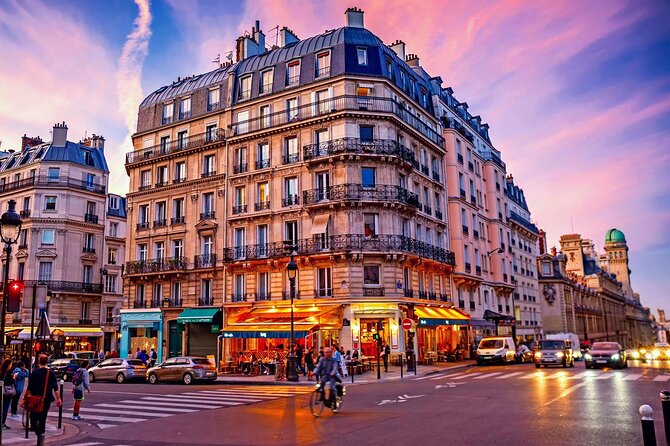
After the crepe break, the tour glides you into a more polished Paris core. Jardin du Palais Royal is next. The Palais-Royal area has royal origins—Cardinal Richelieu had it built (1633–1639) and it later changed hands among royals. Today, the site is administrative and public: the Ministry of Culture and other national institutions use parts of it, while the central garden serves as a public park and the arcade houses shops. Even a short stop gives you the “this is how Paris space is used” perspective.
From there, you pass through cultural landmarks like the Bibliothèque nationale de France’s Richelieu site. The BnF is France’s national library, and some collections—including precious objects and artworks—are shown at the BnF Museum, formerly called the Cabinet des Médailles. You’re not touring galleries here, but the context is helpful: this is part of what makes the city a living repository, not just a sightseeing set.
Then you reach Galerie Vivienne, a covered passage registered as a historical monument. Covered passages are one of Paris’s quiet genius ideas: old-world glass-roof strolling when you want to stay dry or avoid crowd chaos.
You also get a stop by Avenue de l’Opéra, a Haussmann-era boulevard created from 1864 to 1879. It runs northwest toward Palais Garnier. The “walk into the big cultural axis” feeling helps you connect the Louvre area with the broader Paris stage.
Finally, the Louvre Pyramid appears.
Entering the Louvre: timed entry tickets plus audioguide time
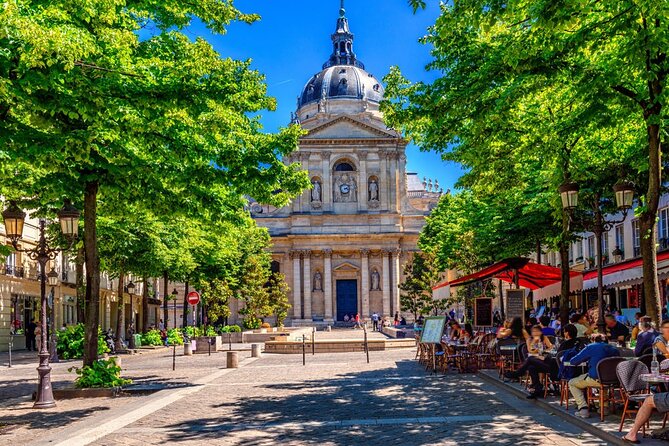
This tour includes timed-entry tickets to the Louvre Museum and an audioguide in your language. That matters because the Louvre’s scale can bully your plan. With timed entry, you can usually get in without losing your entire morning to a line.
Now the big rule: a guide inside the Louvre Museum is not included. So here’s how to make that work.
- Use the audioguide as your backbone while you explore.
- Treat the Louvre as a choose-your-own highlights day, not an attempt to see everything.
- Don’t expect your walking guide to roam the museum giving on-the-spot commentary inside galleries.
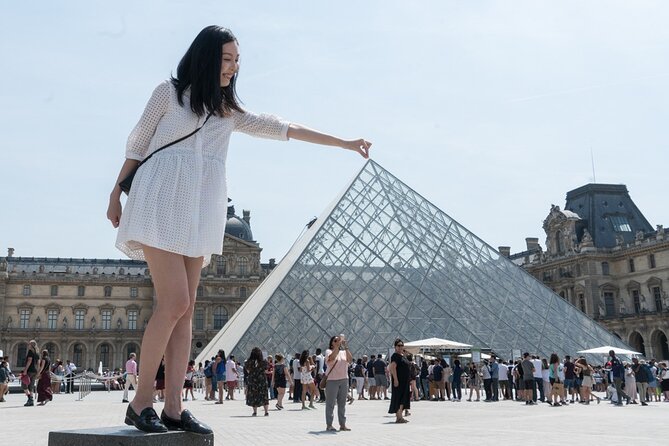
The Louvre Pyramid is your visual arrival marker: the glass and metal structure designed by I. M. Pei, completed in 1988, is the main entrance setup. Even if you never go inside, it’s part of the museum’s identity.
Who will like this setup most: people who want the Louvre’s best-known exterior-to-interior transition, plus enough museum time to feel satisfied, without committing to a full-day museum immersion.
Price and logistics: what $174.60 is really buying
At $174.60 per person for about four hours, the real value is the bundle.
You’re getting:
- Timed entry to the Louvre
- Audioguide in your language
- A private guide for your walking tour outside the museum
- Metro tickets
- Crepes: one savory, one sweet, plus a drink
Because it’s private, you’re not stuck in a big group pace. That can matter around photo stops and around decisions like where to linger. The route also seems designed to keep you moving efficiently between major anchor points rather than zigzagging randomly.
If you’re traveling with teens or adults who like structure but still want freedom, this blend hits a sweet spot. It’s also a good “first Louvre” plan if you’ve never been before and don’t want to spend your first visit figuring out how to navigate.
The drawback is the same reason it’s efficient: you’re not doing a full guided walkthrough inside the Louvre. If your dream is a gallery-by-gallery expert narration, you’ll have to pair this with other plans or accept the audioguide approach.
Should you book this private Louvre + crepes tour?
I think this is a strong choice if you want a well-paced taste of Paris’s central sights and you care about efficiency. The timed Louvre entry is the practical win, and the crepes make the whole day feel like it has a human rhythm, not just transport from landmark to landmark.
Book it if:
- You want a private walking guide for the big outdoor context.
- You’d rather use a Louvre audioguide than pay for someone inside every gallery.
- You want to see the Île de la Cité zone and the Left Bank on the way to the museum.
Skip it if:
- You want a full deep-dive guided tour inside the Louvre itself.
- You need lots of time to linger in one place for an hour or two at a time.
Either way, look at your own travel style: this is a smart “hit the essentials with breathing room” plan.
FAQ
How long is the private tour?
It runs about 4 hours (approx.).
What’s included with Louvre entry?
You get timed-entry tickets to the Louvre Museum plus an audioguide in your language. A guide inside the Louvre Museum is not included.
Do you get crepes on this tour?
Yes. You’ll stop in a crepe house for 1 savory crepe, 1 sweet crepe, and a drink.
Is this a private experience?
Yes. It’s private, and only your group participates.
Where does the tour start and end?
It starts in Île-de-France 75001 Paris, France, and ends at the Louvre Museum, 75001 Paris, France.
Can I cancel and get a full refund?
You can cancel for a full refund up to 24 hours in advance of the experience start time. If you cancel less than 24 hours before, the amount paid is not refunded.