REVIEW · PARIS
Montmartre Self-Guided Audio Tour: More Than Meets the Eye
Book on Viator →Operated by VoiceMap Audio Tours · Bookable on Viator
Montmartre has a way of surprising you at every corner. This self-guided audio walk turns that hilly maze into a step-by-step route with location tracking, plus offline audio and maps. I like that the narration is set up so you feel guided without being stuck with a group, and I also like the art-focused stops—Picasso, Dalida, the windmill—tied together with street-level directions. The main drawback to plan for is the physical side: Montmartre means stairs and uphills, and you’ll also want a fully charged phone for the GPS.
Here’s the basic idea: you start in Abbesses, follow the route at your own pace, and end with a look inside Basilique du Sacré-Cœur. If you’re solo, short on time, or tired of waiting for a group to catch up, this format fits well. If your phone battery is shaky, bring a portable charger and consider using headphones so you don’t have to crank your volume in busy spots.
In This Review
- Key highlights to notice before you go
- Montmartre, mapped for a self-paced audio walk
- Where to start on Rue des Abbesses and how the walk flows
- Mur des je t’aime and a church with records back to 885
- Picasso-era Montmartre: studios, Place Émile-Goudeau, and the First Studio
- La maison de Dalida and the Moulin de la Galette windmill story
- Statues, Rue de l’Abreuvoir, and the story of Le Passe-Muraille
- Maison Rose, a tiny vineyard, and Lapin Agile in full Montmartre mode
- The classic restaurant stop and Van Gogh’s La Guinguette à Montmartre
- Ending at Sacré-Cœur: Chevalier de la Barre and the final climb
- Price and pacing: is $14.99 a good deal?
- Should you book this Montmartre self-guided audio tour?
- FAQ
- How long is the Montmartre self-guided audio tour?
- What language is the audio in?
- What does the price include?
- What do I need to bring?
- Where does the tour start and end?
- Do I need tickets for stops like churches or museums?
- Is this tour private?
- Can I cancel and get a refund?
- Is it suitable for people who don’t want lots of stairs?
Key highlights to notice before you go
- Offline audio, maps, and geodata in the VoiceMap app, so you’re not stuck hunting for signal
- GPS location awareness that helps you keep moving even if you wander a bit
- Picasso-era Montmartre context at the places tied to artists’ lives and work
- Iconic landmarks with specific stories like Wall of Love and the Moulin de la Galette
- A flexible pace that can be quick and snappy or stretched into a slower, stop-everywhere walk
- Ends at Sacré-Cœur with a final climb that feels like a reward, not just a checkbox
Montmartre, mapped for a self-paced audio walk
At $14.99 per person, the value here isn’t that it replaces a guidebook. It’s that it replaces the stress. The audio is delivered through the VoiceMap app in English, and you get lifetime access to the tour. That means you can replay parts later, which is handy if Montmartre felt like a blur the first time.
The biggest practical win is offline access. Montmartre has plenty of thick-street, signal-mess moments (especially around crowded viewpoints and churches). With offline audio and map support, you can keep walking without constantly checking bars on your phone.
Expect the route to take about 1 to 2 hours as designed. But if you actually slow down—enjoy street music, pause for photos, or pop into cafés—plan closer to 4 hours. This is the kind of area where you’ll want time to stand still, look around, and let the stories match the scenery.
You can also read our reviews of more guided tours in Paris



Where to start on Rue des Abbesses and how the walk flows
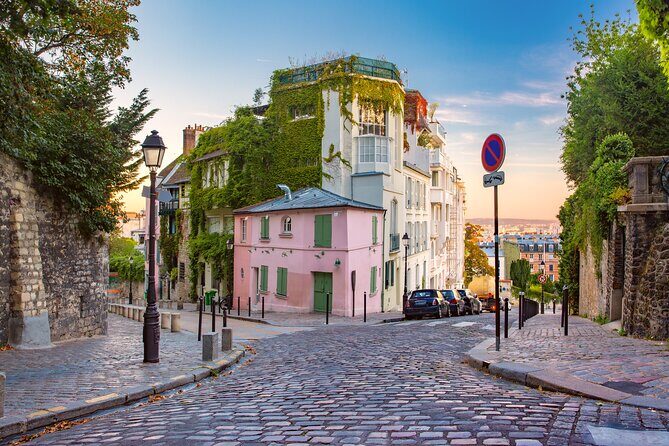
You’ll begin at 22 Rue des Abbesses (75018 Paris). The tour ends at Basilique du Sacré-Cœur de Montmartre, 35 Rue du Chevalier de la Barre (75018 Paris), with the final stop described as a peep inside Sacré-Cœur.
This is not a guided tour where someone shepherds everyone along. It’s set up as a private self-guided activity, so only your group does the route. In practice, that usually means you get to linger. And if you want to speed things up, the experience is built for that kind of personal control.
One thing I strongly suggest: don’t run it on a low-battery phone. Even when the app is working well, GPS and audio use power. If you want to enjoy it instead of worrying, start with a full charge and consider a portable charger. Also, you’ll need your own smartphone and headphones—they’re not included.
Mur des je t’aime and a church with records back to 885
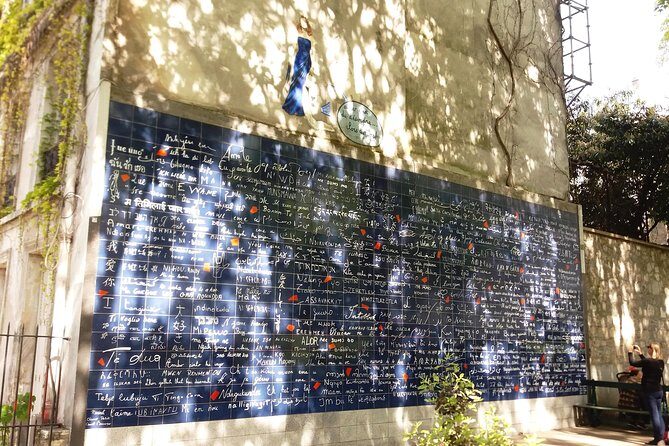
The route opens in the Montmartre neighborhood and quickly gives you a perfect “start thinking differently” moment: the Mur des je t’aime, also known in English as the Wall of Love. This isn’t just a cute photo wall. It was created in 2000 by Frédéric Baron and Claire Kito, and it features 311 ways to say I love you across 250 languages. The audio frames it as a small monument to how language travels, and how Montmartre attracts artists who see the world in symbols.
Next, you hit a church site with written records going back to 885. That age matters. Montmartre often gets marketed as trendy and arty, but this reminds you it also has deep roots as a Christian site in Paris. It’s a good early stop because it changes your mood from sightseeing to understanding.
Practical note: churches can be busy, and the steps and sidewalks around them are narrow. If you’re navigating with the phone held low, keep your balance—Montmartre is uneven even when the route feels straightforward.
Picasso-era Montmartre: studios, Place Émile-Goudeau, and the First Studio
One of the strongest reasons to do this route is that it doesn’t only point at famous buildings. It ties the art to where artists actually lived and worked.
You’ll visit the workshop where Picasso lived between 1904 and 1909. The narration also connects you to other artists who lived and worked there at different times, including Modigliani, Renoir, Juan Gris, Max Jacob, and le Douanier Rousseau. Even if you don’t memorize names, this part gives you a feel for why Montmartre mattered: it wasn’t just a viewpoint. It was a workplace and a community.
As you keep walking, you pass through Place Émile-Goudeau, then Picasso First Studio. These stops help you connect the geography of Montmartre to the art story, so you’re not just checking landmarks—you’re following a thread.
If you care about art history but don’t want a lecture, this works well. The audio keeps moving, so you get context without losing the energy of a walking day.
La maison de Dalida and the Moulin de la Galette windmill story
Montmartre is full of “icon photos,” and this tour picks some of the best ones—while giving you the context people usually miss.
You’ll pass La maison de Dalida, a reminder that Montmartre didn’t stop being artistic after the painters. It continued as a stage for performers and pop-culture legends, and the audio keeps that timeline moving.
Then comes the windmill stop. You’ll see a beautiful windmill that’s one of only two left in Montmartre. The narration explains that it specialized in grinding wheat, and it also worked as a restaurant for a long time. Importantly, famous artists like Renoir, Van Gogh, and Pissarro frequented it and painted it—helping turn the facade into an icon.
You also get a clear art detail: Renoir’s Bal au Moulin de la Galette doesn’t show the windmill itself, only the party behind the famous front. And you’ll hear why Van Gogh painted several versions of this windmill: his brother Theo lived nearby, and Van Gogh knew the area well enough to keep revisiting the subject.
This is a great stop to slow down for photos. The windmill looks like a postcard, but the story makes it feel real.
You can also read our reviews of more tours and experiences in Paris





Statues, Rue de l’Abreuvoir, and the story of Le Passe-Muraille
After the windmill, the tour turns more playful and street-level.
You’ll pass Le Passe-Muraille, a name that already sounds like Montmartre folklore. You’ll also see the Statue of Saint-Denis. The narration uses these stops to keep you connected to Montmartre’s character—part history, part legend, part street art atmosphere.
Then you’ll go down Rue de l’Abreuvoir. This is one of those streets where the buildings help you understand why Montmartre feels like an artistic maze. Instead of treating it like a corridor to rush through, the audio treats it like a place with texture.
A quick tip: Montmartre streets can be slippery and uneven. If it’s wet or you’re in sneakers, go slow on the turns. The audio can guide you, but physics still wins.
Maison Rose, a tiny vineyard, and Lapin Agile in full Montmartre mode
This section is where the tour leans hard into “you’re walking through the stories” energy.
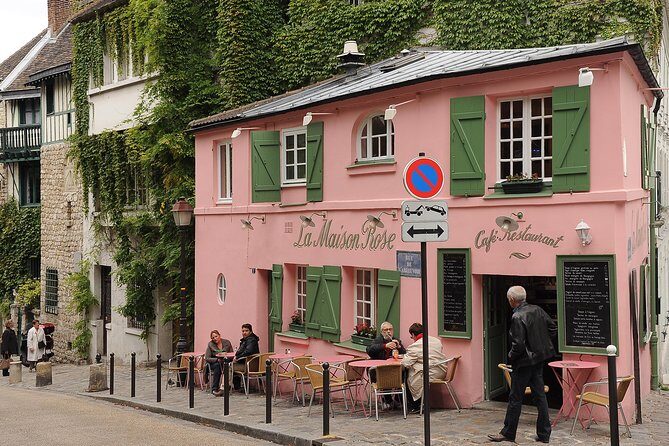
You’ll pass the famous pink house known as Maison Rose, made iconic by a local painter named Utrillo. The audio also adds the social life: it was later bought by someone who was friends with famous singers, so it became a frequent stop for Edith Piaf, Aznavour, and Jacques Brel. And before the singers, Albert Camus was already a fan. It’s a fun reminder that Montmartre isn’t only museums. It’s also where people hung out.
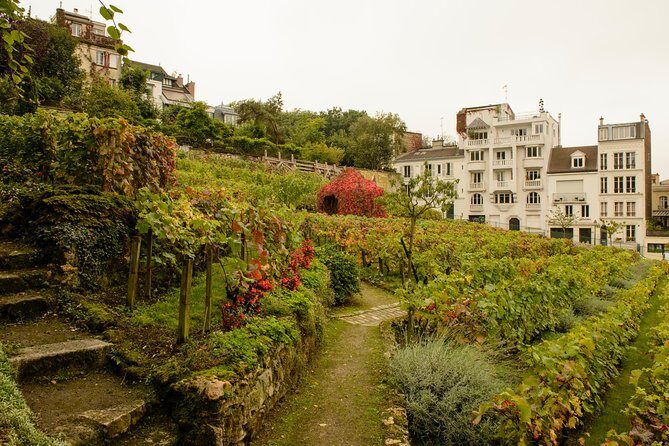
Next, you’ll see one of the last remaining vines in Paris. The vineyard is so small that one person tends it. That detail matters because it shows how rare it is to keep something “old Paris” alive when the city keeps growing.
Then comes Lapin Agile, a cabaret that first opened as a drinking place in 1795. It started under names like Rendez-vous of Thieves and Cabaret of the Assassins, before caricaturist André Gill redesigned it in 1880 and created the rabbit drawing. The audio treats Lapin Agile as a symbol of Montmartre’s quirky spirit—part theatre, part legend.
You’ll also pass Place du Tertre, the classic gathering point for art and sidewalk atmosphere.
The classic restaurant stop and Van Gogh’s La Guinguette à Montmartre
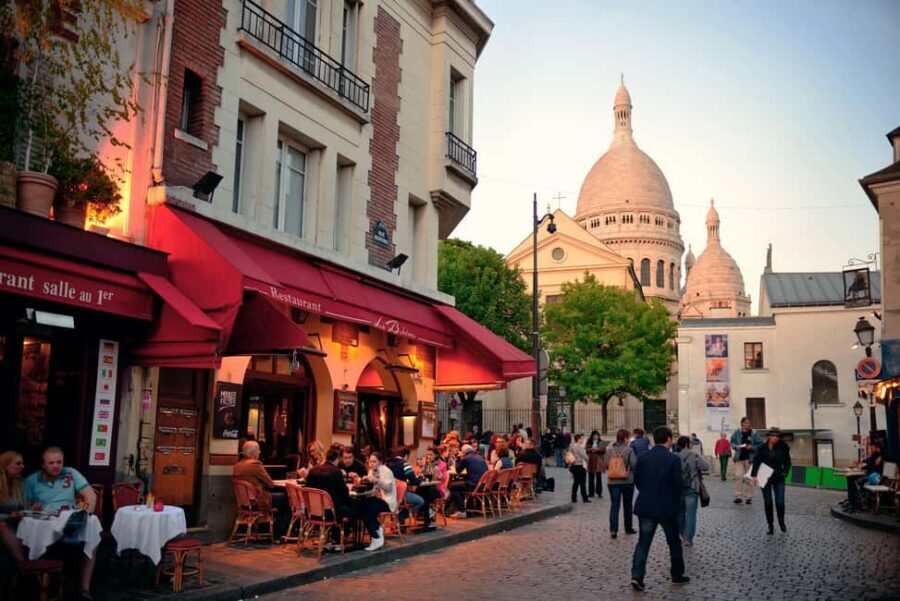
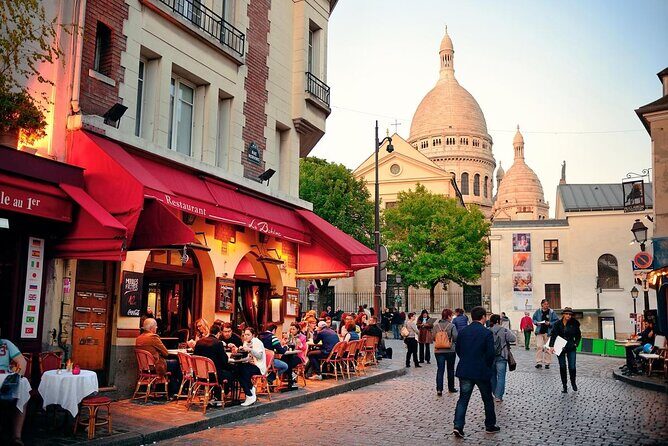
Near Place du Tertre, the tour includes a stop by a classic Montmartre restaurant. The narration notes that its name means simple and without ceremony, and that a restaurant has been here since the 1500s. It’s been rebuilt and renamed multiple times, which is exactly what you want to hear in Montmartre: the neighborhood keeps changing, but the habits remain.
The audio then connects it to a who’s-who of artists: Degas, Renoir, Monet, Cézanne, Sisley, Toulouse-Lautrec, and more. And it gives you a concrete art link: in 1886, Van Gogh painted La Guinguette à Montmartre here.
This is one of the smartest stops on an audio tour because it turns an ordinary street corner into a named scene from art history. You don’t have to have tickets or reservations to get that payoff.
Ending at Sacré-Cœur: Chevalier de la Barre and the final climb
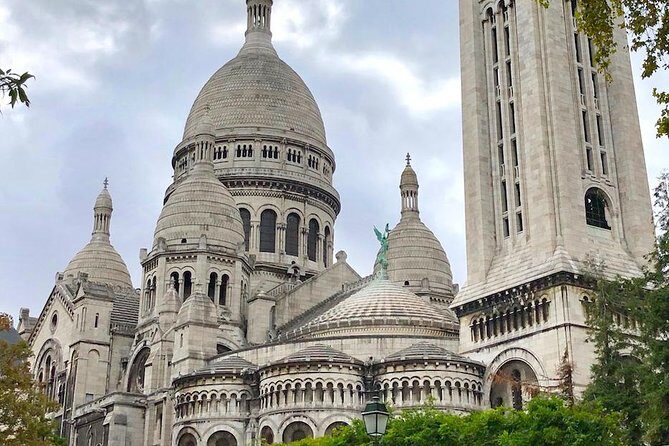
As you near the top, you’ll pass the 2nd Statue du Chevalier de la Barre. Then the route ends with a peep inside Basilique du Sacré-Cœur.
Sacré-Cœur is the obvious headline in Montmartre, but the tour’s real value is how it builds to it. By the time you reach it, you’ve walked through art studios, a vineyard, a historic cabaret, and the neighborhood’s signature icons. That makes the basilica feel like a conclusion, not just a location.
One practical consideration: Montmartre’s hours can be tricky. If your main goal is to linger around top areas like Place du Tertre or spend extra time inside Sacré-Cœur, don’t schedule it as the last thing you do after a long, late start. Plan your climb so you arrive with energy.
Also, if you’re comparing this against flatter walking days in Paris: this one includes stairs and uphill walking. If that’s a problem for you, consider breaking it into shorter chunks over two outings, since the audio stays available.
Price and pacing: is $14.99 a good deal?
For $14.99, you’re basically buying three things: a self-paced route, English narration, and lifetime access to the audio. Most paid sightseeing apps don’t offer that kind of long-term use, and offline support is part of what you’re paying for.
In practical terms, this is usually good value if:
- you prefer independent walking over groups
- you want a route that helps you not feel lost
- you’re interested in art stories tied to specific streets and buildings
- you might replay sections later
It’s less ideal if:
- your phone battery life is unreliable and you hate carrying extra gear
- you need step-by-step physical support for stairs and inclines
- you want a guaranteed, human-led plan with flexibility for closures
And yes, there are small tech realities. The experience depends on your smartphone working correctly and the app tracking your location. If your goal is a stress-free day with zero screen time, you’ll want to carry a charger and keep your expectations realistic about GPS in hilly areas.
Should you book this Montmartre self-guided audio tour?
I think you should book it if you’re the type of visitor who likes walking, prefers your own pace, and wants Montmartre connected to real art names and places instead of just photos. The mix of Wall of Love, Picasso-era stops, Moulin de la Galette, Lapin Agile, and the Sacré-Cœur ending gives you a full neighborhood arc.
Don’t book it if stairs and uphill walking will slow you too much—or if you know you’ll be uncomfortable relying on a phone for navigation. In that case, you’ll likely spend more energy managing the route than enjoying the sights.
If you do book, give yourself time. Start with a charged phone, use headphones, and build in a little extra for photo stops. If you’re flexible with your schedule, the payoff is big: Montmartre starts to feel like a story you can walk through.
If plans change, you can cancel for a full refund if you do it at least 24 hours before the experience starts.
FAQ
How long is the Montmartre self-guided audio tour?
It’s set for about 1 to 2 hours.
What language is the audio in?
The tour is offered in English.
What does the price include?
You get lifetime access to the app and this audio tour, plus offline access to audio, maps, and geodata.
What do I need to bring?
You’ll need your smartphone and headphones. Transportation, food, and drink are not included.
Where does the tour start and end?
It starts at 22 Rue des Abbesses, 75018 Paris and ends at Basilique du Sacré-Cœur de Montmartre, 35 Rue du Chevalier de la Barre, 75018 Paris.
Do I need tickets for stops like churches or museums?
The tour does not include tickets or entrance fees for museums or other attractions en route.
Is this tour private?
It’s listed as a private activity, meaning only your group participates.
Can I cancel and get a refund?
Yes. It’s free cancellation, and you can cancel up to 24 hours in advance for a full refund.
Is it suitable for people who don’t want lots of stairs?
Montmartre is hilly, and the route includes uphill walking. The experience says most people can participate, but be ready for stairs and inclines.