REVIEW · PARIS
Paris Evening Cooking Class French Dinner and Market Visit Option
Book on Viator →Operated by Le Foodist · Bookable on Viator
A French dinner class beats another museum stop. You get an English-taught cooking night in Paris with a clear focus: shop ingredients (if you pick the longer option), cook together, and then sit down to eat what you made, with wine and a bit of food-culture context. In the best moments, instructors such as Chef Luc, Frédérique, Paulo/Paolo, and Chef Luke are praised for making technique feel doable and the group feel welcome.
I especially like how the experience combines two things that matter in Paris: the Latin Quarter market vibe (when you choose it) and the chance to learn practical French methods you can repeat at home. One consideration: the class is English-only, and while most people adapt fine, at least one guest reported difficulty understanding part of the chef’s speech. Also, regular classes can’t accommodate vegan or dairy-free diets.
In This Review
- Quick hits on this Paris cooking night
- Where the evening starts in Paris: Mabillon and the Latin Quarter mood
- 4.5 hours vs 6 hours: what changes and what you gain
- The shorter class (about 4.5 hours)
- The longer class (about 6 hours)
- The Latin Quarter market walk: how it helps you cook like a chef
- In the kitchen: hands-on French technique, not a spectator sport
- Your 3-course dinner menu: what you’ll cook and why it’s a smart choice
- Starter
- Main
- Dessert
- Wine, cheese, and the moment you learn pairing the easy way
- After dinner: French food culture, traditions, and customs
- Group size and teaching style: why max 12 matters for your outcome
- Price and value: what $252.74 buys you in Paris
- Who should book this cooking class (and who should think twice)
- Tips to make your evening smooth and delicious
- Should you book this Paris Evening Cooking Class?
- FAQ
- How long is the Paris evening cooking class?
- Does the tour include a market visit?
- What is included in the 3-course dinner?
- Is the class taught in English?
- Can the class accommodate vegan or dairy-free diets?
- What are the minimum age and drinking age rules?
- What is the cancellation refund window?
Quick hits on this Paris cooking night

- Latin Quarter market option: pick ingredients with your instructor before you cook
- Small group, max 12: more hands-on time and better attention while you chop and stir
- 3-course French menu: learn starter, main, and dessert as a complete dinner flow
- Wine included with dinner: white and red alongside a cheese pairing moment
- Recipes after the class: you get an electronic copy you can actually use later
- Extra tools for pouring: a complimentary Drop-Stop comes with the experience
Where the evening starts in Paris: Mabillon and the Latin Quarter mood
Most evenings begin near public transportation at Mabillon (75006), and your ending point is back there too. You’ll use a mobile ticket, which is handy because you won’t be scrambling for paper. Also, the provider notes there can be two departure points depending on which class option you choose, so check your voucher address carefully before you head out.
This matters more than it sounds. In Paris, a few blocks can mean a different street scene, different noise levels, and a different walk to the kitchen. Starting in the Latin Quarter is a plus because it’s a classic neighborhood feel: older streets, market energy, and lots of places where you can pause for a quick coffee before your class time.
If you’re the kind of traveler who likes your day to end with something you can’t buy on a shelf, this is that kind of evening. It’s not just a show. It’s a real dinner you build with other people.
You can also read our reviews of more tours and experiences in Paris.



4.5 hours vs 6 hours: what changes and what you gain
You’ll see two formats offered: a shorter class and a longer one. The key difference is whether you get the open-air market visit in the Latin Quarter.
The shorter class (about 4.5 hours)
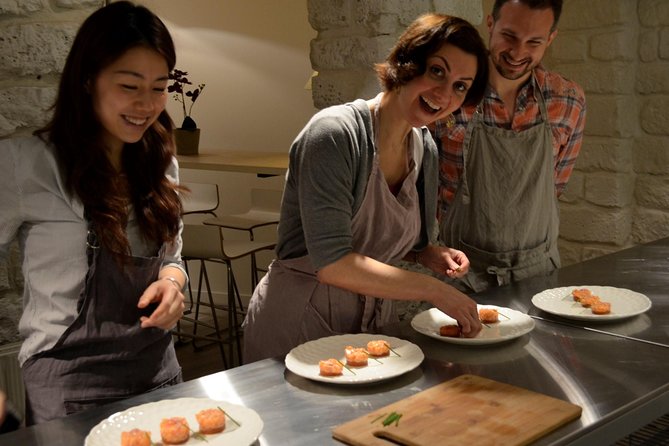
You head to the cookery school in the early evening, meet your instructor, and then plan your 3-course French dinner before cooking starts. You’ll get technique tips as you work, and you’ll still sit down to eat the finished starter, main, and dessert.
This option is best if you’re on a tighter schedule but still want the “shop-and-cook” feeling without adding extra walking time.
The longer class (about 6 hours)
The longer experience adds a market element. You’ll wander stalls with your instructor, select the ingredients you’ll cook with, and then return to cook.
In plain terms: the market walk is where the evening becomes more than a cooking workshop. You start thinking in terms of ingredients—what’s seasonal, what looks right, and why French cooking often starts with smart sourcing. If you want the most value for your money in an experience like this, the longer option usually wins.
The Latin Quarter market walk: how it helps you cook like a chef
When you choose the 6-hour format, your first big stop is the Quartier Latin area for an open-air market visit. You’ll walk with your instructor, sample the ingredients visually and sometimes by aroma, and then pick what your menu will require.
This part is valuable because it changes your mindset from cook-to-follow-a-recipe into cook-to-understand-ingredients. French dinner flavor doesn’t come only from technique. It also comes from buying the right things at the right time.
A few practical tips for you during the market portion:
- Ask how the chef chooses ingredients for the menu. It makes the cooking steps feel logical later.
- Watch for what the chef treats as a “non-negotiable” ingredient. That’s where your future home-cooking upgrades happen.
- Pace yourself. Markets are great, but they’re also busy and can be loud. If you care about hearing every word, stand where you can clearly hear.
Also, note that classes have a maximum of 12 travelers. That group size makes it realistic to stop and ask questions without the instructor sprinting across the room.



In the kitchen: hands-on French technique, not a spectator sport
Once you’re in the cookery school, you’ll follow your menu plan and start cooking. This is where the reviews really lean positive: the instructors are praised for being fun, interactive, and patient—so even if you don’t have knife skills yet, you’re more likely to leave with confidence.
The class includes:
- Use of required equipment and attire
- Professional instructor
- A 2-hour cooking time (for the longer format)
- Electronic copy of recipes
You should expect to do the actual work—mix, chop, assemble, and plate. One review specifically called out mastering a mandoline during a class celebration, including a humorous nod to how careful you need to be with it. That’s a good example of the real value here: technique practice in a controlled setting, with guidance.
What you learn tends to be practical French method, not just “French style.” For example, the menu structure forces you to learn how flavors build across a dinner:
- A starter that sets brightness and texture
- A main with deeper sauce or roasting/simmering logic
- A dessert that balances fruit, acidity, and sweetness
If you like hands-on learning, you’ll feel the difference between reading a recipe and doing it with someone guiding your timing.
One more consideration: the class is only offered in English. That’s great for comprehension, but English clarity can still vary by instructor and room acoustics. If you struggle in noisy environments, sit where you can hear well and ask questions early rather than waiting.
Your 3-course dinner menu: what you’ll cook and why it’s a smart choice
The experience uses a set menu structure, and the sample menu listed is a strong one. You may cook variations depending on the day and market finds, but here’s what’s been featured:
Starter
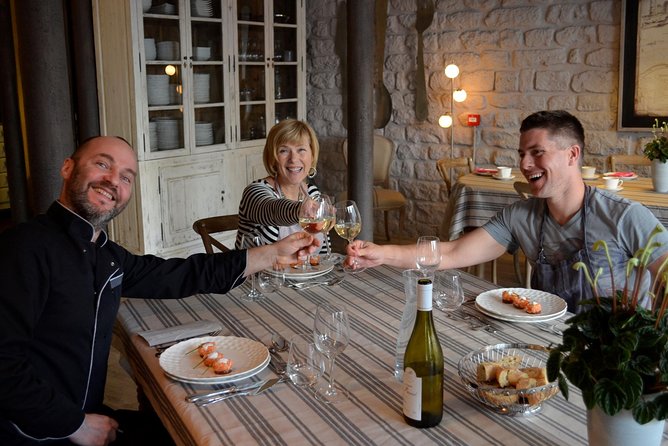
Salmon tartare with yuzu
This blend is a good example of modern French dinner thinking—classic method (tartare) paired with a bright flavor note (yuzu). It’s the kind of dish that teaches technique without being so complicated that it turns into stress.
Main
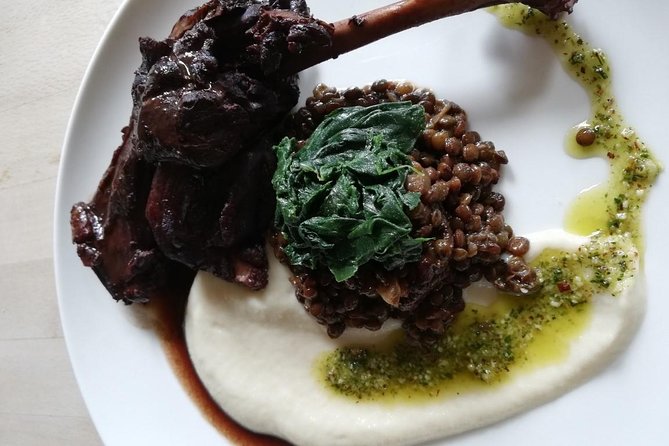
Parisian-style coq au vin
This is the French cooking classic that makes people fall in love with the genre: sauce, simmering, and balance. You learn how to build richness and how to manage timing so the main is ready when the rest of the dinner is done.
Dessert
Poached peach, raspberry coulis, and homemade vanilla ice cream
Dessert can be the hardest part in a cooking class because it has multiple steps. This menu choice teaches how fruit desserts can stay elegant—poach for tenderness, coulis for color and acidity, and ice cream for contrast.
After cooking, you’ll head into the dining area with your fellow cooks and eat your work. That last step is not just a nice payoff—it’s also where you calibrate what you made. French cooking is full of adjustments. Taste-and-fix happens at the table, too.
Wine, cheese, and the moment you learn pairing the easy way
Food tastes better when you learn pairing without it feeling like homework. This class includes wine with your meal:
- You’ll have a glass of wine or two as you work
- Then you’ll get white and red wine (half a bottle equivalent per person) during dinner
- You’ll sample one French cheese and learn the fine art of pairing food with wine
The practical value here: pairing isn’t only about fancy vocabulary. It’s about matching intensity and texture. When you taste a bite of cheese and then take a sip, the lesson sticks fast.
One more thing: you’re not just told what to do. You’re in the flow of cooking and eating. That makes pairing feel like part of the meal, not an extra lecture.
And yes, there’s a small, surprisingly useful bonus: the experience includes a complimentary Drop-Stop. It’s the kind of tool that helps you pour neatly at home, and it reinforces the class’s theme—small details, real-world results.
After dinner: French food culture, traditions, and customs
After you’ve eaten, your host shares insights into traditions and customs concerning French culture and cuisine. The best part of this kind of talk is when it answers your cooking questions. You start to connect ingredients, seasons, and dining habits into something you can actually understand and remember.
This is also a good time to ask follow-ups:
- What makes a sauce taste French?
- How do French home cooks think about timing?
- Which ingredients are worth buying once at a higher quality?
Because the group is small (max 12), you’re more likely to get a real answer instead of a quick line for the crowd.
Group size and teaching style: why max 12 matters for your outcome
A lot of cooking classes fail at one basic thing: too many people, too little attention. Here, the maximum of 12 travelers is a big deal. You’re less likely to be stuck waiting for the instructor to notice your burner, your knife safety, or your sauce thickness.
The reviews strongly praise instructors who:
- answer questions without making you feel slow
- keep the room fun
- run a clear plan so you’re not guessing what comes next
You’ll still be responsible for doing the cooking steps, but you’ll feel guided. That’s what turns the class into a skill-building night rather than a chaotic food experiment.
Price and value: what $252.74 buys you in Paris
At $252.74 per person, this isn’t a bargain like a café meal. But it’s also not overpriced for what you’re getting in a high-cost city, especially if you compare it to piecing together all the components yourself.
Here’s what you’re paying for:
- A professional instructor and structured teaching
- Market visit (in the 6-hour option)
- Equipment and attire
- A full 3-course dinner
- Wine (white and red) included with dinner
- Cheese pairing included
- Recipe access in electronic form
- A Drop-Stop tool to take home
- A small group with limited seats
In other words, you’re buying a guided evening that includes shopping, instruction, food, wine, and take-home references. If you enjoy cooking at home and you want a few French techniques you can reproduce, the value becomes easier to see.
If you’re only in Paris for a quick taste of French cuisine and you don’t cook at all, you might consider whether a more casual tasting experience would suit you better. But if you want to leave with both dinner and know-how, this price starts to look fair.
Who should book this cooking class (and who should think twice)
This is a great fit if:
- you want an evening that teaches skills, not just serves food
- you like learning through doing
- you enjoy meeting other people in a structured, friendly setting
- you want a class in English and prefer clear guidance
It’s a weaker fit if:
- you need vegan or dairy-free options in a regular class (the provider states they can’t accommodate this)
- you rely on a lot of quiet and perfect audio. One guest reported speech clarity issues in English.
- you’re traveling with kids who are very young. The minimum age is 12, and no unaccompanied children are accepted. Also, the minimum drinking age is 18, so your family plans should reflect that.
Tips to make your evening smooth and delicious
- Book the option that matches your energy. If you love food shopping and ingredient choice, go for the 6-hour market version.
- Keep your dietary needs in mind when you book. You should advise specific dietary requirements ahead of time. Avoid assuming you can switch to vegan or dairy-free during the class.
- If you’re sensitive to wine, remember you’ll drink during cooking and at dinner. Eat slowly and pace yourself.
- Arrive a bit early and get settled. It helps you hear instructions and not feel rushed.
- Wear comfortable shoes. Even the walk to and from the kitchen area can add up.
Should you book this Paris Evening Cooking Class?
Yes, if you want a real Paris dinner experience that mixes market sourcing (optional), hands-on French technique, and a sit-down meal with wine. The strongest reason to book is that the format pushes you to do the cooking, not just watch. The second is the instructor style—people consistently highlight how clear, interactive, and fun the teaching feels when the group is small.
Book it with confidence if you can handle English instruction, eat the menu ingredients, and you’re not counting on vegan or dairy-free accommodations.
FAQ
How long is the Paris evening cooking class?
The class is offered in options, including a shorter class of about 4.5 hours and a longer class that’s about 6 hours (approx.).
Does the tour include a market visit?
The market visit is included if you choose the longer market option. It takes place in the Latin Quarter.
What is included in the 3-course dinner?
You cook and then eat a 3-course dinner. Wine is included with dinner, and there is also a cheese pairing component.
Is the class taught in English?
Yes. Classes are only offered in English.
Can the class accommodate vegan or dairy-free diets?
No. The provider states they cannot accommodate vegan or dairy-free diets in their regular classes.
What are the minimum age and drinking age rules?
Minimum age is 12 years, and no unaccompanied children are accepted. The minimum drinking age is 18 years.
What is the cancellation refund window?
You can cancel up to 6 days in advance for a full refund, 2–6 days in advance for a 50% refund, and less than 2 days before the start time is not refunded.