REVIEW · PARIS
Paris Medieval Heart: Walking Tour in Ancient Marais
Book on Viator →Operated by My Super Tour · Bookable on Viator
Paris can feel layered. This walking tour strings those layers together for you.
I like the small group setup (max 15), because it keeps the pace human and makes questions easy. I also love how the route mixes famous addresses with quiet corners, including the hidden gardens you’d never stumble into on your own.
One thing to plan for: the walk is 2.5 hours, and you’ll be on your feet in city weather. Also, one guest reported trouble finding the meeting point, so take a screenshot of the pin before you go.
In This Review
- Key highlights worth showing up for
- A medieval Marais walk built around places you can actually see
- Small group (up to 15) and a guide who brings the route to life
- Finding your way: Bastille start and Pompidou finish
- From the oldest synagogue to Place des Vosges and Victor Hugo
- Hidden courtyards, Sully’s garden, and a Jesuit Baroque church
- The Rosiers route: Jewish Quarter flavor, plus medieval defensive traces
- Templars, ash making, and the Marais you can’t map alone
- Front-row views of major art culture: Musée Picasso and Centre Pompidou
- Price and value: $51.66 for guidance, not just landmarks
- Who this tour suits best (and who might want something else)
- Should you book Paris Medieval Heart in the Marais?
- FAQ
- How long is the Paris Medieval Heart walking tour?
- What time does the tour start?
- Where do I meet and where does the tour end?
- Is the tour offered in English?
- How big is the group?
- Are admissions included for the stops?
- Is bottled water included?
- Are service animals allowed?
- Can I cancel for a full refund?
Key highlights worth showing up for

- Oldest synagogue in Paris on a simple, walkable route
- Victor Hugo and Place des Vosges without the time drain of sorting museum logistics
- Hidden courtyards and Sully’s garden, plus medieval traces around the Rosiers area
- Templar history stops tucked into the fabric of modern Le Marais
- A small-group guide who uses visuals and keeps the story moving
- Finish at Centre Pompidou, so you can extend your day with contemporary Paris
A medieval Marais walk built around places you can actually see

Le Marais isn’t just pretty streets and photo-worthy facades. This experience is designed to move you through real places tied to religion, power, art, and everyday life—so Paris feels less like a timeline you read and more like something you walk through.
What makes it work is the balance. You get big names (Victor Hugo, Place des Vosges) alongside details that usually vanish when you only follow the crowds. And because it’s a walking format with a guided storyline, you won’t have to guess what you’re looking at or why it matters.
You can also read our reviews of more walking tours in Paris



Small group (up to 15) and a guide who brings the route to life
This is priced at $51.66 per person for about 2 hours 30 minutes, and the main included ingredient is the local guide. In practice, that means you’re paying for interpretation and direction—not for a long list of ticketed museum hours.
The group limit (max 15) matters more than it sounds. A larger tour can turn into a shuffle. Here, you’ll get enough breathing room to pause at side streets, courtyards, and transitions between eras.
The guides on this tour are also set up to explain, not just lecture. People have specifically praised guides like Sacha for being entertaining and for using a notebook with illustrations and pictures at the right moments. Other guides mentioned, like Lucie and Maria, were praised for keeping it engaging even when the weather wasn’t ideal.
Finding your way: Bastille start and Pompidou finish
The tour starts at 3bis Pl. de la Bastille, 75004 Paris and begins at 10:00 am. You finish at the square in front of Centre Pompidou (Place Georges-Pompidou, 75004 Paris).
That finish is convenient: you end in a central, easy-to-navigate spot with lots of options for food and your next activity. The start can be the only pinch point. One guest couldn’t find the meeting place and spent too long searching. My practical advice: open the map pin before you leave, and give yourself extra time to find it without stress.
Also note: bottled water isn’t included, so plan on either carrying a small bottle or grabbing water nearby.
From the oldest synagogue to Place des Vosges and Victor Hugo

This tour begins by easing you into the medieval-and-early-modern layers of Le Marais rather than launching straight into the busiest postcard sights.
Stop 1: 21bis Rue des Tournelles (Oldest synagogue in Paris)
You start at the oldest synagogue in Paris. That’s a powerful anchor because it immediately reframes the neighborhood as more than architecture—it’s also community history. The stop is short (about 10 minutes), but it’s a strong starting point, especially if you want your Marais visit to feel grounded in real lived stories. Admission is listed as free.
Stop 2: Place des Vosges (oldest square in Paris)
Next is Place des Vosges, where the guide shares the square’s stories and hidden details. Admission is listed as not included, but this is an outdoor stop, so you’re not paying to stand there—you’re paying for the guide’s context. This is one of those moments where the walking tour format pays off, because you’ll learn what to notice while you’re there.
Stop 3: Maison de Victor Hugo (Victor Hugo apartment)
Then you pivot from public square to private space with Maison de Victor Hugo, focusing on the apartment of the famous writer. It’s listed as a free ticket stop and about 15 minutes, which is a good length for seeing the essentials without feeling trapped inside too long.
Why this trio works: it moves from faith landmark → civic heart → literary legacy. Even if you’re not a museum person, it gives you a clear “what kind of place is this?” answer fast.
Hidden courtyards, Sully’s garden, and a Jesuit Baroque church
After the big-name square and the literary stop, the route turns more intimate. This is where the tour earns its keep: smaller spaces, quiet gardens, and architecture that explains itself when you have someone pointing things out.
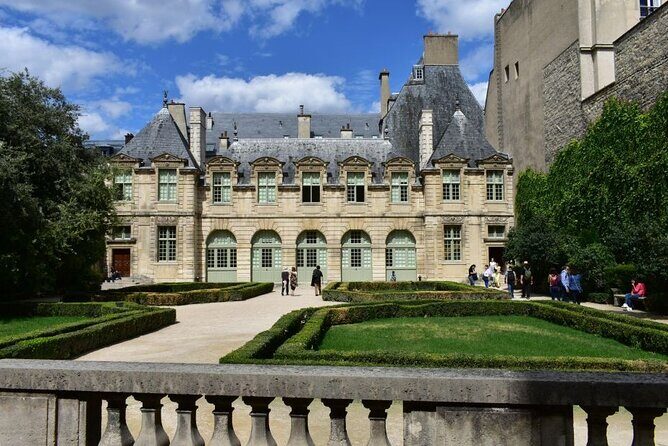
Stop 4: Cour et jardin de l’Hotel de Sully
This is the tour’s “you have to see it” pause: a hidden garden inside the Hotel de Sully grounds. The mansion was built by Sully, finance minister of King Henry IV (1589–1610). The time is brief (around 10 minutes), but it’s the kind of stop that makes Le Marais feel more lived-in than Instagram-famous. Admission is free.
Stop 5: Paroisse Saint-Paul Saint-Louis
Next comes Paroisse Saint-Paul Saint-Louis, a church that marks a style shift: it’s described as the first church to break away completely from Gothic style and adopt the newer Baroque style associated with the Jesuits. You get about 10 minutes here. The value isn’t only the building—it’s understanding the architectural turning point while you’re still looking at it.
How to get the most from these stops: slow down your camera instinct. Spend a minute noticing façade vs. side details, then let the guide’s explanation tell you what those differences mean.






The Rosiers route: Jewish Quarter flavor, plus medieval defensive traces

Le Marais is one of the few parts of Paris where you can feel multiple cultural identities layered within a few blocks. The next stretch brings you into that atmosphere in a practical way.
Stop 6: La Rue des Rosiers
You’ll spend about 15 minutes on Rue des Rosiers, known here as a gastronomical deli street in the heart of the ancient Jewish Quarter. The stop is short, but it’s useful because it orients you: you’ll know where the food lane is and you’ll also leave with local-style recommendations (the tour is described as including suggestions for boutiques and cafés, so you can plan your next meals well).
Stop 7: Jardin des Rosiers – Joseph-Migneret
Then you get a surprise counterpoint: a hidden garden where you can see traces of the medieval defensive wall of Paris. Admission is free and the stop is about 10 minutes. This is one of the most satisfying contrasts on the whole tour: a busy street feel outside, then a calmer pocket inside—while still connected to medieval fortification lines.
Tip for this part of the walk: if you’re hungry, resist the urge to eat right at the first corner. Rue des Rosiers is packed, and the guide’s framing helps you choose better once you understand the area’s logic.
Templars, ash making, and the Marais you can’t map alone
A lot of walking tours stick to “big stones and famous names.” This one includes stops that are more specific—places that sound like trivia until you learn what they’re doing in the neighborhood.
Stop 8: Halles des Blancs Manteaux (Templars in the Middle Ages)
Halles des Blancs Manteaux is described as a fortress used by the Templar Knights in the Middle Ages. You’re there for about 10 minutes with free admission. Whether you’re a medieval-history fan or just curious, the Templar connection gives you a story thread that most self-guided walks won’t offer.
Stop 9: Rue des Francs Bourgeois (factory of ashes until mid-19th c.)
Then comes one of the tour’s strangest, most interesting ideas: a unique institution called the factory of ashes, which worked until the middle of the 19th century. This stop is also around 10 minutes and free. It’s a great reminder that historic neighborhoods weren’t only “grand mansions and churches.” They had industry, infrastructure, and support systems—things that kept the city running.
Why these two matter: they help you read the neighborhood as an ecosystem. You start noticing that walls, marketplaces, and streets each had jobs, not just aesthetics.
Front-row views of major art culture: Musée Picasso and Centre Pompidou
By the end, the tour shifts from medieval clues to modern culture, and that’s a smart way to finish your day in Le Marais. You’re still in the same general part of Paris, but the vibe changes.
Stop 10: Musée Picasso-Paris (stop in front of the museum)
You get a stop in front of Musée Picasso-Paris for about 10 minutes, with the guide connecting it to Pablo Picasso and the invention of Cubism. Admission isn’t listed here as a museum entry, and the language in the stop description reads like a viewing point. That said, even a front-facing stop can be helpful if you want to decide later whether to go inside on your own.
Stop 13: Centre Pompidou (postmodern museum, library, cinema)
Finally, you reach Centre Pompidou with about 15 minutes. The building is described as a postmodern museum for contemporary art, plus a library and cinema, created in the 1970s. The tour ends on the square in front of it, which is a practical finish: it’s easy to meet up with friends, grab a drink, or continue walking.
Price and value: $51.66 for guidance, not just landmarks
At $51.66 per person for around 2.5 hours, you’re paying for three things: routing, timing, and explanation. What makes the price feel fair here is that many stops are listed as free admission tickets (synagogue, Maison de Victor Hugo, Sully’s garden, and more).
You’re also not trapped into long entry queues for ticketed attractions across the whole route. Instead, it’s a sequence of short, focused stops—perfect for travelers who want a strong overview without spending half a day inside buildings.
What you should remember: bottled water isn’t included, so factor that small extra cost. And like any good walking tour, the real value comes from staying mentally present. If you treat it like a race, you’ll miss the payoff.
Who this tour suits best (and who might want something else)
This is a good fit if you:
- Want a structured walk through the Marais that explains what you’re seeing
- Appreciate mixing famous stops with lesser-known gardens and courtyards
- Like small-group tours, where questions actually get answered
- Are traveling as a family; guides have been praised for engaging younger people too
It might not be ideal if you:
- Strongly prefer spending most of your time inside major museums (this tour is mostly about guided stops and views)
- Really hate walking in city weather for 2.5 hours
- Plan to arrive at the last second and don’t like hunting for exact meeting locations
If you’re the type who enjoys architecture and street-level history, this tour is a solid way to build context before you branch out on your own.
Should you book Paris Medieval Heart in the Marais?
Yes, if you want a guided overview of the Marais that feels specific, not generic. The small group size, the mix of big icons (Place des Vosges, Victor Hugo) with quieter stops (Sully’s garden, medieval wall traces, and the odd-but-true factory-of-ashes story) is a strong combo for first-timers.
Book it especially if Le Marais is one of your priorities and you’d like local guidance for food and shopping afterward. If you hate walking, don’t like weather exposure, or you’re worried about finding the meeting point, treat this as a “start early and arrive prepared” tour. With a little planning, it’s exactly the kind of experience that makes your neighborhood wandering later feel smarter.
FAQ
How long is the Paris Medieval Heart walking tour?
It lasts about 2 hours 30 minutes.
What time does the tour start?
The start time is 10:00 am.
Where do I meet and where does the tour end?
Meet at 3bis Pl. de la Bastille, 75004 Paris, and the tour ends at the square in front of Centre Pompidou (Place Georges-Pompidou, 75004 Paris).
Is the tour offered in English?
Yes, it is offered in English.
How big is the group?
The maximum group size is 15 travelers.
Are admissions included for the stops?
Most stops are listed with free admission tickets. Place des Vosges is listed as not included, and the tour description indicates some stops are view points rather than ticketed museum entry.
Is bottled water included?
No, bottled water is not included.
Are service animals allowed?
Yes, service animals are allowed.
Can I cancel for a full refund?
Yes. You can cancel up to 24 hours in advance for a full refund. If you cancel less than 24 hours before the start time, the amount paid is not refunded.