Montmartre is a hill you can walk. This 90-minute English tour strings together the district’s art myths, poetic corners, and famous lookouts into one doable route. You’ll go beyond the postcard stuff by focusing on small sights and the people behind them, from Picasso-linked hangouts to a windmill that still feels like theater.
I especially like the mix of iconic landmarks and lesser-noticed details. Stops like the I Love You Wall, Bateau-Lavoir, and the sculpture inspired by Marcel Aymé make the neighborhood feel human, not just famous. I also like how the tour stays light on fuss and heavy on stories, so you finish with a clear sense of where everything is and why it matters.
One consideration: Montmartre is built on hills and narrow streets. Even without stair-by-stair focus, you should be confident with uphill walking and crowds at popular points like Sacré-Cœur and Place du Tertre.
In This Review
- Key Things You’ll Love About This Montmartre Walk
- Montmartre on Foot: why this 90 minutes feels bigger than it is
- Start at Rue des Abbesses, end at La Bonne Franquette
- The I Love You Wall: a poetic warm-up before the art stops
- Montmartre’s oldest street: cafés, boutiques, and the bohemian era vibe
- Bateau-Lavoir: Picasso, Modigliani, and Braque in one name
- Moulin de la Galette: the windmill that still looks like a stage prop
- Marcel Aymé’s wall-walking sculpture: surreal humor, Montmartre style
- Dalida’s bronze bust: a peaceful tribute in a quieter square
- The pink house café: a long-running photo stop with artist connections
- A small Montmartre vineyard: how vines survived in the city
- Sacré-Cœur exterior and top-of-Paris views: plan for the climb in your head
- Place du Tertre: where art is still performed in public
- How to use this tour for a full Montmartre day
- Price and value: why $38.70 can make sense here
- Who should book this Montmartre walking tour?
- FAQ
- How long is the Montmartre walking tour?
- Is the tour in English?
- Does the tour include entry into Sacré-Cœur Basilica?
- Where does the tour start and end?
- How physically demanding is it?
- Can I cancel for a full refund?
- Should you book this tour?
Key Things You’ll Love About This Montmartre Walk
- Story-first guide style that connects each stop to artists, writers, and everyday Paris life
- Top views without a marathon: Sacré-Cœur exterior area puts you near the highest point in Paris
- Art landmarks in short doses: Bateau-Lavoir and Moulin de la Galette are included as walk-by highlights
- Poetry and play along the way: the I Love You Wall and the Marcel Aymé wall-walking sculpture
- Small group size capped at 25 people, which makes it easier to hear your guide
Montmartre on Foot: why this 90 minutes feels bigger than it is
This is the kind of tour that works because it respects your time. Ninety minutes is short enough to fit into a tight schedule, but long enough to stitch together multiple “this is Montmartre” moments.
You’re walking through an area that looks like it belongs in a movie set: steep lanes, clever little squares, and viewpoints that remind you why people come here. The guide’s job is to add the missing context—who lived here, what artists did here, and how the neighborhood changed over time.
You can also read our reviews of more walking tours in Paris



Start at Rue des Abbesses, end at La Bonne Franquette

The tour starts at 19 Rue des Abbesses (75018 Paris) and ends at La Bonne Franquette, 18 Rue Saint-Rustique (75018 Paris). That matters because Montmartre is spread out, and having a clear finish point helps you plan lunch or a second wander afterward.
Rue des Abbesses is a practical pickup area: it’s in the heart of Montmartre’s daily life and close to public transportation. Plan to arrive about 15 minutes early so you’re checked in before the group moves on—Montmartre is slow enough when you’re walking; you don’t want to lose your place.
The I Love You Wall: a poetic warm-up before the art stops

Your first stop is in a small square near the I Love You Wall, an installation that spells I Love You in over 300 languages. It’s simple, colorful, and surprisingly effective as a reset button.
Why it works: it sets the tone for Montmartre. This neighborhood has always traded in drama and symbolism—so starting with a multilingual love message prepares you for everything else that turns into art, myth, and storytelling.
Montmartre’s oldest street: cafés, boutiques, and the bohemian era vibe
Next you’ll walk a street described as one of the oldest in Montmartre. The guide points out the mix of cafés, boutiques, and older architecture, then ties it to Montmartre’s bohemian past.
Here’s the practical value: when you know what you’re looking at, you spot patterns faster. You start to notice where the neighborhood feels lived-in versus where it feels like a theme-park version of itself. That makes your self-guided time afterward much more rewarding.
Bateau-Lavoir: Picasso, Modigliani, and Braque in one name
Bateau-Lavoir is a highlight for anyone who likes art stories with real places behind them. The tour stop explains it as an artists’ residence, and it names major figures tied to the setting—Picasso, Modigliani, and Braque—who helped shape modern art.
Even if you don’t consider yourself an art person, this stop connects dots. It helps you understand why Montmartre became a magnet for creators: low barriers, lots of imagination, and a scene that encouraged experimentation.






Moulin de la Galette: the windmill that still looks like a stage prop
Then you’ll see Moulin de la Galette from outside. It’s the windmill featured in paintings by Renoir and Van Gogh, and it’s described as a symbol of Montmartre. Historically it was also known as a dance hall, which helps explain why the place still feels lively in the way it’s framed.
A quick tip: even if you only catch the exterior views, you’ll understand why artists keep using it. When you’re later back at photo spots or postcards, this windmill stops being a random landmark and becomes a symbol with a story.
Marcel Aymé’s wall-walking sculpture: surreal humor, Montmartre style
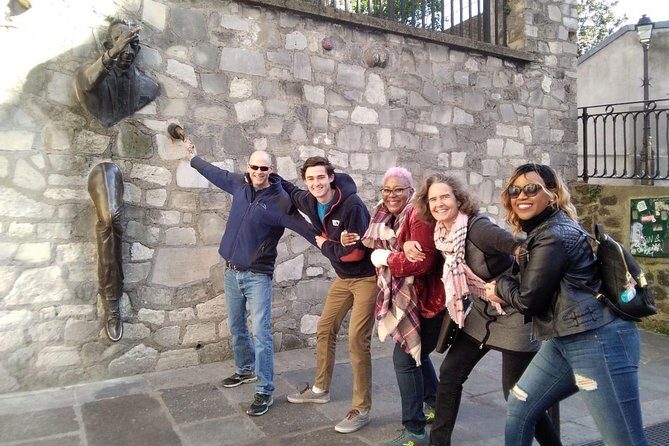
One of the more charming stops is a whimsical sculpture showing a man walking through a wall. It’s linked to a short story by Marcel Aymé, and it’s located near the author’s former home.
Why this matters: Montmartre has a streak of playful logic. It’s not all grand architecture and big names. This is the neighborhood’s wink—the kind of surrealism that fits the hills and the human-scale streets.
Dalida’s bronze bust: a peaceful tribute in a quieter square
Next you’ll learn about Dalida, a long-time Montmartre resident, remembered in the form of a bronze bust in a calm square. It’s a different emotional beat than the art-spot stops.
This moment is useful because it shows another layer of Montmartre: not only painters and writers, but performers and everyday celebrities who shaped the district’s identity. You also get a breather from constant motion, which helps when you’re doing hills.
The pink house café: a long-running photo stop with artist connections
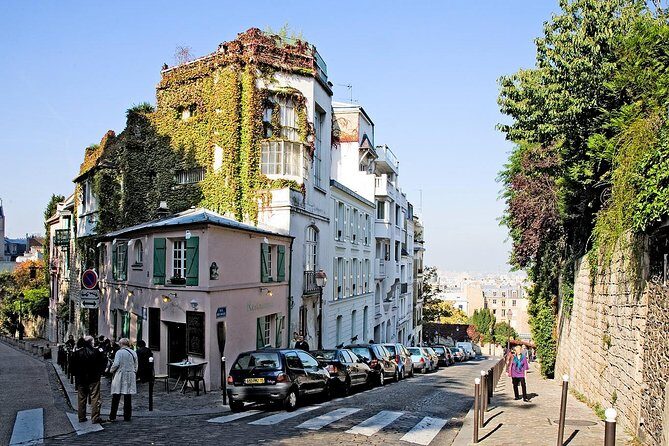
You’ll reach a famous little pink house that’s been an emblem of Montmartre for decades. It’s mentioned as a place frequented by Picasso and Utrillo, and today it functions as a café—also called out as a great photo opportunity on the tour.
Think of this stop as a two-for-one. You get the visuals people associate with Montmartre, and you also get an artist link that makes the scene feel less manufactured. If you want to take photos, this is a good moment—there’s time to pause without making the whole group wait too long.
A small Montmartre vineyard: how vines survived in the city
Then comes one of the most surprising stops: a small vineyard in the heart of Montmartre that produces wine linked to the area’s winemaking heritage. It was established in 1933 to preserve that tradition.
This is the kind of detail that changes how you think about the neighborhood. A city district with a vineyard tells you Montmartre didn’t just become a tourist stage. People kept routines here—growing grapes, maintaining land, and holding onto local identity even as the world around it shifted.
Sacré-Cœur exterior and top-of-Paris views: plan for the climb in your head
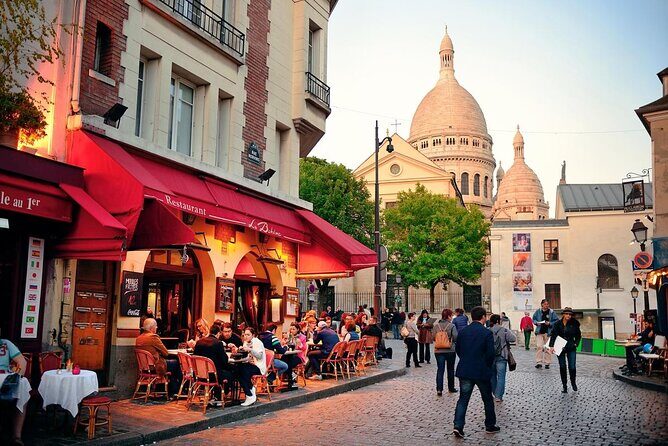
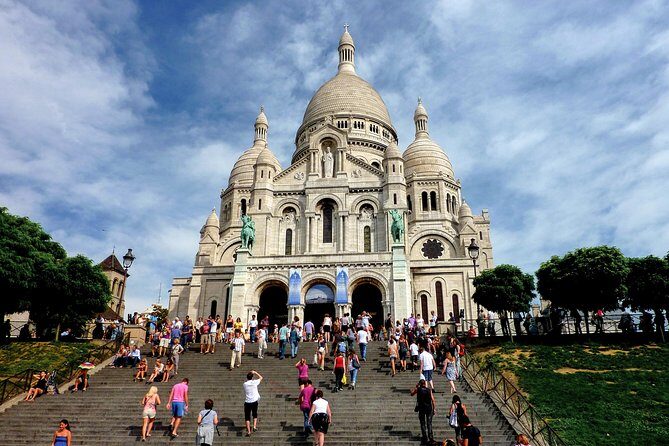
Next you’ll get to Sacré-Cœur Basilica from the outside. The tour describes the basilica as perched at the highest point in Paris, built in the late 19th century, with white domes and intricate mosaics.
You’ll also receive tips on what to see inside if you decide to go in later on your own. Entry is not part of the tour, so you can choose based on time, crowd levels, and your energy for stair-heavy areas around the complex.
Even if you skip the inside, the exterior and the surrounding viewpoint area are worth it. This is where Montmartre stops feeling like a neighborhood and starts feeling like a viewpoint.
Place du Tertre: where art is still performed in public
The last major storytelling stop is a lively square often described as the heart of Montmartre’s artistic spirit. The tour frames it with painters, caricaturists, and street performers, plus surrounding cafés and restaurants.
This is a good place to slow down after the formal guide portion. Use what you learned on the walk to pick out what’s happening and why it fits the district. When you’ve heard the stories first, it’s much easier to spot the difference between performance and actual art culture.
How to use this tour for a full Montmartre day
If you’re planning more time in Montmartre, this walk is a fast way to get your bearings. Afterward, you’ll know where to head for viewpoints, where the “artist” zones tend to be, and which stops connect to specific names like Picasso, Van Gogh, Renoir, Marcel Aymé, and Dalida.
A smart move: schedule this earlier in the day. There are comments tied to the fact that the area becomes crowded quickly, and starting sooner keeps the hills and busy streets more manageable.
Also, treat Sacré-Cœur like a menu, not a rule. The tour takes you by it and shares what to notice if you enter on your own. If you want quieter time, you can also aim for a different hour later rather than forcing Sacré-Cœur at the first chance.
Price and value: why $38.70 can make sense here
At $38.70 per person, the price feels reasonable for what you get: an organized 90-minute guided circuit, in English, with a guide who ties landmarks to art and culture themes instead of just listing names.
You also benefit from having someone manage the route. Montmartre can look confusing on maps because streets fold into hills. A guided walk helps you move with confidence, and that saves you time and energy.
And because the group is capped at 25 people, you generally get a better experience than with very large groups—especially at the narrow stop points where everyone has to look the same direction.
Who should book this Montmartre walking tour?
This tour is a strong fit if you:
- Want a short, story-driven way to learn Montmartre without buying separate tickets for every stop
- Like art, literature, and the way famous names connect to real streets
- Prefer walking with a plan instead of guessing your way uphill
- Have enough stamina for hills and narrow streets (even without stair-by-stair focus)
You might choose a different option if you:
- Know you need step-free routes or have strict mobility limits, since Montmartre’s terrain can be tough
- Expect a long deep visit inside major sights (Sacré-Cœur entry is not included)
FAQ
How long is the Montmartre walking tour?
It’s about 1 hour 30 minutes.
Is the tour in English?
Yes. The tour is offered in English.
Does the tour include entry into Sacré-Cœur Basilica?
No. The tour passes by the exterior of Sacré-Cœur, and entry is not included. Your guide shares tips if you want to go inside on your own.
Where does the tour start and end?
Start: 19 Rue des Abbesses, 75018 Paris.
End: La Bonne Franquette, 18 Rue Saint-Rustique, 75018 Paris.
How physically demanding is it?
It doesn’t include stair-focused routing, but it involves hills and narrow, sometimes busy streets. Plan for moderate walking ability.
Can I cancel for a full refund?
Yes. The tour offers free cancellation. You can cancel up to 24 hours in advance for a full refund.
Should you book this tour?
If you want a high-value Montmartre intro that mixes recognizable landmarks with the smaller, weirder, more human details (I Love You Wall, Bateau-Lavoir, Aymé’s wall-walking sculpture, the vineyard, and the art-square finale), this is a smart booking.
Book it especially if you’re short on time, want good orientation for the rest of your day, and you’re comfortable with Montmartre hills. Skip it only if you specifically need long indoor time or step-free movement.