REVIEW · PARIS
Seine River Direct Access Guided Cruise
Book on Viator →Operated by Vedettes de Paris · Bookable on Viator
Paris looks different from the Seine.
This direct-access cruise turns a simple boat ride into an easy, guided “orientation loop” of the city. I like that it’s on a 100% electric boat with panoramic windows, so you get big views without the noise and fumes. I also like the live guide narration (English is available), which helps the landmarks click into place. The one drawback to plan around: the ride is only about an hour, so if you want long stops or museum time, this won’t scratch that itch.
If you time it right, you can do this early in your trip to learn the shape of central Paris, then build the rest of your day on what you liked most. Keep one practical thing in mind: the top deck can feel chilly or windy in colder months, and the inside can feel warm in hot weather, so dress for the conditions you’ll actually face.
In This Review
- Key things to know before you board
- Why this 1-hour Seine cruise is a smart first-day move
- Boarding at Port de Suffren and how the 1-hour timing really works
- The view-from-the-deck plan: what each stop adds to your Paris picture
- Eiffel Tower: the 1889 Exhibition gamble that paid off
- American Church in Paris: green clock-tower and Tiffany stained glass
- Hôtel des Invalides: Napoleon’s tomb and Louis XIV’s military hospital
- Alexandre III Bridge: gold leaf, nymphs, and Franco-Russian symbolism
- Pont de la Concorde: Bastille stones and the Revolution’s edge
- Musée d’Orsay area: the former railway station turned art museum
- Institut de France: the Académie Française and language shaping
- Pont Neuf: oldest bridge in stone, 381 unique grimacing masks
- Pont Saint-Michel and the Latin Quarter connection
- Île de la Cité: presumed birthplace of Paris
- Notre-Dame and the core cathedral corridor you’ll recognize
- A quick pass-by: Tournelle Bridge and Saint Genevieve
- Cultural and royal institutions: Louvre, City Hall, and Palais Bourbon area
- Louvre: royal palace turned museum
- Hôtel de Ville (Paris City Hall): Neo-Renaissance style and the Hall of Mirrors link
- Place de la Concorde: Luxor obelisk and the Revolution’s turning point
- Grand Palais and Palais de Chaillot: universal exhibition architecture still doing jobs today
- Comfort, weather, and where you should stand or sit
- How the guide narration affects your experience
- Champagne onboard: a treat, not a requirement
- Value check: is $25.23 for an hour a good deal?
- Best fit: who should book this cruise
- Should you book it
- FAQ
- How long is the Seine River Direct Access Guided Cruise?
- Where does the cruise start and end?
- Is there a live guide?
- Is the tour offered in English?
- Is this cruise on an electric boat?
- Are alcoholic drinks included?
- Do I need to bring paper tickets?
- What should I know about weather?
- What if my tour gets canceled due to mechanical issues?
- What if I miss my scheduled departure?
Key things to know before you board
- Direct access from Port de Suffren (75007): start near the Eiffel Tower side, then cruise through the historic core.
- Live narration with English option: you’ll hear sights explained as you pass them, not just read a sign.
- Panoramic windows: great for photos and for staying comfortable when the weather isn’t.
- 100% electric boat: you’ll travel quietly and smoothly compared to older-style boats.
- Optional champagne onboard: alcohol isn’t included, but you can buy it during the cruise.
- Not a massive crowd: max is 220 travelers, and many sailings feel manageable for a 1-hour trip.
Why this 1-hour Seine cruise is a smart first-day move
The Seine is the easiest way to understand Paris fast. Roads can confuse you, streets can snake, and viewpoints can be far apart. From the water, you get an instant “map in motion,” with landmarks lining up in a way that helps you remember where everything sits.
This cruise is built for that exact purpose. You’re on the river for about an hour with narration that connects what you’re seeing—bridges, domes, cathedrals, palaces—to why each place matters. It’s not a slow, take-your-time day trip. It’s an efficient, guided highlight reel that still feels relaxed.
You also get a real comfort upgrade: this is a 100% electric boat, and that usually means a quieter ride and a more pleasant atmosphere on board. Plus, with panoramic windows, you’re not forced to be glued to one side for views.
You can also read our reviews of more boat tours in Paris


Boarding at Port de Suffren and how the 1-hour timing really works
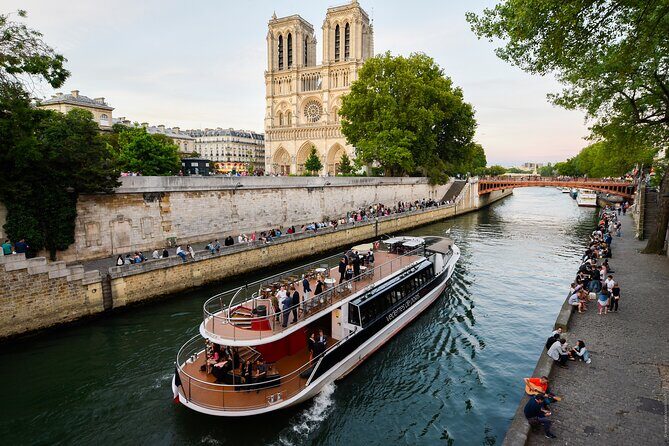
The meeting point is 2 Port de Suffren, 75007 Paris. The tour ends back at the same place, so you don’t have to worry about a “different drop-off” later.
Because it’s about 1 hour, pacing is everything. I’d treat this like a “set appointment” rather than a wander-when-you-feel-like-it kind of activity. Arrive early enough to settle in, because the best photo angles and the most comfortable viewing spot depend on where you end up at departure.
You’ll have a mobile ticket, which is convenient, especially on a day when you’re carrying only what you need. The operator notes it’s near public transportation, so it’s easier to slot into a schedule that includes other sights.
The view-from-the-deck plan: what each stop adds to your Paris picture
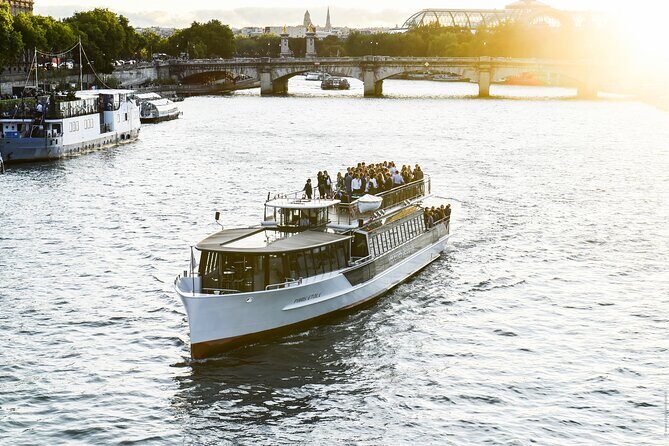
You’ll pass a long chain of iconic sites, and the guide’s narration is the glue that turns them from “pretty buildings” into a coherent story.
Here’s what you’ll see, and what to look for from the boat.
Eiffel Tower: the 1889 Exhibition gamble that paid off
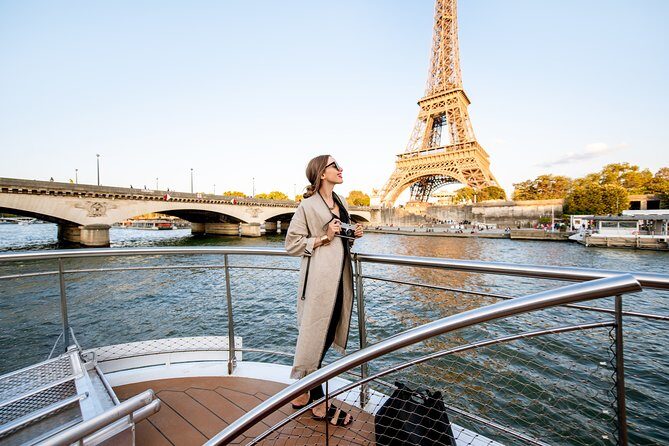
You start with the Eiffel Tower in the story mix. It was built by French engineer Gustave Eiffel for the 1889 Universal Exhibition, and it went up fast by world’s-fair standards: a bit over two years. At 324 metres tall and about 7,300 tonnes in metal, it was also controversial at the time—people in Paris were skeptical about its height and industrial look.
From the Seine, it’s more than a postcard. You’ll see how the tower dominates the skyline from a distance, and you’ll get a sense of how it frames river traffic and bridges. It’s a great moment to reset your bearings: this is the spine of the city’s “center of gravity.”
American Church in Paris: green clock-tower and Tiffany stained glass
Next up is the American Church in Paris, with its distinctive green clock-tower. It was the first American Church built outside the US, in 1931. The church is especially noted for its stained-glass windows by Louis Comfort Tiffany, which have historic protection.
From the river, this is one of those landmarks that feels more “specific” than the big global icons. It helps you notice that Paris has layers of international influence, even in a place that’s often treated as purely French and purely classic.
You can also read our reviews of more guided tours in Paris

Hôtel des Invalides: Napoleon’s tomb and Louis XIV’s military hospital
As you cruise, you’ll pass Hotel des Invalides—built on orders of Louis XIV as a military hospital for injured soldiers and officers. The royal chapel there is now the final resting place for Napoleon I.
The dome from the Seine gives you a clean, recognizable shape. If you’re doing other areas of Paris later, this stop helps explain why this part of town feels so formal and important—Invalides is not just a building, it’s a statement about how rulers wanted their stories preserved.
Alexandre III Bridge: gold leaf, nymphs, and Franco-Russian symbolism
The Alexandre III Bridge is a showstopper even from the water. It was built for the 1900 Universal Exhibition and designed to represent the Franco-Russian alliance. The center feature includes Paris’s coat of arms covered in gold leaf, plus nymphs symbolizing the river Seine.
Look for the corresponding symbolism on the opposite side: you’ll see the arms of Saint Petersburg and nymphs representing the Neva. This is a rare chance to “read” a bridge like a monument—sculpture as diplomacy.
Pont de la Concorde: Bastille stones and the Revolution’s edge
Pont de la Concorde ties together architecture and the French Revolution. The bridge was built with stones from the former Bastille prison, stormed in 1789.
From your seat, you’ll also get useful orientation: to the right is the Palais Bourbon, seat of the National Assembly; to the left is the Place de la Concorde. It’s one of those sights where the river route turns into a guided map of where power sits in Paris.
Musée d’Orsay area: the former railway station turned art museum
You’ll pass the former Orsay railway station, originally built for the 1900 Universal Exhibition with lines leading toward the southwest of France. In the 1980s, it was transformed into a museum for 19th-century art, including major names like Auguste Renoir, Claude Monet, and Vincent van Gogh.
From the Seine, this stop is your “wait, that’s the museum?” moment. It’s a reminder that Paris often reuses its grand industrial architecture. If you’re the kind of traveler who likes to connect today’s museums to older structures, this will feel satisfying.
Institut de France: the Académie Française and language shaping
Next comes the Institut de France, built using funds left by cardinal Mazarin in 1661. It was formerly the Collège des Quatre Nations and now houses five academies, including the famous Académie Française, whose role includes updating and modifying the official French dictionary.
On a boat, you won’t get deep interior time here—but you will get a meaningful “why this city cares about words” moment. It’s a quick way to tie Paris’s influence to language, not just art and monuments.
Pont Neuf: oldest bridge in stone, 381 unique grimacing masks
Then you’ll cruise by Pont Neuf—despite its name, it’s actually the oldest bridge in Paris. It was the first Parisian bridge built in stone with pavements rather than houses lining it.
The big visual detail to watch for: 381 stone masks, individually decorated and unique. From the river, these can look almost like a moving gallery of faces as you pass. It’s one of the best “look closely” moments on the route.
Pont Saint-Michel and the Latin Quarter connection
You’ll also see Pont Saint-Michel, built at the request of Napoleon III, which is why you’ll notice two imperial Ns on its pillars. On the right side, it leads toward the Latin Quarter, named because students at the University of Paris spoke Latin there until the 19th century.
This is a helpful stop if you plan to walk later. Knowing which bridge lines up with the Latin Quarter makes it easier to choose what to do on foot—especially if you want lively streets, student history, and classic Left Bank atmosphere.
Île de la Cité: presumed birthplace of Paris
Your cruise reaches Île de la Cité, described as the presumed birthplace of Paris. The Parisii tribe settled here around 300 years before the Common Era, calling the island Lutetia.
From the river, it feels like the historical heart. Even if you don’t step off and explore right then, this is where you start to connect the dots: the Seine isn’t just scenery—it’s where Paris grew.
Notre-Dame and the core cathedral corridor you’ll recognize
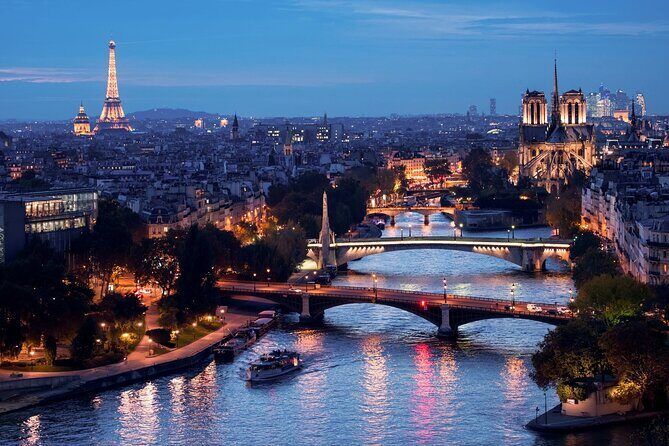
After Île de la Cité, you’ll pass Cathedral Notre-Dame de Paris. Construction started in 1163 and was completed nearly two centuries later, in 1345. The narration also points you to its gargoyles and sculptures, plus the Rose du Midi (south rose window), dedicated to the New Testament and described as a gift from Saint Louis.
A cruise doesn’t replace walking up to the cathedral. Still, it’s a strong way to see the building’s mass and placement. You’ll understand why this site is central, and why it keeps pulling people back again and again—because from the water, you get a clear “this is the anchor” view.
A quick pass-by: Tournelle Bridge and Saint Genevieve
You’ll also see the Tournelle Bridge area, along with a statue of Saint Genevieve, sculpted by Paul Landowski. Landowski is also connected here to the later Christ the Redeemer statue in Rio de Janeiro.
This is one of those moments where the river view reminds you Paris isn’t only about French royalty. It’s also about patron saints, civic identity, and the way beliefs get carved into stone.
Cultural and royal institutions: Louvre, City Hall, and Palais Bourbon area
Once you’re in the heart of the cruise corridor, you’ll pass landmarks that connect politics, culture, and city governance.
Louvre: royal palace turned museum
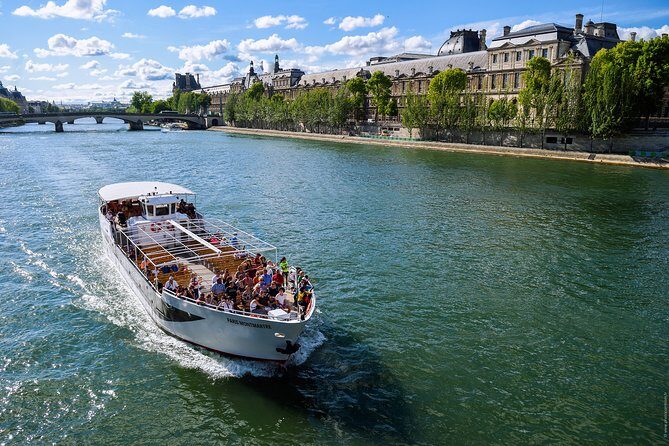
You’ll see the Louvre, which used to be a royal palace and became a museum in 1793. It’s described as the largest monument in Paris, with over four kilometres of façades and nearly 14 kilometres of galleries. It’s also noted as the most visited museum in the world, with about 38,000 works, including the Winged Victory of Samothrace, the Venus de Milo, and the Mona Lisa.
From the river, you don’t get gallery access, but you get something else that matters: scale. The Louvre’s size is easier to grasp when you’re moving alongside it.
Hôtel de Ville (Paris City Hall): Neo-Renaissance style and the Hall of Mirrors link
You’ll cruise past the Hôtel de Ville de Paris, the seat of the City Council since 1357. The construction draws inspiration from Neo-Renaissance style. The tour notes it’s open to visitors, and highlights the banquet hall designed with the template of the Hall of Mirrors in Versailles.
Again, you won’t tour it during this hour, but the river view helps you see why it belongs on a list of “must-not-miss” civic buildings.
Place de la Concorde: Luxor obelisk and the Revolution’s turning point
You’ll pass Place de la Concorde, tied directly to the French Revolution. It’s named as the execution site of King Louis XVI and Queen Marie-Antoinette. The central feature is an obelisk from Luxor, Egypt, brought to France in 1836.
This stop is also practical. It helps you understand why people treat this area like a crossroads. The river gives you a straight line of sight, and the obelisk gives you an anchor you can remember later.
Grand Palais and Palais de Chaillot: universal exhibition architecture still doing jobs today
As you glide along, you’ll see:
- Grand Palais, built for the 1900 Universal Exhibition, with a glass roof described as the largest in Europe. It now hosts cultural events and exhibitions and is even referenced as a funfair and Europe’s largest skating rink.
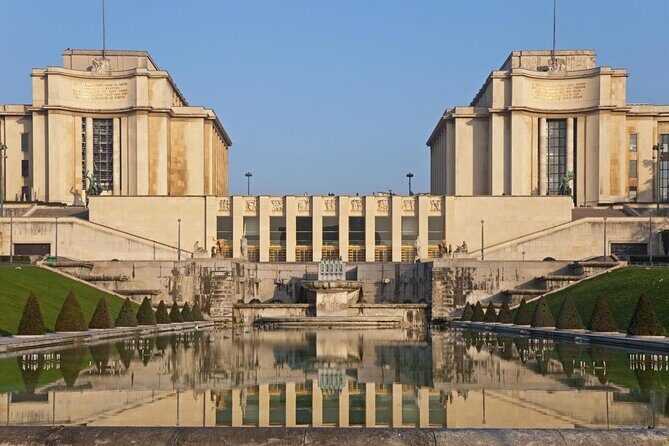
- Palais de Chaillot, built for the Universal Exhibition in 1937 and composed of two Neoclassical pavilions on Place du Trocadéro. It houses multiple institutions, including the National Navy Museum, the City of Architecture and Heritage, and the National Theatre of Chaillot.
From the Seine, these buildings are big, formal backdrops. You won’t walk inside on this cruise, but you’ll leave with a better sense of what “architectural Paris” means beyond churches and apartment façades.
Comfort, weather, and where you should stand or sit
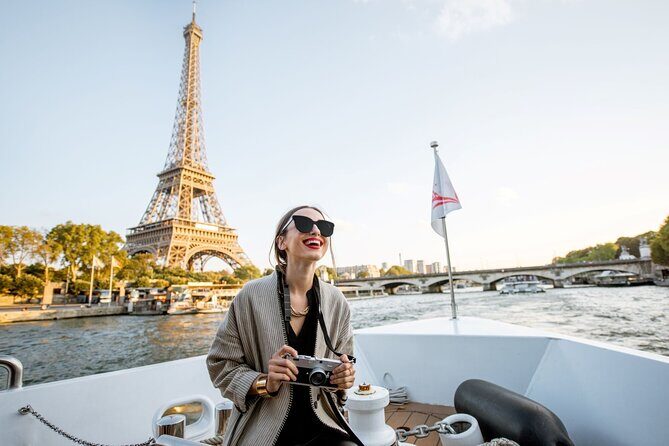
This kind of cruise is mostly about comfort decisions.
In cooler months, the top deck can get chilly and windy. Bring a hat and a windbreaker if you’re sailing in autumn or winter. One practical tip from real-world experience: if you want the crispest view and don’t mind the air, the upper deck is often the spot—but don’t forget warmth.
In hot weather, it can be the opposite problem. The inside can feel very hot until the boat moves enough for airflow. Dress in layers so you can adapt when you shift between inside comfort and outside views.
Also think about visibility. Panoramic windows help a lot when weather pushes you inside. But if you’re set on photos of landmarks like the Eiffel Tower, you’ll want to be in the part of the boat where you can see clearly without people blocking your line.
How the guide narration affects your experience
A good guide makes a 1-hour cruise feel longer and more meaningful. The operator uses live narration, and English is offered. The experience is described as bilingual in French and English at times, which is helpful if you speak just enough French to recognize words but still want the full story.
One consideration: clarity in English can vary depending on the day and the speaker. If English is your priority, try to get a seat where you can hear easily, and don’t plan to multitask with phone audio at the same time.
The upside is that the narration is tied to what you’re seeing right now. You aren’t trying to memorize dozens of monuments after the fact.
Champagne onboard: a treat, not a requirement
Champagne is available to purchase onboard. Alcoholic drinks aren’t included in the price, and serving is limited by age—only to those 18 and above, with non-alcoholic drinks for minors.
If you want a Paris-with-a-treat moment, this can be fun. If you’d rather save money, you can still enjoy the scenery just fine and spend that budget on a proper meal after.
Value check: is $25.23 for an hour a good deal?
At around $25.23 per person for about 1 hour, this is a value play if your goal is quick orientation and landmark context. You’re not paying for museum tickets. You’re paying for guided interpretation plus a comfortable, scenic transportation mode.
Where the value shines:
- You get a guided route of major river landmarks in one go.
- You can take photos without fighting big walking crowds across multiple sites.
- The electric boat and panoramic setup makes it feel pleasant and modern.
Where it may not be worth it:
- If you want to linger at each site, this won’t let you.
- If you dislike guided narration or need total silence, it might feel like the boat is doing more “talking” than you’d prefer.
Best fit: who should book this cruise
This fits best if you:
- want an easy way to learn central Paris early in your trip
- prefer sitting and looking to standing in line
- like history told in plain language while you’re moving
- have limited time and want the big highlights covered
It’s also a good family option, because narration can keep kids interested while you rest your feet.
If you’re coming for a deep dive into any one building, plan separate time for museums or walking tours. This cruise is about the river view and the skyline connections.
Should you book it
Yes—if you want a fast, guided way to see a lot of Paris without exhausting your legs. The strongest reason to book is the combination of live guide narration, panoramic viewing, and the fact that it hits iconic sights in a tight timeline.
My advice: choose a departure time that matches the weather you’re likely to face, dress accordingly, and arrive a bit early so you can pick a comfortable spot. If your day is packed, this cruise can act like your reset button—after it, you’ll know where to go next.
FAQ
How long is the Seine River Direct Access Guided Cruise?
The cruise lasts about 1 hour (approx.).
Where does the cruise start and end?
It starts at 2 Port de Suffren, 75007 Paris, France, and ends back at the same meeting point.
Is there a live guide?
Yes. The cruise includes a live guide.
Is the tour offered in English?
Yes. The tour is offered in English.
Is this cruise on an electric boat?
Yes. It’s a 100% electric boat.
Are alcoholic drinks included?
No. Champagne is available to purchase onboard, but alcoholic drinks are not included in the base offering.
Do I need to bring paper tickets?
No. You’ll use a mobile ticket.
What should I know about weather?
This experience requires good weather. If it’s canceled due to poor weather, you’ll be offered a different date or a full refund.
What if my tour gets canceled due to mechanical issues?
If there’s a major technical issue, the cruise may be canceled. In those cases, an automatic refund is issued, and the operator works to prevent it from happening again.
What if I miss my scheduled departure?
If you miss your scheduled departure, the operator offers the possibility to board the next available cruise, subject to availability.