REVIEW · PARIS
Early Access Paris Notre Dame Cathedral Walking Tour
Book on Viator →Operated by LetzGo City Tours · Bookable on Viator
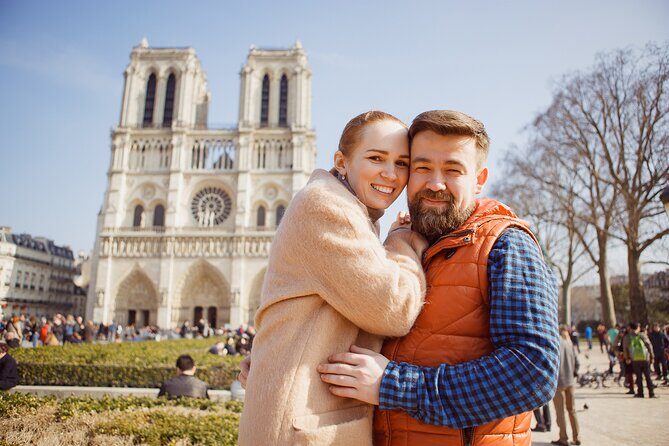
A cathedral tour can be either rushed or revelatory. This one is set up to be the second. You’ll get a smooth, guided walk through medieval Paris on the Île de la Cité, then step into the newly restored Notre-Dame to notice details most people miss.
Two things I like right away: first, the pairing of history with what you can actually see—from Roman-era hints near the square to Gothic structure at the water’s edge. Second, the Notre-Dame interior visit feels well-timed, so you’re not just lining up; you’re also looking for the right visual cues.
One possible drawback: this is early access to a wildly popular site, so wait times can still happen. On top of that, the walk includes cobblestones and some uneven ground, so plan for a bit of leg work.
In This Review
- Key takeaways before you go
- Early access at Notre-Dame: worth it, even when Paris is crowded
- The route: a 2-hour loop that hits the big ideas fast
- Square Jean XXIII: where the Roman past peeks through
- The Seine and Île de la Cité: UNESCO views with a story attached
- Notre-Dame interior (45 minutes): what to look for inside the restoration
- Parvis Notre-Dame and Place Jean-Paul II: the cathedral’s front door story
- Préfecture de Police and WWII scars on the façade
- Marché aux fleurs and Palais de Justice: commerce and authority on one island
- Sainte-Chapelle upgrade: when the Gothic glow is the main event
- Revolutionary prison echoes, the 650-year-old clock tower, and pétanque time
- Pont Neuf views: finishing with the classic river panorama
- Price and value: why $71.20 can feel fair here
- Should you book this Early Access Notre-Dame walking tour?
- FAQ
- What is the duration of the Early Access Paris Notre Dame Cathedral Walking Tour?
- How much does the tour cost?
- Is the tour offered in English?
- What’s included with the base tour?
- Is Sainte-Chapelle included or optional?
- Where do I meet the tour, and where does it end?
- Is Notre-Dame Cathedral entry included?
- Do I need to bring anything with me?
- What if the cathedral line is long?
- Is there free cancellation?
Key takeaways before you go
- Early access feel, not a guaranteed zero-wait day at Notre-Dame
- Notre-Dame interior time after a structured explanation outside
- Guides repeatedly praised for making details click (names that come up often include Maja, Nina, Abbie, Saeed, Maya, Carol, Ben, and Ife)
- Île de la Cité route that connects the cathedral to the Seine and the palace-prison-revolution stories
- Optional Sainte-Chapelle upgrade with time set aside for interior viewing
Early access at Notre-Dame: worth it, even when Paris is crowded
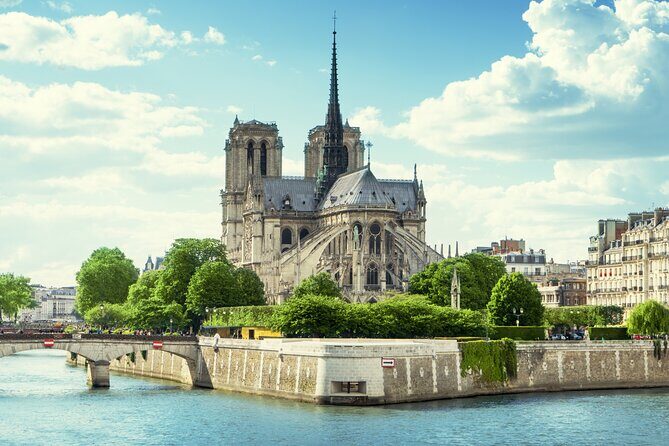
Early access to Notre-Dame is valuable for one simple reason: you’re visiting a place that draws everyone. When it’s reopened and in full spotlight mode, even a well-run schedule can’t always control the line outside. What the tour does well is give you a plan and context so the time you spend waiting (if it happens) doesn’t feel wasted.
The price—$71.20 per person—makes sense if you treat it like a guided “how to look” session plus a timed entry into the cathedral experience. You’re not paying for the building itself; you’re paying for the route, pacing, and commentary that helps you understand what you’re seeing.
Also, this tour stays small: up to 25 people. That matters at Notre-Dame. Big groups can turn into stampedes. Small groups make it easier to hear the guide and keep everyone moving without chaos.
You can also read our reviews of more walking tours in Paris



The route: a 2-hour loop that hits the big ideas fast
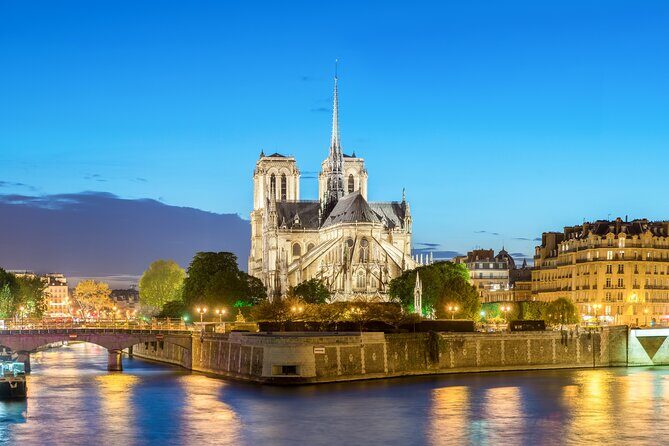
The walk runs about 2 hours, from Place Louis Aragon (75004) to Pont Neuf (75001), unless you upgrade for Sainte-Chapelle. The end point shift matters: the upgraded experience continues onward to Sainte-Chapelle, while the standard flow finishes by Pont Neuf with those classic river-and-views vibes.
You’ll want comfortable shoes. This is not a stroller-friendly shuffle. Expect cobblestones, short climbs/declines, and some steps. You’re also outside in the weather, so dress for rain and wind, but also for sun—water helps, because you’ll be waiting and walking.
A practical tip: your meeting point is not right next to Notre-Dame. If you arrive late, you risk missing the start. I recommend arriving early enough to find the group without rushing.
Square Jean XXIII: where the Roman past peeks through
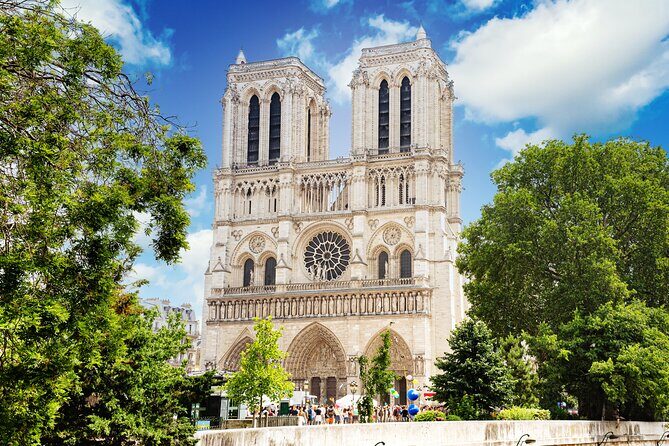
Your first stop is Square Jean XXIII, a small space that feels like “nothing” until the guide points out why it’s important. Excavations here uncovered a pillar tied to Roman propaganda—connected to les Nautes, a powerful corporation of traders. It’s one of those details that makes you realize Paris didn’t start with medieval churches.
This stop also sets the tone: you’ll look for shapes and structure before you even step fully into Notre-Dame territory. People often come for the cathedral and forget that the island is layered, century upon century. The guide’s photos of the flying buttress are a good example—your brain starts mapping what you’ll later see in real stone.
For anyone who likes architecture, this early framing helps. You’re not just learning facts; you’re learning how to read the place.
The Seine and Île de la Cité: UNESCO views with a story attached
From the square, you’ll walk along the Seine, one of the central Paris river scenes that’s part of UNESCO-listed river-banks in the core city area. This isn’t a scenic “stand here for a selfie” segment. It’s a connection moment: the Seine is the stage for why the Île de la Cité became so important.
Then you shift into the mindset of the island itself—Île de la Cité as the heart of medieval and royal Paris. The tour helps you see the island as a compact timeline: church power, royal power, civic power, and later revolutionary history all fit within walking distance.
If you like efficient sightseeing, this is exactly that. You get “big Paris” views without bouncing between far-apart neighborhoods.
Notre-Dame interior (45 minutes): what to look for inside the restoration
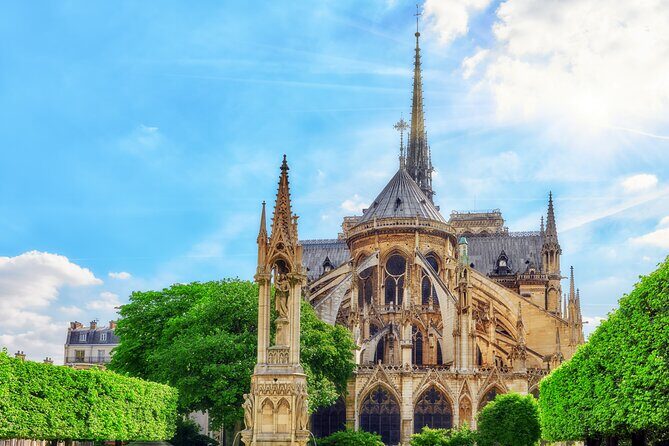
The highlight is the Notre-Dame visit. You’ll enter the cathedral to see the restored 12th and 13th-century Gothic structure, and you’ll have about 45 minutes inside.
Here’s what makes the restoration worth your time: the interior you’ll encounter is dramatically bright, because cream-colored limestone has been meticulously cleaned. That means centuries of grime have been removed, and you can suddenly see the vaults, thick columns, and tall walls with clarity that’s hard to imagine if you only remember old photos.
The restoration also has a human side. You’ll hear that thousands of workers and craftsmen contributed from across France, and you’ll spot results in the details—especially in sculpted scenes and liturgical elements like new furniture (including the altar area).
What I’d tell you to focus on during your time inside:
- Look up for the blue ceiling with gold-leaf stars in one painted side chapel.
- Find the oculus ring in the center of the transept crossing and notice the cherubs.
- Scan for delicately sculpted moments from the life of Christ in the chapel areas.
- Take in the central nave so you understand how the architecture pulls your eye upward.
One important logistics note: for this particular tour option, the guide’s role is primarily before/after your interior time, not necessarily inside with you. In other words, you should plan to explore your Notre-Dame time independently while the guide provides the “what matters” framing.
If you’re sensitive to rules once inside, be aware there can be quiet expectations in parts of the cathedral. Keep your voice low and your phone use respectful.






Parvis Notre-Dame and Place Jean-Paul II: the cathedral’s front door story
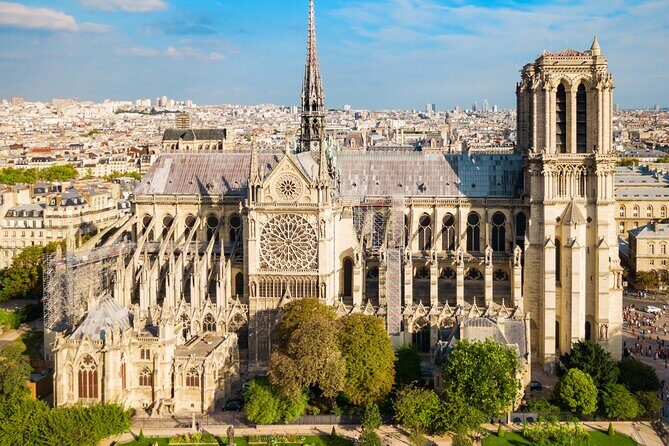
After the cathedral, you step onto the Parvis Notre-Dame (Place Jean-Paul II). This plaza is in the middle of redesign work meant to open things up toward the Seine and help visitors move more smoothly—because millions of people now want the same view.
This stop gives you a chance to shift from “inside wonder” to “outside Paris meaning.” The guide points out major local landmarks and connects the square’s older timeline, including Roman-era background.
You’ll also see the Statue of Charlemagne and His Guards. It’s a memorable visual anchor, and it’s a reminder that the cathedral’s story isn’t only about religion—it’s also about political identity and royal legitimacy.
Préfecture de Police and WWII scars on the façade
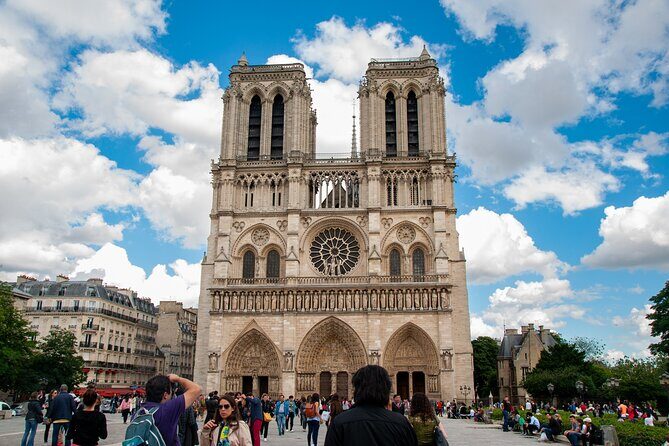
Next is a quick, interesting look at the Préfecture de Police building. You’ll learn how the police prefecture functions as part of the French government system—covering police and emergency services, plus administrative functions like IDs and driver licenses.
But the part most people actually remember is the physical history: the building shows bullet impact marks from the WWII liberation period of Paris. It’s one of those stops that changes your mood. You move from medieval stone into a modern reminder that Paris has been fought over too.
This brief segment works because it’s short. It doesn’t hijack the day; it adds a layer of realism.
Marché aux fleurs and Palais de Justice: commerce and authority on one island
The walking route passes through Marché aux fleurs on Île de la Cité, near Place Louis Lépine between Notre-Dame and Sainte-Chapelle. It’s a flower market that has attracted gardeners and passersby since 1830.
There’s one practical catch: the market isn’t always open. Still, the tour walks through the area so you get the context of the space even if you don’t catch the stalls running.
Then you head to the nearby Palais de Justice area (the law courts). Here the guide ties together centuries of government use—from Roman times through later dynasties. You’ll also have time for photos, so this stop is a good place to switch from listening mode to quick snapshot mode.
If you’re the kind of person who likes how a city organizes its power, you’ll probably enjoy this part. It makes the island feel like a seat of authority, not just a tourist postcard.
Sainte-Chapelle upgrade: when the Gothic glow is the main event
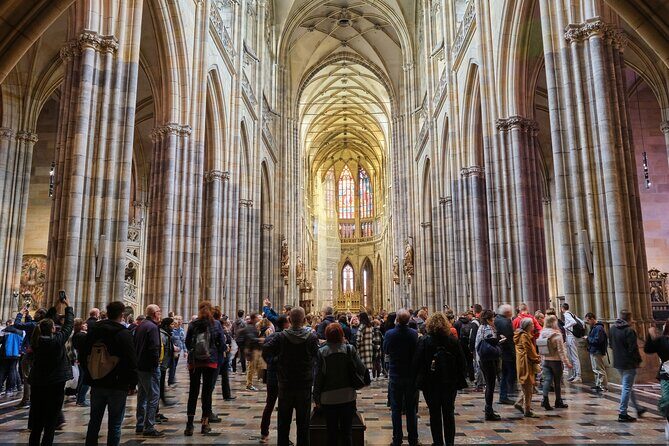
Sainte-Chapelle is optional on this tour, but it’s the kind of add-on that often turns a good day into a great one. The chapel is Gothic, built under royal direction by King Louis IX, with construction beginning after 1238 and consecration in 1248.
In the upgraded version, you’ll get a brief introduction and photo time focused on the exterior, and then you’ll have a separate 60-minute interior visit later with those who booked the option. The design matters here: Sainte-Chapelle is famous for light and height, so time inside is what you really pay for.
If you don’t upgrade, your tour ends at Pont Neuf instead. That’s not a loss—it just means you’ll miss the chapel interior segment and its specific Gothic intensity.
Based on what’s been emphasized by guide performance, the upgrade tends to land well when the guide helps you know where to look before you enter. When you walk in already knowing the key visual targets, the building rewards you faster.
Revolutionary prison echoes, the 650-year-old clock tower, and pétanque time
One of the most gripping segments is the stop near the old prison area where Marie Antoinette stayed for about nine months. This is also tied to the Revolutionary Tribunal and the Reign of Terror, including the fact that 2,639 people were sentenced to execution by guillotine in Paris.
That’s heavy material, but it’s handled as part of the island’s full story. It gives weight to what you’re seeing as more than decoration.
After that, you’ll see Tour de l’Horloge—a clock tower about 650 years old. You’ll learn that it originally functioned as a watchtower for the royal palace security, and that its rectangular shape and massive walls (nearly a meter thick) helped it last. At around 47 meters high, it’s hard to miss once you’re standing close.
The guide also explains restoration phases over the 1800s that consolidated the tower and brought the upper parts back toward medieval appearance. This stop is compact, but it gives you a sense of how these structures survive through repair cycles, not just original construction.
Then you hit an open square with a relaxed French pastime: people play pétanque. It’s also identified as the oldest square in Paris, associated with Henri IV, built for his first son. This is a nice mood shift—after prisons and tribunals, you get a slice of everyday local life.
Pont Neuf views: finishing with the classic river panorama
The end is at Pont Neuf, the oldest bridge in Paris. This is where the tour cashes out on scenery: views toward the Louvre, the Seine, the Eiffel Tower, the French Academy, and the Monnaie de Paris.
If your brain needs a last memory hook, this works. You’re literally standing where the city opens up, and the whole Île de la Cité area feels easier to picture.
It’s also a good stopping point for onward planning. Pont Neuf makes it easy to branch out into more neighborhoods, grab food nearby, or just keep walking without feeling like you’ll lose your bearings.
Price and value: why $71.20 can feel fair here
Let’s be honest: Notre-Dame entry is free and open to all. So why pay?
You’re paying for three things that add value fast:
- A guided route that connects the cathedral to the Seine and to the island’s civic and revolutionary layers.
- A structured Notre-Dame experience, so you’re not wandering inside hoping you notice the right details.
- Time efficiency, especially with the early access approach in a high-demand setting.
At $71.20, the tour works best if you want your day to feel planned rather than improvised. If you’re the type who can wander alone and catch details by yourself, you might decide to do free entry on your own. But if you’d rather save time and learn what to look for, the guided pacing is the point.
This also isn’t a long day. About two hours is enough to get orientation and key sights without turning your feet into a full-day casualty.
Who it suits best:
- First-time visitors who want Notre-Dame plus the Île de la Cité story in one pass
- People who like architecture, Christian art details, and how monuments connect to civic history
- Travelers who prefer small-group guiding (max 25) and clear timing
Who might want to skip it:
- Anyone who can’t handle cobblestones and uneven walking
- Visitors who want a fully guided interior walkthrough inside Notre-Dame specifically (this option is more about guided context before/after your interior time)
Should you book this Early Access Notre-Dame walking tour?
If your main goal is to see Notre-Dame and understand what you’re looking at, I’d book it. The tour’s strength is the blend: Gothic interior time plus a connected walk through the island’s power centers and dramatic historical chapters.
If you’re debating the Sainte-Chapelle upgrade, I’d lean toward upgrading when you can. Sainte-Chapelle’s interior is a different feeling than Notre-Dame’s scale, and the extra time set aside can make the day feel complete.
Just do two things before you go: wear good shoes, and arrive early enough to find your meeting point without panic. Then you’ll get a focused, high-payoff morning around Île de la Cité, with Notre-Dame as the centerpiece.
FAQ
What is the duration of the Early Access Paris Notre Dame Cathedral Walking Tour?
It runs for about 2 hours.
How much does the tour cost?
The price is $71.20 per person.
Is the tour offered in English?
Yes, it is offered in English.
What’s included with the base tour?
You get the guided walk, an interior visit to Notre-Dame, and commentary and viewpoints around Île de la Cité and the Seine. Sainte-Chapelle entry is available as an optional upgrade.
Is Sainte-Chapelle included or optional?
It’s optional. If you upgrade, you’ll have a 60-minute interior visit time for Sainte-Chapelle, and the tour ends there for those guests.
Where do I meet the tour, and where does it end?
You start at Place Louis Aragon (75004) and end at Pont Neuf (75001). If you upgrade for Sainte-Chapelle, your ending point is Sainte-Chapelle.
Is Notre-Dame Cathedral entry included?
Yes. The tour includes entry for the Notre-Dame interior time.
Do I need to bring anything with me?
Bring a photo ID, comfortable shoes, water, and a scarf or jumper to cover your shoulders (church dress code).
What if the cathedral line is long?
Notre-Dame is extremely popular after reopening, so wait times can increase. The tour notes that this is outside their control.
Is there free cancellation?
Yes. You can cancel for a full refund up to 24 hours in advance of the experience start time.