REVIEW · PARIS
One Hour Père Lachaise Cemetery: A Self-guided Audio Tour
Book on Viator →Operated by VoiceMap Audio Tours · Bookable on Viator
One-hour in Père Lachaise sounds short. Somehow, it’s just enough time to hit a real mix of famous names and follow the story line across the cemetery’s paths. This is a self-guided audio tour built for offline use, so you can keep going even when your phone signal gets moody.
What I like most is how GPS guidance keeps you from wandering in circles (this cemetery is famously maze-like). I also like that the narration connects people through themes like political intrigue, forbidden love, and sex, so the graves feel linked instead of randomly scattered.
One thing to keep in mind: this route covers only one third of the cemetery, so you won’t see every major grave you might hope for. If you’re a “must-see every famous name” person, you may want a second plan for the extra sections.
In This Review
- Key highlights worth your time
- Why a GPS Audio Tour Makes Père Lachaise Feel Less Like a Maze
- Your One-Hour Circuit: One Third of the Grounds, Two Kinds of Value
- Starting at 56 Rue des Rondeaux and Getting the App Ready
- Stop-by-Stop: What You’ll See and Why Each Section Feels Different
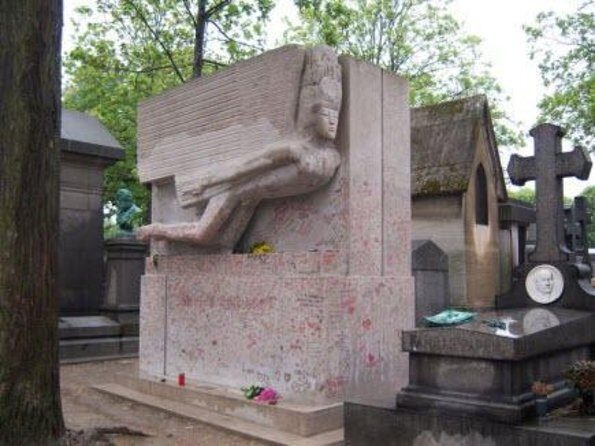
- Oscar Wilde to the Stein–Toklas connection
- Ettore Bugatti and Amadeo Modigliani: art meets invention
- Edith Piaf and Henri Salvador: performance energy
- Beaumarchais and Anna de Noailles: political and literary echoes
- The Carton family and Quintin Craufurd: not just celebrities
- Victor Noir and the dramatic center of gravity
- Sarah Bernhardt, Yves Montand, and Simone Signoret
- Isadora Duncan and Stéphane Grappelli: movement and sound
- The Dragon: the odd stop that makes the route memorable
- What to Watch For: What This Route Includes and What It Skips
- Price and Value: Is $11.99 Fair for a One-Hour GPS Walk?
- Pacing, Directions, and Real-World Comfort Tips
- Who This Self-guided Père Lachaise Tour Fits Best
- Should You Book It? My Decision Guide
- FAQ
- How much does the Père Lachaise audio tour cost?
- How long is the tour?
- What language is the audio in?
- Do I need an internet connection to use it?
- Where do I start the tour?
- Do I need to pay for museum tickets or entrances during the route?
- Do I need my smartphone?
Key highlights worth your time
- Offline audio, maps, and geodata via the VoiceMap app, so the tour doesn’t rely on signal
- GPS-based route guidance that helps you choose easier paths through the cemetery
- A tight one-hour circuit covering about one third of the 44-hectare grounds
- Big-name graves included, from Oscar Wilde to Edith Piaf and Isadora Duncan
- Story-driven narration with connections between historical figures and dramatic themes
- Easy pacing with multiple stops, so you don’t feel rushed between “hosts”
Why a GPS Audio Tour Makes Père Lachaise Feel Less Like a Maze
Père Lachaise can overwhelm you fast. The grounds are huge (44 hectares), and the paths don’t exactly scream a simple route. A guided audio format helps because it turns a “wander and hope” visit into a planned walk—without the pressure of a group tour timing you through.
This one is built with the VoiceMap app and uses GPS. That matters in practice. When you’re standing at a complicated fork in the paths, the phone becomes your compass. Several stops are far enough apart that a basic “look at the map” approach can feel slow and frustrating, especially if you’re trying to read signage while walking.
The other thing that helps is the offline setup. You get audio plus the mapping layer you need (maps and geodata) downloaded ahead of time. If you’re visiting on a day with weak reception—or your battery starts losing the fight—offline support keeps the experience on track.
You can also read our reviews of more guided tours in Paris



Your One-Hour Circuit: One Third of the Grounds, Two Kinds of Value
This tour aims to cover about one third of Père Lachaise in roughly one hour. That size-to-time ratio is the main value play here. You’re not trying to see everything, you’re trying to see enough of the cemetery to understand why people care about it.
There are two kinds of value you get from that one-hour scope:
First, you get focused storytelling tied to specific graves. The tour doesn’t just point you at landmarks; it names the people and uses narrative connections. That’s useful in a cemetery setting, where it’s easy to look at stone and feel like you learned nothing.
Second, you get a walk that’s structured enough to avoid aimless wandering. One review pointed out that the tour avoids an aimless drift, and that’s exactly the practical goal: let you enjoy the architecture and monuments without spending half your time figuring out where you are.
Starting at 56 Rue des Rondeaux and Getting the App Ready
You start at 56 Rue des Rondeaux, 75020 Paris, and the tour ends back at the same meeting point. That round-trip setup is helpful for two reasons. You don’t have to guess your exit route at the end, and you can plan the rest of your day around a predictable return.
You should also plan time for the tech setup. This isn’t a problem of complexity, it’s a problem of first-time friction. After purchase, you receive a redemption code and instructions to download the tour in the VoiceMap application. Several people reported that the download or starting steps were confusing at first—especially the jump between the main booking page and the VoiceMap app.
My practical advice: build in a buffer. Download and test the start button before you’re standing at the cemetery gates. If anything doesn’t work, you’ll have time to troubleshoot rather than scrambling with low battery and limited patience.
Stop-by-Stop: What You’ll See and Why Each Section Feels Different
The route includes a curated set of graves across Père Lachaise. The tour names the people you’ll hear about and covers the final resting places of luminaries such as Oscar Wilde, Gertrude Stein, Alice B Toklas, Ettore Bugatti, Amadeo Modigliani, Edith Piaf, Henri Salvador, Beaumarchais, Anna de Noailles, the Carton family, Quintin Craufurd, Victor Noir, Sarah Bernhardt, Yves Montand, Simone Signoret, Isadora Duncan, Stéphane Grappelli, plus a Dragon.
Here’s how that works as an experience: the stop list gives you variety in tone and visual style, while the narration ties the people together through themes. You’re not just reading names—you’re walking a thread.
Oscar Wilde to the Stein–Toklas connection
You’ll start by heading through one of the best-known clusters on the grounds, with Oscar Wilde among the early highlights. From there, the narration moves into the orbit of Gertrude Stein and Alice B Toklas. Even without needing deep background, the tour format helps you notice how the cemetery becomes a kind of social map—names that feel unrelated at first start to make sense once the stories connect.
You can also read our reviews of more tours and experiences in Paris





Ettore Bugatti and Amadeo Modigliani: art meets invention
Next up, the tour brings in Ettore Bugatti and Amadeo Modigliani. This is where the cemetery starts to feel less like a single “famous people” section and more like a cross-section of different worlds. You’re hearing about figures with different creative identities, and the audio helps you hold onto that variety instead of getting bored by repetition.
Edith Piaf and Henri Salvador: performance energy
Then the tone shifts toward performers and public-facing lives with Edith Piaf and Henri Salvador. When you’re in a cemetery, it’s easy to feel heavy the whole time. This part gives you a different kind of emotional rhythm—more motion in the stories, even if you’re still walking slowly on cobblestones and through still air.
Beaumarchais and Anna de Noailles: political and literary echoes
You’ll also cover Beaumarchais and Anna de Noailles. The tour description frames the storytelling around political intrigue and forbidden love, and these names fit that vibe. For me, this is where the audio approach helps most. Without it, you might treat each grave as a standalone monument. With it, you get a sense of the bigger web the narration is trying to build.
The Carton family and Quintin Craufurd: not just celebrities
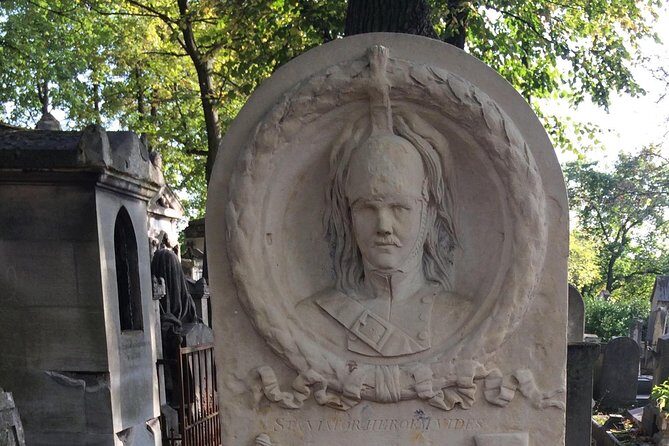
Midway through, the route includes the Carton family and Quintin Craufurd. This matters because it prevents the experience from turning into a straight “greatest hits only” routine. You still get famous names, but you also get reminders that Père Lachaise isn’t only for the most widely recognized figures.
Victor Noir and the dramatic center of gravity
You’ll reach Victor Noir, which is a name that carries a lot of weight for many visitors. The tour’s pacing keeps you from rushing past these turning points. You’ll stop long enough for the stories to land, which helps when the space around you can be visually loud.
Sarah Bernhardt, Yves Montand, and Simone Signoret
Then comes a performance-heavy trio: Sarah Bernhardt, Yves Montand, and Simone Signoret. If you like theatre and film, this part is likely to feel extra satisfying because the audio is already setting up a narrative thread across dramatic lives. It’s also where the “fun but still respectful” balance shows up most clearly.
Isadora Duncan and Stéphane Grappelli: movement and sound
Next: Isadora Duncan and Stéphane Grappelli. This section feels like it leans into movement and music. Even if you’re not starting from deep knowledge, the audio format gives you enough context to make the visit feel like more than just a photo stop.
The Dragon: the odd stop that makes the route memorable
Finally, the route includes a Dragon. I love when an itinerary includes one surprising element because it breaks the pattern of famous-name gravity. It also gives your brain a quick reset. In a cemetery, small moments of strange or unexpected detail can make your memory of the whole walk stick.
What to Watch For: What This Route Includes and What It Skips
This tour covers only one third of the cemetery. That’s the trade. You get a manageable route and a coherent story line, but you’re not going to see every iconic grave.
Some people specifically wished for graves like Jim Morrison and Chopin. Others felt an entire section connected to the Holocaust memorials was not included in their one-hour plan. If those names or themes are your top priority, treat this as a great taste of Père Lachaise—not the final answer.
A smart strategy: use this tour as your foundation. Then, if you’re motivated, add extra walking on your own before or after. Because the route ends back at the starting point, you’ll have an easier time plugging in a second plan without feeling trapped.
Price and Value: Is $11.99 Fair for a One-Hour GPS Walk?
At $11.99 per person for about one hour, the value depends on how you like to travel.
If you like structure, this is good value. You’re paying for a planned circuit across a complex place, plus offline audio and maps so you aren’t relying on a paper map or constant signal. That can save time, battery, and stress.
If you’re a “I want the best-known graves only, no questions” person, it might feel pricey for what you don’t see. But even then, it can still be worth it as an efficient way to learn the cemetery’s layout and get your bearings fast.
Think of it like this: you’re buying a route plus a narrative guide. For one hour, that’s exactly the kind of purchase that can make a famous place feel personal instead of distant.
Pacing, Directions, and Real-World Comfort Tips
The route is paced with multiple hosts (narration segments tied to stops), and most of the experience is designed for walking at an easy pace. Still, a few practical issues can pop up:
- Directions can sometimes feel quick, especially when you’re trying to locate a specific grave name in a busy section.
- Some route confusion can happen if you enter from a different side of the cemetery than the tour expects.
My suggestion is simple: arrive with time. Walk with your phone ready, keep an eye on the on-screen map, and don’t wait until you’re lost to try to understand the route.
Also, because this is self-guided, you control the pace. That’s the benefit. If you want extra time at a monument, you can spend it. If you’re less interested in one stop, you can move along and save your energy for the names you care about most.
Who This Self-guided Père Lachaise Tour Fits Best
This works especially well if you:
- Want to experience Père Lachaise without committing to a full-day plan
- Like history that’s told through story threads, not just dates
- Prefer offline GPS-style guidance over constant map checking
- Are the type who enjoys famous names but also wants a route that mixes in lesser-expected stops (family names and the Dragon)
It may be less ideal if you:
- Need to see specific missing graves on a tight schedule
- Want a full memorial-focused itinerary in a single hour
If you’re unsure, this tour is a solid starting point. Then build from there based on what you feel you missed.
Should You Book It? My Decision Guide
If your goal is a satisfying one-hour intro to Père Lachaise with an easy walking plan, I’d book this. The combo of offline materials, GPS support, and named stops makes it one of the more practical ways to do Père Lachaise without turning it into a scavenger hunt.
If your goal is a “complete list” cemetery experience, I’d think twice. This route is intentionally only part of the 44 hectares, and it won’t cover every high-demand grave or memorial section. But even then, you might book it as your groundwork and then add a second walk for the names that matter most to you.
In short: book it if you want a guided-feeling stroll. Skip it if you need a full, must-see checklist in one hour.
FAQ
How much does the Père Lachaise audio tour cost?
It costs $11.99 per person.
How long is the tour?
The tour takes about 1 hour.
What language is the audio in?
The tour is offered in English.
Do I need an internet connection to use it?
No. It includes offline access to audio, maps, and geodata in the VoiceMap app.
Where do I start the tour?
The meeting point is 56 Rue des Rondeaux, 75020 Paris, France.
Do I need to pay for museum tickets or entrances during the route?
No. Tickets or entrance fees to any museums or other attractions en route are not included.
Do I need my smartphone?
Yes. A smartphone is not included, but it’s required to run the VoiceMap application.