REVIEW · PARIS
Premium private tour of Paris in an Electric TukTuk (4 hours)
Book on Viator →Operated by TukTuk Ride Paris · Bookable on Viator
Paris gets easy in four hours. This electric tuktuk tour is a fast, fun way to see big Paris landmarks with real local storytelling, plus photo-friendly stops that make it feel effortless. I especially like the mix of major sights and classic neighborhoods, and I love that warm blankets (and rain protection) keep the ride comfortable. One drawback to plan for: many stops are short and most museum/monument entries are not included, so you’re mostly soaking in views rather than going deep inside.
For first day nerves, this kind of tour is a lifesaver. You’ll start and end in Saint-Germain des Prés, then zip through the city in a way that helps you understand where things are, how neighborhoods connect, and what to revisit later.
The other big plus is how many different guides show their Paris pride. Names like Rafael, Bruno, Romain, Felix, Oliver, and others come up for the same reason: they’re friendly, flexible, and willing to take photos at the best angles, including from the best spot for the Arc de Triomphe and the Eiffel Tower viewpoint from Trocadéro.
In This Review
- Key reasons this electric tuktuk tour earns near-perfect scores
- Price and group value: what $564.69 covers in real life
- Where you start in Paris: the Saint-Germain des Prés meeting point
- The 4-hour route works because it’s built for motion
- Place de la Concorde: the wide-open start that sets the scene
- Champs-Élysées by electric tuk-tuk: see the avenue without the stress
- Arc de Triomphe: quick photo positioning at the best spot
- Eiffel Tower without the crowds: the Trocadéro viewpoint stop
- Les Invalides (Le Dôme des Invalides): history in front of the Army Museum area
- Saint-Germain des Prés: the neighborhood stop that feels like Paris
- Quartier Latin: Luxembourg Gardens, the Pantheon, and Sorbonne area views
- Île de la Cité and Notre-Dame: a fast look at the heart of old Paris
- Louvre area: see the monument even if you don’t go in
- Montmartre and Sacré-Cœur: the panoramic payoff
- Palais Garnier: opera-house architecture in a quick stop
- Weather and comfort: blankets help, but covers can change sightlines
- What the guide actually adds (beyond facts)
- Timing expectations: you might end close to 4 hours
- Who this tour suits best (and who should choose something else)
- Should you book this Paris electric tuktuk tour?
- FAQ
- How many people are in the group?
- How long is the tour?
- Is it offered in English?
- Are museum or monument tickets included?
- What weather protection do you get?
- Where do we meet, and where does it end?
- Is this a private tour?
Key reasons this electric tuktuk tour earns near-perfect scores
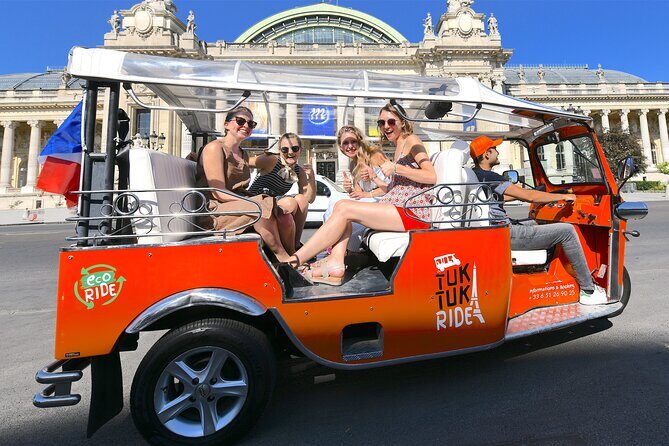
- Photo-stop pacing: quick windows at landmarks, built for pictures without marathon walking
- Small-group comfort: up to 6 people in one tuk-tuk, so it stays personal
- Weather protection that actually helps: blankets plus a transparent rain cover on cooler or rainy days
- A guide who adapts: if you have special interests or need a slower pace, your driver can often adjust
- Great first-day orientation: you get the layout of central Paris fast, then you can plan the rest of your trip
Price and group value: what $564.69 covers in real life
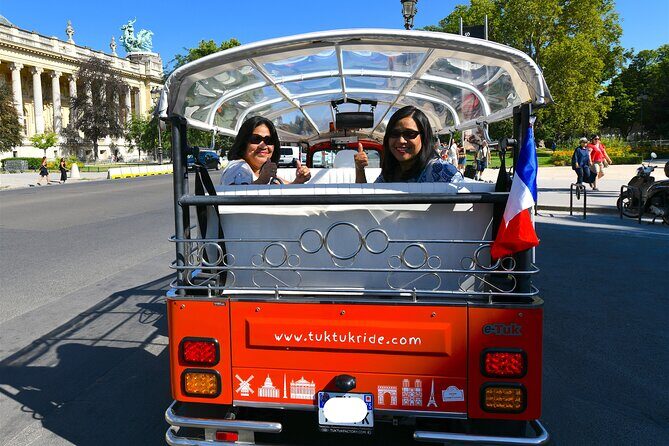
This tour is priced per group, up to 6 people, for about 4 hours. At $564.69, it’s not cheap in solo terms. But for a couple, a small family, or friends, it turns into one of the more practical ways to “buy time” in Paris—especially if your feet get tired easily or you want a low-effort sightseeing day.
Here’s the real value math: split the cost across 4–6 people and the per-person price becomes much more reasonable than buying separate tickets, taxis, and time-slots for a bunch of individual stops. You’re also paying for private transportation plus a guide who times the ride so you can hit a lot of the skyline in one morning or afternoon.
One thing to keep your expectations straight: this is a highlights tour. Most monument/museum entries are listed as not included, and many stops are around 10 minutes. You’ll see a lot, but you won’t leave with a full museum day.
You can also read our reviews of more private tours in Paris



Where you start in Paris: the Saint-Germain des Prés meeting point
You’ll meet at 3 Pl. Saint-Germain des Prés (75006). That location is a smart start if you want to experience Paris beyond just the postcard areas. Saint-Germain des Prés also makes the day feel “local” from the first minutes: cafés, bookish energy, and that classic Left Bank vibe.
The tour ends back at the same meeting point. That matters more than it sounds. Paris traffic can be chaotic, and coming back to your original hub makes it easier to catch a dinner reservation, hop onto public transportation, or roll right into your next neighborhood without backtracking.
The 4-hour route works because it’s built for motion
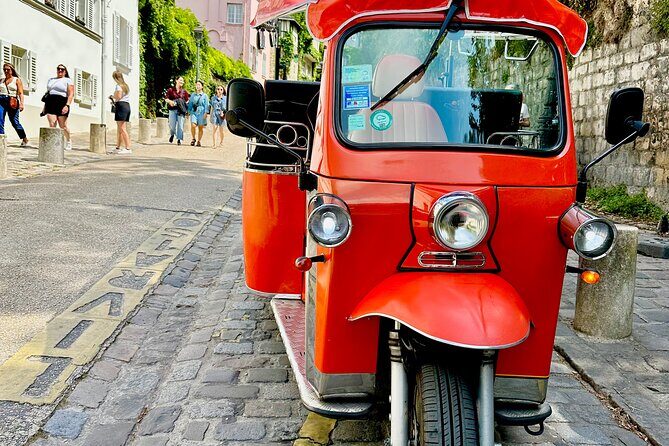
This tour is all about momentum. In a few hours, you’ll cover central Paris landmarks that normally require lots of walking, multiple transit legs, and guesswork about timing.
A helpful way to think about the day: you’re getting a sequence of “best view” moments. Your guide helps you position for photos, shares stories while you move between stops, and keeps the day flowing even when the city slows down.
You’ll likely feel like you’re touring from a moving vantage point: you see the monuments as they appear in the street-level rhythm of Paris, not just from one museum courtyard.
Place de la Concorde: the wide-open start that sets the scene
Your first stop is Place de la Concorde. This square is huge and photogenic, with a classic Paris skyline around it. You’ll get a quick photo break and a chance to orient yourself visually before the day tightens into the more famous “monument corridors.”
This stop is short (about 10 minutes), but it’s a good warm-up. It also primes your eyes for how the city lines up visually—useful if you want to do independent photos later.
Champs-Élysées by electric tuk-tuk: see the avenue without the stress
Next comes the Champs-Élysées area. This is one of those places where walking can feel long and crowded. In the tuk-tuk, you can glide along the avenue and enjoy the sweep without fighting for space.
This is also a moment where you’ll feel the tour’s core benefit: minimal walking with maximum “I’m in Paris” payoff. It’s quick, but it gets you onto one of the most iconic streets in the world.






Arc de Triomphe: quick photo positioning at the best spot
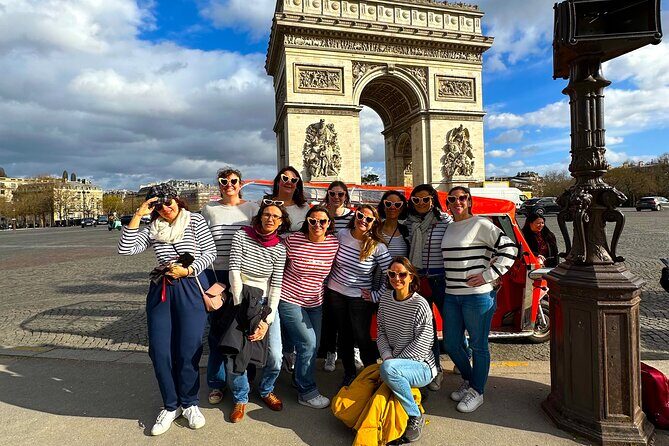
The tour heads to the Arc de Triomphe. Expect admiration, not museum time—the stop is about 10 minutes. Your driver will take your photo from the best spot, which is a big deal here because the Arc is all about angles and perspective.
Practical tip: if you care about photos (and you probably do), use the stop to choose one person in your group to handle camera settings and framing while the rest gets into place.
Eiffel Tower without the crowds: the Trocadéro viewpoint stop
Then it’s Place du Trocadéro for the Eiffel Tower view. The stop is longer (around 20 minutes), and that extra time helps. Trocadéro is one of the best viewpoints because you get the Eiffel Tower framed across the square with strong lines.
Your guide shares knowledge of the monuments and takes photos from different angles. This is one of those moments where the tour format makes sense: you’re not stuck circling for the perfect shot. You arrive, you position, you shoot, you move.
If the weather is moody, this is still a strong stop. Even in cloudy conditions, you’ll get that “I’m looking at the Eiffel Tower” hit.
Les Invalides (Le Dôme des Invalides): history in front of the Army Museum area
Next is Le Dôme des Invalides. The guide points out why the area matters historically and takes a photo in front of the monument. The stop is about 10 minutes.
This is the kind of stop that works well when you want context without committing to ticketed entry. You’ll learn enough to make the monument feel meaningful, then you can decide later whether you want to return for the Army Museum or Napoleon-related sights when you have more time.
Saint-Germain des Prés: the neighborhood stop that feels like Paris
Now the tour turns toward one of my favorite parts of central Paris: Saint-Germain des Prés. This is not just a “pass through.” It’s a chance to see how the city breathes at a human pace.
You’ll have about 30 minutes here, with time for the neighborhood atmosphere—art galleries, antique shops, and famous cafés. There’s also an oldest-church note built into the description of the area, which helps you understand why Saint-Germain is more than just a postcard stop.
This is also a good spot for quick browsing if you want to buy something small (like a book, postcard, or perfume souvenir) without squeezing it into the tight photo windows.
Quartier Latin: Luxembourg Gardens, the Pantheon, and Sorbonne area views
After Saint-Germain, the route moves into the Quartier Latin. You’ll ride through with stops that point out major anchors such as Luxembourg Gardens, the Pantheon, and the university district around Sorbonne University.
This is another roughly 30-minute segment. The key here is that you’re traveling through an area with layers: student energy, intellectual Paris, and old stone streets that always feel a little theatrical.
A practical benefit: after this part of the tour, you’ll have a much easier time mapping where the left bank “old Paris” feeling sits, so you can plan your own walking later.
Île de la Cité and Notre-Dame: a fast look at the heart of old Paris
Next is Notre-Dame Cathedral at Île de la Cité. The stop is about 10 minutes. You’ll see the cathedral and get photos in front, with your guide showing you around the island area.
Because it’s a quick stop, this is not the time for deep exploration. But it’s a strong orientation moment. You’ll understand the island’s geography, where the cathedral sits relative to the surrounding streets, and how the area fits into the broader city.
If your goal is photos and first impressions, this works. If your goal is a full cathedral visit, you’ll likely want a separate ticketed trip later.
Louvre area: see the monument even if you don’t go in
Then comes the Louvre Museum area. The stop is about 20 minutes, and the focus is mostly on seeing the museum from outside and taking a photo in front.
Not having museum entry included is important to understand. You’re not getting the inside highlights here. You’re getting the exterior grandeur and a sense of where it sits in central Paris.
If you’re trying to decide later whether you need a formal Louvre time-slot, this stop helps. You’ll remember the scale and feel of the building, and you can better judge how much you want to commit.
Montmartre and Sacré-Cœur: the panoramic payoff
Next up is Basilique du Sacré-Cœur de Montmartre, with about 20 minutes. The big reason this stop matters is the view from up on Montmartre hill.
This is your “okay, now we get the big view” moment. It’s also one of the best stops to bring your whole group into a shared photo stance, because everyone can take in the panorama together before you move on.
Palais Garnier: opera-house architecture in a quick stop
Finally, you’ll reach Palais Garnier, home to the Opéra Garnier. Expect an architecture-focused visit, plus time for photos in front.
The stop is about 10 minutes. It’s short, but it gives you a sense of Parisian theatrical grandeur without needing a full performance or tour ticket.
If you’re a design person, this is a satisfying stop because it’s all about facade details and street presence.
Weather and comfort: blankets help, but covers can change sightlines
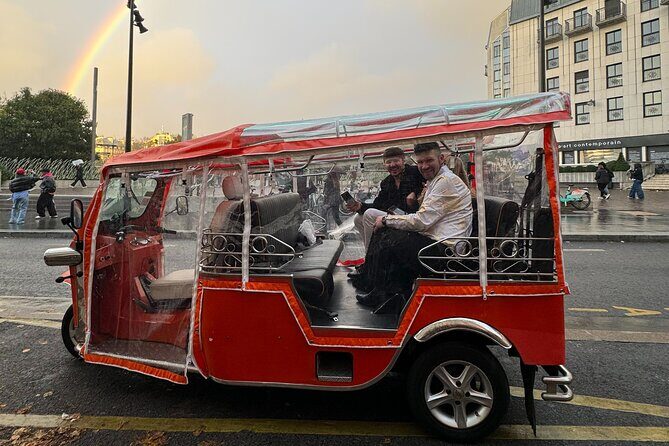
This tour includes blankets for cold weather and a transparent rain cover on the tuk-tuk for wet conditions. That’s a real advantage in Paris, where weather can change fast and waiting in line isn’t fun.
One caution from experience shared with the guides style: when the transparent cover is in place, your view of buildings can feel blocked at certain angles, especially if you’re looking for perfect photos. If you’re planning for weather, dress in layers anyway and bring your camera strap or phone mount so you’re not fumbling.
The good news: the tour is built to keep you moving and comfortable, rather than forcing you into long exposure.
What the guide actually adds (beyond facts)
The tour isn’t just driving from point to point. Your driver-guide is there for stories, context, and practical photo help.
You’ll often see guides named Rafael and Bruno praised for being flexible and going out of their way to make sure everyone is happy—taking photos, adjusting the pace, and sharing the kind of city details that make landmarks feel less like random stops.
Another pattern: Romain and Felix style guides are described as personable and responsive to questions. That matters because Paris is full of “how should I interpret this?” moments. A guide helps you understand why a street looks the way it does, what you’re seeing, and what to notice if you return later.
Also, on some days, guides may add small “life in Paris” touches if time allows, like a quick coffee or pastry stop. Don’t assume it’s guaranteed, but it’s part of how some guides personalize the day.
Timing expectations: you might end close to 4 hours
The tour is listed at about 4 hours. In a city like Paris, traffic can shift the rhythm, and most of the stops are timed for photo opportunities.
If your trip is packed, give yourself a little buffer afterward. If something runs a bit tight, it’s usually because the city decided to be the city.
If you want to avoid disappointment, go in with a clear “must-see” list and let your guide know right away what matters most to your group. The best tours are the ones where you’re decisive from the start.
Who this tour suits best (and who should choose something else)
This experience is ideal if you:
- Want to see a lot of Paris without long walks
- Are visiting for a first or short stay and need orientation fast
- Have older kids, teenagers, or anyone who benefits from a calmer pace
- Prefer private transport with a small group of up to 6
- Value photo positioning and quick context for major landmarks
It may be less ideal if you:
- Want deep museum time inside places like the Louvre or long cathedral visits
- Need long, uninterrupted downtime at one site
- Are sensitive to road noise while listening to stories
- Travel with accessibility needs that require more detail than what’s stated here (the tour says most travelers can participate, but specific mobility accommodations are not detailed)
Should you book this Paris electric tuktuk tour?
I’d book it if you want a smart first-day plan that trades walking for views and gives you a guided “map in motion.” The best part is the combination: major monuments, classic neighborhoods like Saint-Germain and the Quartier Latin, and a guide who helps you get good photos without turning your day into a logistics puzzle.
I’d think twice if you’re hoping for full museum tickets or long interior experiences. This tour is designed to show you where things are and what they look like in real space. For the Louvre, Notre-Dame, and any museum you care about most, plan to come back separately.
If your schedule is tight and your feet need a break, this is a strong use of time in Paris—especially on days when you want to stop, look, take a few photos, and keep moving.
FAQ
How many people are in the group?
This is a private tour/activity with a maximum of up to 6 passengers in one electric tuktuk.
How long is the tour?
The duration is about 4 hours.
Is it offered in English?
Yes, it is offered in English.
Are museum or monument tickets included?
Tickets for museums and monuments are not included. You may see some “free” stops listed, but do not count on entry fees being covered.
What weather protection do you get?
The tour includes blankets for cold weather and a transparent tarpaulin for rain protection.
Where do we meet, and where does it end?
You meet at 3 Pl. Saint-Germain des Prés, 75006 Paris and the tour ends back at the same meeting point.
Is this a private tour?
Yes. Only your group participates, and it includes private transportation.