REVIEW · PARIS
Paris Private Flexible Duration Guided Tour on a Vintage Sidecar
Book on Viator →Operated by RETRO TOUR · Bookable on Viator
A sidecar is the best kind of wrong.
This private, vintage ride is a retro way to see Paris that feels fast, personal, and a little cinematic. You pick a time window (about 1 to 7 hours), and your guide shapes the route—so you’re not stuck on a one-size loop. Vintage sidecar energy turns famous sights into something you actually experience, not just walk past.
What I love most is the route customization. Guides start by checking what you’ve already seen and what you want to skip, then they steer you toward the right streets and viewpoints. Second, I like the way your driver turns each stop into a story—everything from Roman Paris at the Arènes de Lutèce to the big symbolic drama of the Eiffel Tower and Arc de Triomphe.
One possible drawback: if you only want the biggest icons, you’ll get the best results by saying so early. Some rides naturally lean toward side streets and less-expected angles, and you don’t want surprises if you have limited time and want maximum monuments. A simple instruction like tell me the Eiffel plus Arc plus Montmartre, with minimal detours helps.
In This Review
- Key things I’d plan around
- Why a Vintage Sidecar Works Better Than a Bus in Paris
- Where You Meet and How the Ride Actually Works
- Building Your Own Paris Plan with Flexible Duration
- Stop Strategy: From Arènes de Lutèce to Saint-Germain-des-Prés
- Île de la Cité: The Best Place for Medieval Paris Storytelling
- Eiffel Tower, Trocadéro, and the Seine Piers: Getting the Angles Right
- Marais and Place Vendôme: Old Money Streets and Real Paris Style
- Montmartre by Sidecar: Place du Tertre and Sacré-Cœur at Real-World Speed
- Opera Garnier, Grands Boulevards, Champs-Élysées, and Arc de Triomphe
- Value Check: Is $119.72 Per Person Worth It?
- Tips That Make Your Sidecar Day Better
- Should You Book This Paris Vintage Sidecar Tour?
- FAQ
- How long is the vintage sidecar tour?
- Where does the tour start?
- Is this tour private?
- Who can ride in the sidecar?
- Is pickup available?
- What language is the tour offered in?
- What sights can the route include?
- Can I cancel and get a full refund?
- Is the tour good for kids?
Key things I’d plan around
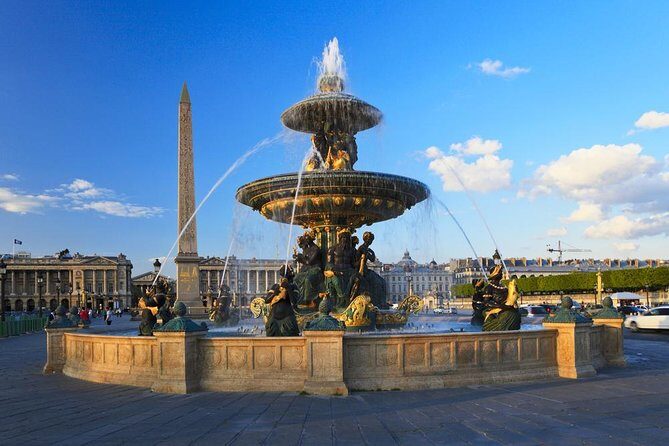
- Flexible duration (1–7 hours): Start short for highlights, go longer for neighborhoods and extra photo stops
- Private experience: Only your group rides; you’re not sharing your guide with strangers
- Two-people setup: One in the sidecar and one behind the pilot, with the option to switch halfway
- Guide-led storytelling: Expect local street-level context, not just dates and names
- Classic Paris, plus overlooked streets: You’ll hit major sights and also smaller lanes that guidebooks don’t emphasize
Why a Vintage Sidecar Works Better Than a Bus in Paris
Paris is best when you’re moving—yet walking only gets you so far, so fast. A vintage sidecar ride gives you the feeling of freedom without the stress of navigating traffic and turns. You also get a street-level view of neighborhoods that buses just skim past.
The real magic is the mix of retro form and practical speed. You’re close enough to monuments to notice details, but you’re also not stuck with long gaps between stops. On top of that, a good driver can time the scenery so you’re seeing the right angles without spending your day in gridlock.
If you’re the type who likes photos, you’re in good shape. People loved getting unusual viewpoints of landmarks like the Eiffel Tower, and they also liked that guides watched for the moments that make pictures look different from the usual postcard angle.
You can also read our reviews of more guided tours in Paris



Where You Meet and How the Ride Actually Works
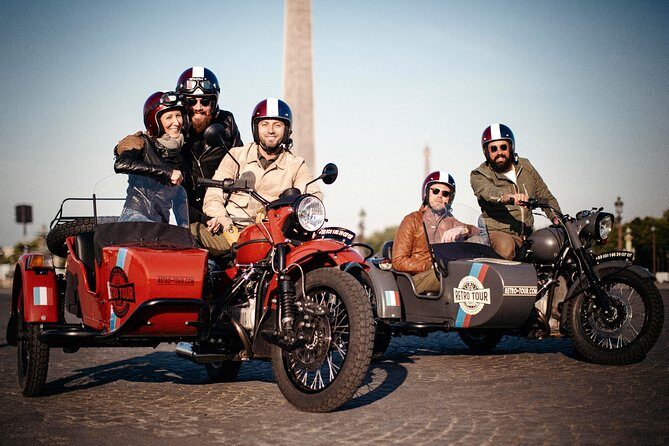
Meet-up is at Place Saint-Michel. If you don’t choose pickup, you’ll meet at 4 Pl. Saint-Michel, 75006 Paris. The tour ends back at the same meeting point.
On the vehicle, it’s typically two passengers: one rides in the sidecar and one sits behind the pilot. There’s also the possibility to switch halfway, which is a big deal if you’ve got two people and you both want the sidecar view.
For small groups, expect a private setup. If you’re a family or a group, you might ride in multiple sidecars—one review mentioned a family of four using two bikes, and a group of five used three. That’s useful because it keeps everyone in the action rather than “taking turns” for hours.
The tour is offered in English, and it’s near public transportation, which matters if you want an easy start and end without extra hassle.
Building Your Own Paris Plan with Flexible Duration

This is sold as a flexible private tour, and that flexibility is the point. A 1-hour ride can act like a fast orientation, while 3 hours is a sweet spot for pairing major sights with a few meaningful neighborhoods. If you go longer, you’ll have room for extra photo stops and for the driver’s street picks.
Your guide should ask what you’ve already seen. In one ride, Gio pulled out a map and asked what major sites were already covered and what you wanted to focus on or skip. That kind of start matters because it shapes whether the route feels like a greatest-hits tour or a more local storyline.
If you’re doing Paris for the first time, I’d use the flexibility to build a “first impression day.” If you’ve already done a lot on foot, use the flexibility to target the sights you missed and the neighborhoods you don’t want to re-walk.
Stop Strategy: From Arènes de Lutèce to Saint-Germain-des-Prés
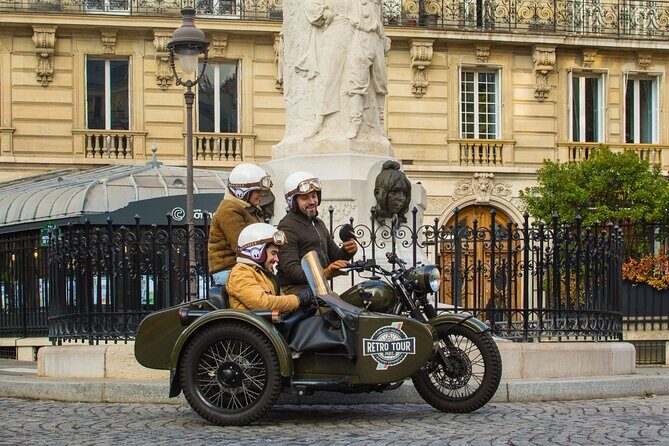
A lot of great Paris happens when you start away from the big postcard crowd. Early in the ride, you may pass through the Arènes de Lutèce area in the 5th arrondissement. This Roman amphitheater dates back to the 1st century AD and could seat around 15,000 people in its day. Today it’s a quieter pocket in the Latin Quarter, and you can still pick up the shape of the old arena.
Then you may connect to Saint-Germain-des-Prés in the 6th arrondissement, one of Paris’s oldest churches. Founded in the 6th century (originally a Benedictine monastery), it carries layers of Roman and Gothic elements, plus later influences. The cloister and nave are the kinds of details you’ll remember because they make the area feel “lived in,” not staged.
The benefit of doing these early: you set context for the city before you hit the big symbols. It also breaks up the day so you don’t bounce instantly from monument to monument.
Practical note: these stops are included as time-on-site options. If you want longer walking at a stop like Saint-Germain-des-Prés, tell your guide at the start so your route has breathing room.
Île de la Cité: The Best Place for Medieval Paris Storytelling
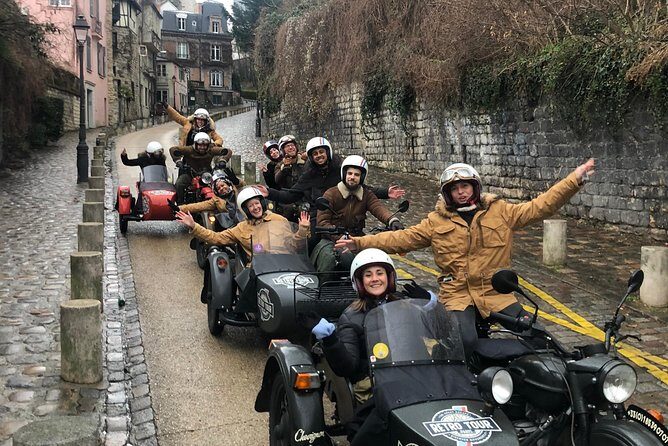
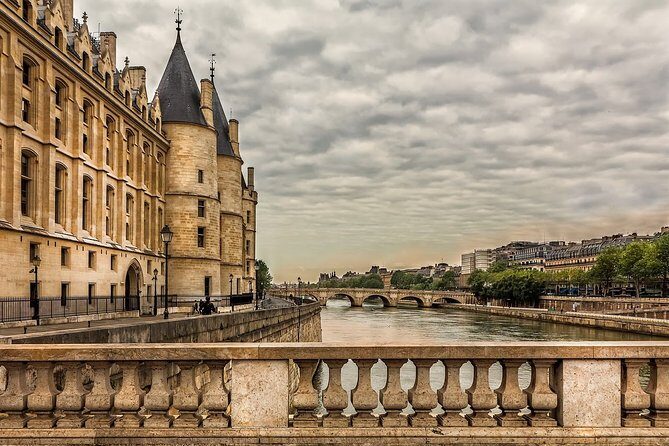
The ride often targets Île de la Cité, the historic heart of early Paris. This island in the Seine is where the city’s story starts in the era of the Parisii (around the 3rd century BC). It’s also where you’ll find major landmark gravity—think Notre-Dame area, Sainte-Chapelle, and the Conciergerie.
Even if you’re not going inside every building, you’ll feel the medieval layout. The quays, the alley-like streets, and the way the island compresses views all make the area unique. On a sidecar, it also helps because you’re not fighting for walking space in the tightest zones.
If you care about photos, this is one of your best chances for story-rich shots. The Seine gives you line-of-sight framing, and the island’s geometry makes your images look more intentional than random curb photos.
You can also read our reviews of more private tours in Paris






Eiffel Tower, Trocadéro, and the Seine Piers: Getting the Angles Right
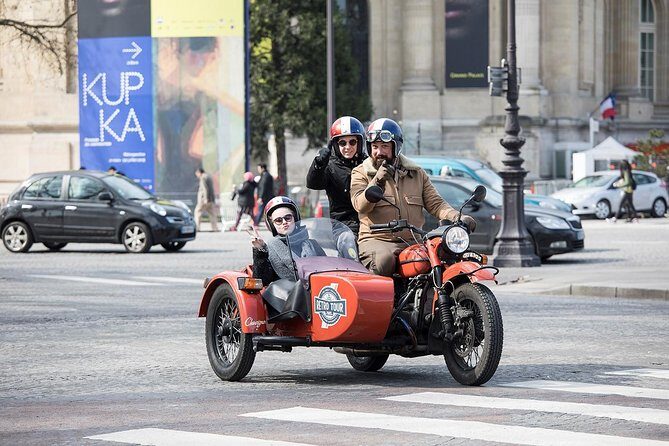
No Paris day stays complete without the Eiffel Tower. It’s a wrought-iron structure that rises to 330 meters, designed for the 1889 Universal Exhibition. From street level and through nearby viewpoints, it’s less like a distant landmark and more like a moving backdrop.
Next, you’ll likely head to Trocadéro, directly across from the Eiffel Tower. This area—gardens and the plaza in front of Palais de Chaillot—is famous for one reason: the Eiffel viewpoint looks clean and powerful. It’s also great for photos because you’re set up for a classic composition without standing in the densest tourist lanes.
Then there are the Seine piers, which act like a long living corridor for Paris life. Expect promenades, booksellers, cafés, and people on foot and on bikes. The big plus is the contrast: you see monumental Paris while also seeing daily rhythm.
One of the most memorable elements from the experiences people described was how guides tailored photo moments. A guide even made time for an Eiffel photo stop with the tower in the background, which tells you you should plan to ask for what you want early.
Marais and Place Vendôme: Old Money Streets and Real Paris Style
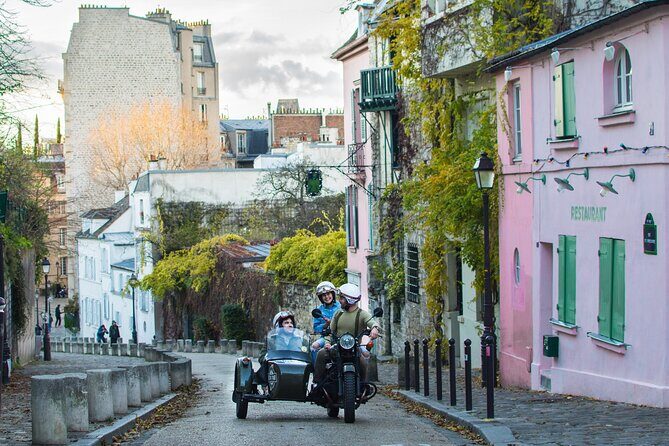
If your route stretches beyond the center highlights, the Marais often comes up. It used to be an aristocratic district and still shows off strong architecture—townhouses and museum spaces like Musée Carnavalet and Musée Picasso. What you’ll notice is the street feel: cobblestones, art galleries, and a mix of old and new that stays distinctly Paris.
From there, you may reach Place Vendôme, tied to luxury and elegance. It’s surrounded by grand mansions and prestige boutiques, with the Vendôme Column at the center. Built under Louis XIV, the column is tied to Napoleon’s commemorations, so the square has a “power story” behind its beauty.
Why this matters on a sidecar: you can cover the visual rhythm of these areas without turning your day into nonstop walking. You get a feel for texture—how the streets rise and narrow, where views open, and where the city’s mood changes.
If you love architecture and Paris styling, this is where the ride starts to feel like more than sightseeing. It becomes a guided sense of place.
Montmartre by Sidecar: Place du Tertre and Sacré-Cœur at Real-World Speed
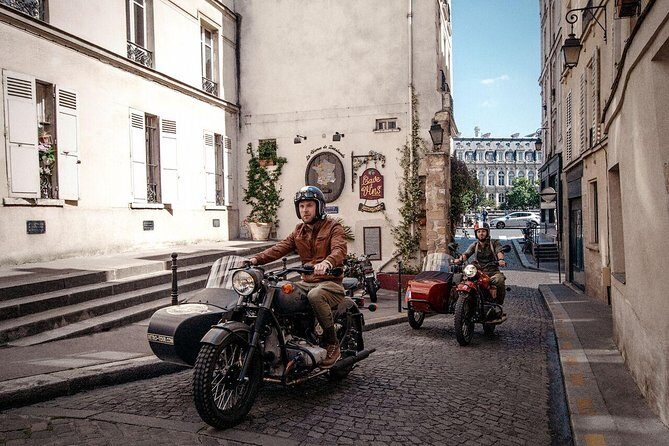
Montmartre is where Paris turns dramatic. A sidecar gets you there with less friction than walking uphill and weaving through the densest areas.
Your plan may include Place du Tertre, a longtime artist spot. In the 19th century it was known for painters and intellectuals, and today you’ll still see artists working—portraits, caricatures, and the general bohemian energy that keeps the area alive. It’s close to Sacré-Cœur, so it pairs naturally for a photo-and-panorama storyline.
Then you’ll hit Basilique du Sacré-Cœur de Montmartre perched on the hill. Its Romanesque-Byzantine style and the immaculate dome are easy to spot, and the forecourt offers panoramic views over the city. Inside, there’s a famous mosaic depicting Christ in glory.
A key advantage: you can do Montmartre without losing half your day to transfers and uphill stamina. You see it, then you decide how much time you want for steps versus photos.
In one family ride, Thierry and Jordan covered a wide sweep in about 3.5 hours, with the highlight being the narrow Montmartre streets ending at Sacré-Cœur. That’s the kind of outcome sidecars are good at: “get to the good part fast.”
Opera Garnier, Grands Boulevards, Champs-Élysées, and Arc de Triomphe
This is the Paris you recognize instantly, and a sidecar lets you take it in with motion.
The Opéra Garnier is one stop that makes people stop talking for a second. Designed by Charles Garnier and inaugurated in 1875, it’s known for sculpture-adorned façade details, the grand marble staircase, and an auditorium famous for its painted ceiling by Marc Chagall. Even if you don’t go inside, the building’s presence is the point.
Then your route may continue along the Grands Boulevards, the Haussmann-era backbone stretching from the Madeleine area toward République. This is lined with theaters and famous covered passages, and it’s a good segment for people who like city scale and street theatre.
Next: Champs-Élysées, the celebrated avenue from Place de la Concorde to the Arc de Triomphe. It’s luxury storefront territory mixed with iconic cafés and big-name theaters. Even if you don’t plan to shop, it gives you a direct view of how Paris celebrates showmanship.
Finally, there’s the big finale: Arc de Triomphe on Place de l’Étoile. Built under Napoleon Bonaparte to honor military victories, it includes sculpted battle scenes and the Flame of the Unknown Soldier beneath. The top view is one reason people chase this monument, and you’ll also feel how it anchors the city’s major axis lines.
One review highlighted the thrill of driving through traffic and even circling the Arc de Triomphe, which is exactly the kind of “you can’t replicate this by walking” moment this tour can deliver.
Value Check: Is $119.72 Per Person Worth It?
At $119.72 per person, you’re paying for three things: speed, guidance, and the thrill of doing it in a vintage sidecar.
Compared with a walking-only day, you’re buying time back. Compared with a bus tour, you’re buying access to street-level angles and a more personal route design. Compared with a private car, you’re paying a smaller amount for a more memorable experience.
The reviews that had the strongest results shared a common ingredient: the ride matched expectations. When someone was open to an insider route, they loved the lesser-known streets and behind-the-scenes areas. When someone wanted more classic monuments in limited time, they recommended being explicit upfront about your must-sees—so the guide doesn’t guess wrong.
If your goal is simply to see Paris icons with zero planning, this still works. But if your goal is maximum “Eiffel + Arc + Montmartre + Seine” in a tight window, you’ll get the best value by telling your guide exactly that at the start.
Tips That Make Your Sidecar Day Better
A few practical choices will help you enjoy the ride more and stress less.
Wear layers. Even in fair weather, you’ll feel wind. One person specifically mentioned enjoying the experience even on a cold day, which is a reminder to dress for the ride, not for standing still.
Bring a camera that can handle fast motion. Your guide will likely create photo opportunities at viewpoints like Trocadéro and the Eiffel area, but you don’t control street timing. Being ready helps.
Ask for your photo moment early. Guides can adjust, like making time for an Eiffel background shot when asked, so you don’t want to save requests for the last minute.
Finally, set priorities in plain language. Gio used a map to ask what you’d already seen and what to focus on, and guides like Michael, Emmanuel, and Antoine have been described as customizing routes based on what guests wanted. Your best outcome comes from giving clear inputs.
Should You Book This Paris Vintage Sidecar Tour?
Book it if you want Paris in a format that feels different from walking. You’re likely to enjoy it if you like street-level views, quick access to classic landmarks, and a driver who tells you what you’re actually looking at.
Skip it or book with extra clarity if your priority is a strict checklist of the biggest sights only. The flexibility is great, but it only becomes perfect when you tell your guide what you must see and what you’re willing to trade off.
If you’re celebrating, it can be memorable in a very specific way. One couple described an evening ride that ended with a glass of champagne at the foot of the Eiffel Tower, and that’s the kind of happy ending this style of tour can support when time and mood line up.
Bottom line: for a fun, guided, high-photo-potential day, this is an easy yes—just spend 30 seconds at the start making your priorities clear.
FAQ
How long is the vintage sidecar tour?
It runs for about 1 to 7 hours, depending on the option you choose.
Where does the tour start?
The meeting point is Place Saint-Michel, Paris, France. If you do not select pickup, meet at 4 Pl. Saint-Michel, 75006 Paris.
Is this tour private?
Yes. It’s a private tour/activity, so only your group participates.
Who can ride in the sidecar?
The vehicle setup is typically 2 passengers total: 1 in the sidecar and 1 behind the pilot. There’s also the possibility to switch halfway.
Is pickup available?
Pickup is offered, depending on your selection.
What language is the tour offered in?
The tour is offered in English.
What sights can the route include?
The experience can be tailored to include highlights such as the Eiffel Tower, Arc de Triomphe, Latin Quarter areas like Arènes de Lutèce and Saint-Germain-des-Prés, and Île de la Cité, plus other Paris stops along the way.
Can I cancel and get a full refund?
Yes. You can cancel up to 24 hours in advance for a full refund.
Is the tour good for kids?
Many families do this successfully, and one review mentioned a 9-year-old riding safely. It’s still important to follow the guide’s safety guidance during the ride.