REVIEW · PARIS
Private cruise with Paris water way
Book on Viator →Operated by Paris Water Way · Bookable on Viator
Seine sights, minus the crowd.
This private Paris waterway cruise is built for an easy, scenic overview of the city’s most famous river landmarks in about 1 hour 30 minutes. You’ll pass the Île Saint-Louis and the power center on Île de la Cité, then keep rolling along the quays toward world-class museums and bridges, with commentary in English.
What I like most is that you’re not just watching views you’re getting explanations that make the landmarks easier to place. A standout example from one group: a guide named Diego described what you were seeing in a way that worked well even for kids, with everyone staying relaxed. The one real consideration is that the experience depends on good weather—if conditions are poor, it may be rescheduled or refunded.
In This Review
- Key highlights you’ll care about
- How the 90-Minute Private Seine Cruise Feels From the Start
- Meeting on Quai François Mitterrand: A Convenient Paris Starting Point
- Île Saint-Louis: Why This Small Island Feels Like a Time Capsule
- Île de la Cité and the Palais de Justice: Paris Power Seen Side-On
- Pont Neuf: The Oldest Bridge and the Pedestrian Upgrade
- Pont des Arts and the Love-Padlock Era That Paris Ended
- Louvre Along the River: A Museum as a Landmark
- Musée d’Orsay: The Station Building That Turns Into Art
- National Assembly and Alexandre III: When Architecture Smiles Politically
- Eiffel Tower Views: The Closing Act of Your River Loop
- Price: Is $94.63 Worth It for This Route?
- Who Should Book This Private Seine Cruise
- The Call: Should You Book Paris Water Way?
- FAQ
- How long is the private cruise?
- Is the experience private?
- What language is the tour offered in?
- Where do we meet for the cruise?
- Do I receive a mobile ticket?
- What landmarks does the cruise pass?
- Do I need good weather?
- Is free cancellation available?
Key highlights you’ll care about
- Private by default: only your group participates, so the pace feels calmer.
- Iconic river sequence: Île Saint-Louis → Île de la Cité → Pont Neuf → Louvre/Orsay area → Eiffel Tower area.
- Old bridges with stories: Pont Neuf and the Pont des Arts padlock era get clear context.
- Museums from the river: Louvre and Orsay viewpoints help you understand where they sit in Paris.
- English commentary: offered in English, plus a format that suits families.
- Mobile ticket + easy meet-up: mobile ticket and a set meeting point on Quai François Mitterrand.
How the 90-Minute Private Seine Cruise Feels From the Start
You’re signing up for a short, high-impact ride. At roughly 1 hour 30 minutes, you’re not committing to half a day, and that matters in Paris where plans can multiply fast. The cruise runs as a private tour/activity, meaning it’s just your group onboard, not a mixed crowd being herded from one side of the boat to the other.
English is the key here. If English is your comfort zone, you’ll be able to follow the running commentary rather than guessing what’s important. And because it’s a mobile ticket, you can keep things simple on the day—less fuss, less paper, less hunting.
One more practical note: it’s listed as near public transportation, and service animals are allowed. Most travelers can participate, but you’ll still want to dress for river weather. Even a light breeze can make you feel cooler than you expect when you’re sitting still and taking photos.
You can also read our reviews of more boat tours in Paris

Meeting on Quai François Mitterrand: A Convenient Paris Starting Point
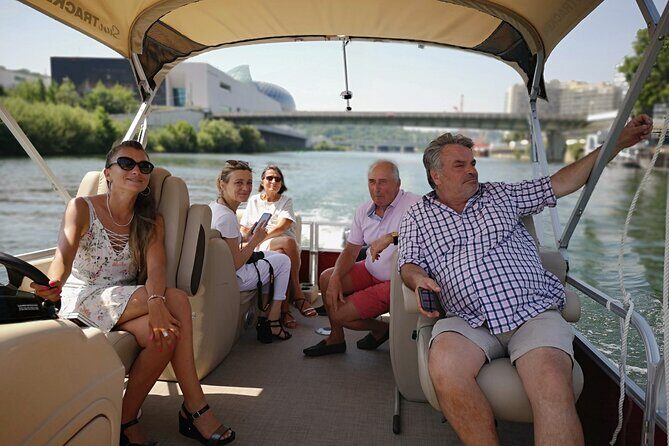
The tour starts at 14 Quai François Mitterrand, 75001 Paris, and it ends back there. That round-trip finish is underrated value: you don’t have to mentally map how to get back to where you started, and you can keep your day plan intact after you step off the boat.
Why this matters: Paris days often hinge on timing. With this meeting point, you’re positioned for an easy follow-on plan afterward—whether that’s walking toward the museums nearby, grabbing lunch, or continuing to other central sights. If you’re doing this as your first or second major activity of the trip, the route is also a good way to get your bearings fast along the Seine.
Île Saint-Louis: Why This Small Island Feels Like a Time Capsule
Your cruise passes Île Saint-Louis, the smaller of the two natural Seine islands in Paris, with an area of 11 hectares. Even from the water, you’ll get a sense of scale—this isn’t a huge, sprawling island. It’s more intimate, which is part of the charm.
The island’s story connects directly to the city’s longer timeline. It took its current name in 1725, linked to King Louis IX—nicknamed Saint Louis—whose legend includes prayers and a crusade connection. If you only half-listen, you might remember the name change and the Saint Louis tie-in. If you follow along, you’ll start spotting the way Paris layers religious, royal, and residential eras on top of each other.
There’s also the Lambert hotel detail: it’s described as one of the most beautiful private mansions on the island and was bought by Abdallah Ben Abdallah-Al-Thani, from the princely family of Qatar. A major fire in July 2013 is part of its modern history. From a cruise, you may not see the whole building up close, but you can appreciate why this island reads as both quiet and historically loaded.
What to watch for: the river bend angles and sightlines. Île Saint-Louis tends to look best when you allow the boat to reposition—you’ll get clearer views of the façades and how the island sits within the Seine’s flow.
Île de la Cité and the Palais de Justice: Paris Power Seen Side-On
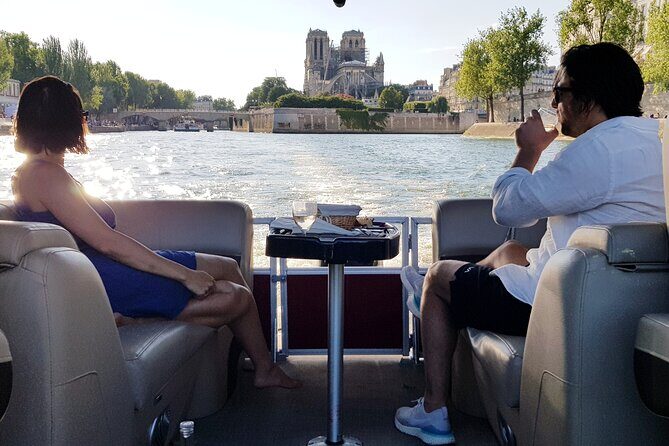
Next up is Île de la Cité, the island in the heart of Paris that’s often described as the ancient cradle of the city—formerly Lutèce. This is the historical center you hear about in almost every “first time in Paris” story, but seeing it from the water helps you understand what that phrase means: the city’s core was literally wrapped around this island.
The narration frames it as the city’s fortified limits at the end of Antiquity, then later the urban core of the medieval city. That turns into a practical takeaway for you. When you picture later Paris, it helps to know that this is where power first concentrated.
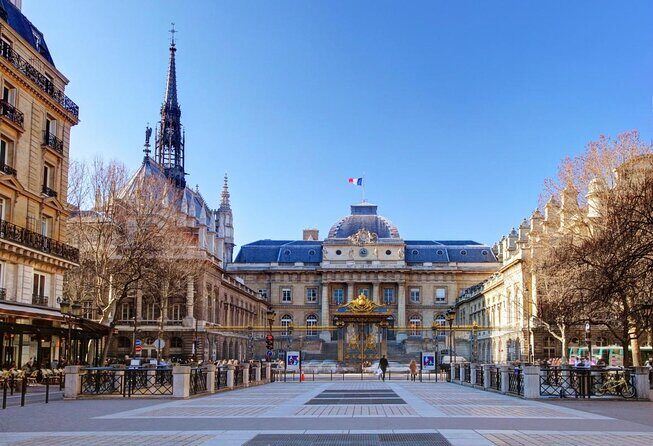
Then the cruise passes the Palais de Justice, described as the former Curia Regis—the seat behind Parliament of Paris and a range of sovereign jurisdictions. It’s a lot of institutional names, but the key idea is simple: this is where governance and legal authority gathered. The tour also references how the complex has been located since its inception in the royal residence area on Île de la Cité, dating from the 10th to the 14th centuries, with key remnants like the Conciergerie and the Sainte-Chapelle.
How this plays for you: even without stepping inside, you get a more grounded sense of where France’s big decisions happened. Many Paris landmarks are beautiful; this one is both beautiful and functional—power wrapped in stone.
Possible drawback: if you expect a stop where you’ll get to explore interiors, this cruise is more about the view and context. You’ll learn, but you won’t roam.
Pont Neuf: The Oldest Bridge and the Pedestrian Upgrade
Passing under Pont Neuf is one of the easiest ways to feel how long Paris has been building in the same space. It’s described as the oldest existing bridge in Paris, crossing the Seine at the western tip of Île de la Cité.
A detail I love here is the naming logic. Despite the name meaning new, Pont Neuf was old as soon as it was completed. It was called new because it was built at a time when it was notably free of houses and included sidewalks designed to protect pedestrians from mud and horses.
From the cruise, you’ll likely catch the bridge from below and in motion, so you won’t get the same full architectural “read” as if you were standing on it. But you will feel the bridge’s role as a connector—this is the kind of infrastructure that shaped how people moved across Paris for centuries.
It’s also listed as a historical monument and part of the UNESCO World Heritage recognition for the Seine quays. That matters because it explains why the bridge keeps showing up in major Paris heritage photos.
You can also read our reviews of more private tours in Paris


Pont des Arts and the Love-Padlock Era That Paris Ended
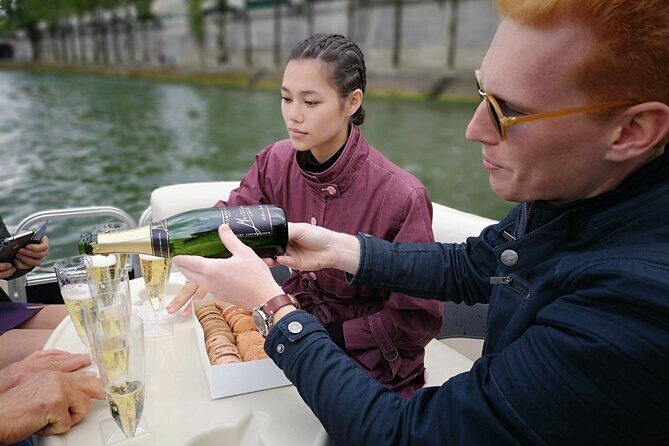
Next comes Pont des Arts, famous in recent decades for the love padlocks. The cruise info points out that from 2008, couples began hanging locks from the wire mesh parapets, and the trend spread to other nearby bridges too.
Then Paris got practical—and political—about it. The controversy wasn’t just about aesthetics; it included concerns about degradation of heritage and the added weight. Paris’s mayor decided to end the practice in September 2014, with the fences removed on June 1, 2015. After that, there were temporary panels and then glass panels installed starting in autumn 2015.
What I like about including this part in a river cruise is that it gives you a clear modern story: Paris doesn’t only preserve the past; it also manages how modern habits interact with heritage.
Tip for your photos: look for the parapet lines and the angle from the boat. Even if you’re not photographing locks, the bridge’s current appearance and the river’s reflections create strong images.
Louvre Along the River: A Museum as a Landmark
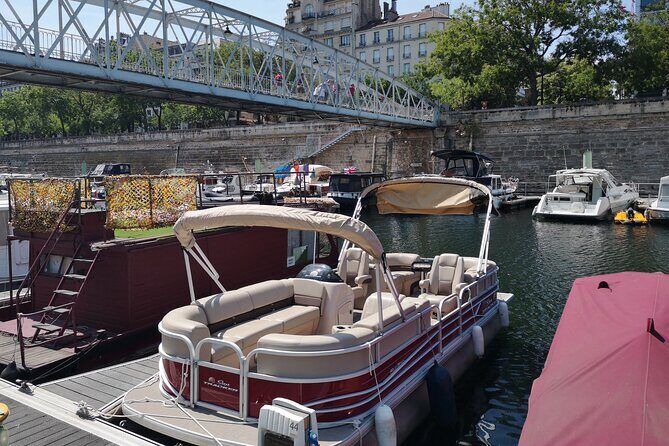
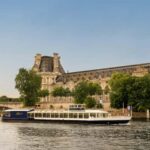
When the cruise passes in front of the Louvre, you’re seeing one of the world’s most famous museum addresses from the water. It’s located in the 1st arrondissement, and it’s also described as having a long path to become the museum we know today.
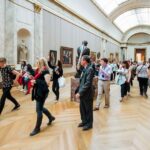
The info traces a foreshadowing back to 1775–1776 and notes that the museum was inaugurated in 1793 under the name Muséum central des arts de la République, inside the Louvre Palace (a former royal residence). It’s framed as the largest museum in art and antiques to the world, with an exhibition area listed at 72,735 m² and collections totaling more than 500,000 works, with a little over 36,000 on display.
You don’t need to memorize the numbers to get value from this pass-by. The real win is orientation: when you know where the Louvre sits along the Seine, later museum decisions become easier. You can line up “where I’ll walk later” because you’ve already seen its river face.
What to keep in mind: if you want to actually spend hours inside, this cruise won’t replace that. But for first-timers, it helps you understand why the Louvre belongs in almost every Paris itinerary.
Musée d’Orsay: The Station Building That Turns Into Art
Then the cruise passes Musée d’Orsay on the left bank. It’s housed in the former Orsay station, originally built by Victor Laloux from 1898 to 1900 and later converted into a museum by the decision of President Valéry Giscard d’Estaing. That conversion detail matters, because it explains the building’s vibe: it feels engineered for drama.
The museum covers Western art from 1848 to 1914 across painting, sculpture, decorative arts, graphic art, and photography. The provided info highlights that it has the largest collection of Impressionist and Post-Impressionist paintings in the world, with nearly 1,100 canvases out of more than 3,650 total.
Again, you’re not walking in during this cruise, but you’re getting a strong “why this building matters” moment from outside. From the Seine, you can understand how Orsay sits above the waterline and how it frames the river promenade view.
Photo tip: Orsay is often best when the light hits the station façade at a slight angle. If the sun cooperates, you’ll get cleaner reflections and a sharper museum outline than you would later in the day.
National Assembly and Alexandre III: When Architecture Smiles Politically
Passing the National Assembly gives your cruise a different tone. The narration connects it to a two-century story of democratic representation and the shifting names and powers of representatives over time. You may not catch every historical term from the moving boat, but you’ll get the big point: France’s institutions evolve, and this building reflects that.
Then comes Alexandre III Bridge. This one is pure “Paris brochure energy,” but with real history behind it. It was inaugurated for the 1900 Universal Exhibition, intended to symbolize Franco-Russian friendship. The info ties this to an alliance signed in 1891 between Emperor Alexander III and President Sadi Carnot.
The build story is detailed: the first stone was laid on October 7, 1896 by Tsar Nicolas II, Empress Alexandra Fedorovna, and President Félix Faure. Construction work involved engineers Jean Résal and Amédée Alby, and architects Cassien-Bernard and Gaston Cousin. From the boat, you don’t need to memorize names to feel the scale and ceremonial design.
Why it matters for you: the bridge is part of a larger axis connecting the Esplanade des Invalides to the Petit and Grand Palais. So when you see it, you’re also seeing how Paris planned “grand sightlines,” not just random beauty.
Eiffel Tower Views: The Closing Act of Your River Loop
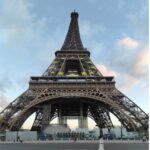
The cruise also passes in front of the Eiffel Tower, described here as a 324-meter iron tower built by Gustave Eiffel and collaborators in two years for the Universal Exhibition of Paris of 1889, celebrating the centenary of the French Revolution. It was initially named the tower of 300 meters and later became a symbol of Paris.
The provided details include visitor scale too: it says it welcomed more than 300 million visitors since opening and was the third most visited French cultural site in 2015 with 5.9 million visitors in 2016.
You’ll likely see the tower from a distance and at an angle, not as a “standing next to it” moment. Still, there’s value here. River views often give you a clearer sense of size because you can compare it to the span of bridges and the width of the Seine. It’s a good way to end a cruise loop with a landmark that even non-museum-goers instantly recognize.
Photo strategy: keep your camera ready the moment the boat line-up looks right. With a moving boat, waiting too long can mean missing the cleanest angle.
Price: Is $94.63 Worth It for This Route?
At $94.63 per person, this isn’t a budget throwaway. It makes more sense when you value two things that private cruises typically deliver: comfort and clarity.
A private format means you’re paying for a calmer experience—only your group aboard—plus a guided explanation in English over about 90 minutes. You’re also getting a concentrated route: Île Saint-Louis, Île de la Cité and its legal-power complex, Pont Neuf, Pont des Arts, and major museum areas including Louvre and Orsay, ending with the Eiffel Tower area.
So when does the price feel fair?
- If you’re traveling as a group and you want a quieter, more guided way to see multiple top sights without bouncing between neighborhoods.
- If you’re the type who likes learning what you’re looking at, not just photographing it.
- If you want a family-friendly plan that feels manageable in time, especially since at least one group noted how guide Diego kept things interesting for kids while staying relaxed for everyone.
When might it not be ideal?
- If you’re trying to fill every minute with walking and you prefer deep museum time, this cruise is more of a highlight overview than a full experience by itself.
Who Should Book This Private Seine Cruise
This cruise is a strong match for:
- Families who want a guided, seated activity that covers multiple sights without the usual chaos.
- First-timers who want to connect the dots between islands, bridges, government buildings, and museum districts.
- Couples who like scenic city views and don’t want to squeeze into a crowded tour format.
- Anyone who likes having a guide explain why places matter, especially around the Seine’s “layers” of royal, legal, and modern stories.
If you’re traveling with mobility constraints, you’ll want to think practically: this is a boat experience, so conditions on deck and river movement matter. The information you have says most travelers can participate and service animals are allowed, but you should still consider the day-of comfort factors.
The Call: Should You Book Paris Water Way?
I’d book this if you want a private, English-guided Seine overview that hits the classics—Île Saint-Louis, Île de la Cité, Pont Neuf, Louvre/Orsay area, and the Eiffel Tower zone—without turning your day into a sprint.
Don’t book it as your only Paris plan if you’re hungry for inside-the-museum time. Do book it as a high-value connector activity: it helps you understand where everything sits and why the river is the spine of the city.
And if the weather forecast is looking solid, that’s your green light. When the Seine cooperates, this kind of cruise becomes one of those Paris memories that feels both easy and meaning-packed.
FAQ
How long is the private cruise?
The duration is listed as approximately 1 hour 30 minutes.
Is the experience private?
Yes. It’s a private tour/activity, so only your group participates.
What language is the tour offered in?
The experience is offered in English.
Where do we meet for the cruise?
The meeting point is 14 Quai François Mitterrand, 75001 Paris, France, and the activity ends back at the meeting point.
Do I receive a mobile ticket?
Yes, the tour includes a mobile ticket.
What landmarks does the cruise pass?
The cruise includes passages in front of Île Saint-Louis and Île de la Cité, Pont Neuf, Pont des Arts, the Louvre, the Musée d’Orsay, the National Assembly area, the Alexandre III bridge, and the Eiffel Tower.
Do I need good weather?
Yes. The experience requires good weather, and if it’s canceled due to poor weather, you’ll be offered a different date or a full refund.
Is free cancellation available?
Yes. You can cancel up to 24 hours in advance for a full refund.