REVIEW · PARIS
Walking Tour in Montmartre with a guide
Book on Viator →Operated by Touristica · Bookable on Viator
Montmartre plays its own Paris soundtrack. This guided evening stroll threads together famous landmarks and smaller stops, so you get the big feelings without staring at your phone. I particularly love the Le mur des je t’aime stop and the classic Sacré-Cœur photo time, all wrapped into a tight 1 hour 45 route.
One thing to consider: it moves at a walking-tour pace. If you want to linger extra long at squares like Place du Tertre, you’ll have to save that for after the tour ends.
In This Review
- Key things to know before you go
- Why Montmartre at 6 pm is a smart move
- Meeting at Abbesses and getting your bearings fast
- Le mur des je t’aime: the quick stop that sets the tone
- St Jean Montmartre: red brick, art glass, and church-time calm
- Le Bateau-Lavoir: Picasso-era energy without a museum day
- The Montmartre Water Tower: a 40-meter clue to how the hill works
- Place du Tertre: cobblestones, buskers, and portrait artists
- Place Dalida and the tribute-to-a-star pause
- The vineyard moment: Paris’s last surviving vines
- Saint-Denis landmark and Saint-Pierre de Montmartre: old stones, older stories
- Sacré-Cœur: domes, mosaics, stained glass, and a crypt
- Au Lapin Agile: classic French songs in a 19th-century stone house
- Guide quality matters, and Kateryna gets praised for it
- Price and value: is $35 worth 1 hour 45 in Montmartre?
- Who this walk is perfect for
- Should you book this Montmartre walking tour?
- FAQ
- How long is the Montmartre walking tour?
- How much does the tour cost?
- What time does the tour start?
- Where do I meet the guide?
- Where does the tour end?
- What is included in the price?
- What is not included?
- Are tickets required for the stops?
- How big is the group?
- Can I cancel for a full refund?
- Is the tour near public transportation, and can I bring a service animal?
Key things to know before you go
- Wall of Love in 250 languages: a quick, free stop that sets the mood for the whole hill.
- St Jean Montmartre details: red-brick church finished in 1904 with art nouveau-style stained glass, plus mosaics and sculptures.
- Bateau-Lavoir, the art hangout: the famed building at 13 Rue Ravignan where early 20th-century artists gathered.
- Paris’s only remaining vineyard: you’ll get a chance to see it while you’re already in the right neighborhood.
- Sacré-Cœur at the center of it all: domed white church finished in 1914, with mosaics, stained glass, and a crypt.
- Au Lapin Agile for the show-factor: a 19th-century stone house tied to classic French chanteuses.
Why Montmartre at 6 pm is a smart move
Montmartre is at its best when the light starts to soften. A 6:00 pm start means you’re out before late-night crowds, and you still end the walk near Sacré-Cœur when you can enjoy the view from the hilltop area.
This tour is designed to connect landmarks in a logical flow. You’re not bouncing around the city hunting for “the next thing.” The guiding time also helps you keep your attention up and moving, which is the difference between seeing Montmartre and getting Montmartre.
You can also read our reviews of more walking tours in Paris



Meeting at Abbesses and getting your bearings fast
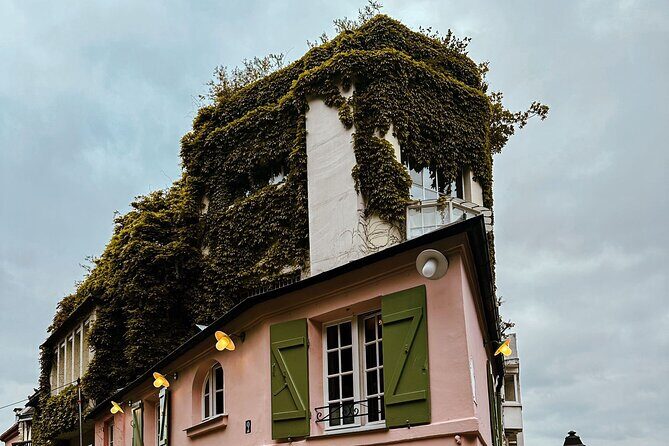
You start near Métro Abbesses, at 9 Rue des Trois Frères, and your walk heads toward the heart of the hill. That starting point matters because Abbesses sits in the thick of Montmartre’s local streets, not out on some far edge.
With a maximum of 25 people, the group stays small enough for the guide to keep the pace and spot questions. And because bottled water is included, you can focus on the walk instead of hunting down a shop after you’ve already climbed a bit.
Le mur des je t’aime: the quick stop that sets the tone
The tour opens at Le mur des je t’aime, the Wall of Love where the words are written in 250 languages. This is the kind of stop that’s short but memorable, because you immediately feel the romance theme without any effort.
Since the admission ticket is listed as free here, it’s a great way to start without worrying about cost or timing. I also like that it’s a simple target for photos: you can frame it fast, then move on while the feeling is still fresh.
St Jean Montmartre: red brick, art glass, and church-time calm
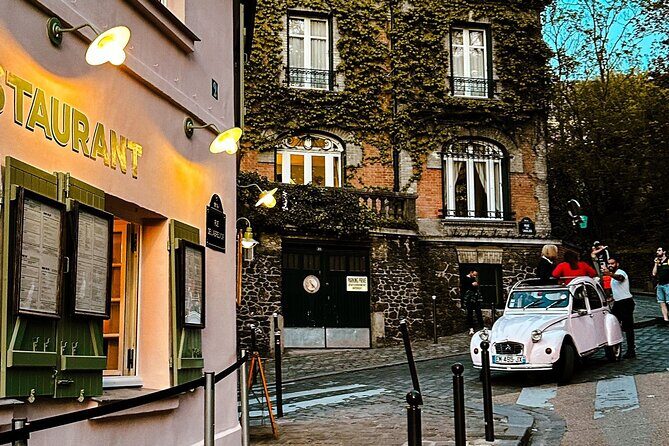
Next comes Église de St Jean Montmartre, a red-brick church completed in 1904. The standout details are the art nouveau-style stained glass, plus mosaics and sculptures, which give you plenty to look at even if you’re not the type to study architecture.
This is a free-entry stop too, so you can step in or pause outside without feeling like you’re paying a ticket just to see a doorway. The advantage of adding a church like this early is that it gives your brain a breather before the street scenes and cabaret stop later.
Le Bateau-Lavoir: Picasso-era energy without a museum day
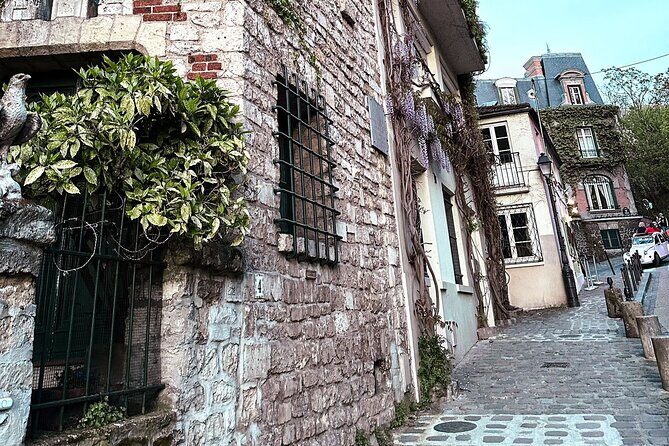
Then you reach Le Bateau-Lavoir, nicknamed the Washhouse Boat. It’s famous in art history as the residence and meeting place for early 20th-century artists like Pablo Picasso, plus writers, theatre people, and art dealers.
What I like about this stop is that it adds a human story to the neighborhood. Even if you do not plan a full museum day, you still get the sense that Montmartre was a working creative district, not just a scenic postcard.
The location is specific—No. 13 Rue Ravignan at Place Émile Goudeau, just below Place du Tertre—so it feels grounded rather than vague. You’re not just hearing a legend; you’re standing near where the scene happened.
You can also read our reviews of more guided tours in Paris





The Montmartre Water Tower: a 40-meter clue to how the hill works
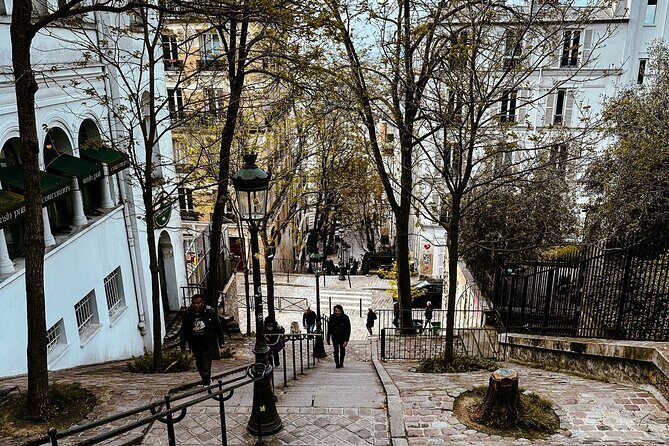
At Château d’Eau de Montmartre, you’ll see the Montmartre Water Tower, roughly 40 meters high. The simple explanation is that it distributes water to the top areas of Montmartre Hill.
This stop might feel more technical than romantic, but it’s useful. Montmartre’s charm comes from the hilltop layout, and water supply is part of why life could function up there. It’s the kind of context a guide can give quickly, and it makes later views feel more meaningful.
Place du Tertre: cobblestones, buskers, and portrait artists
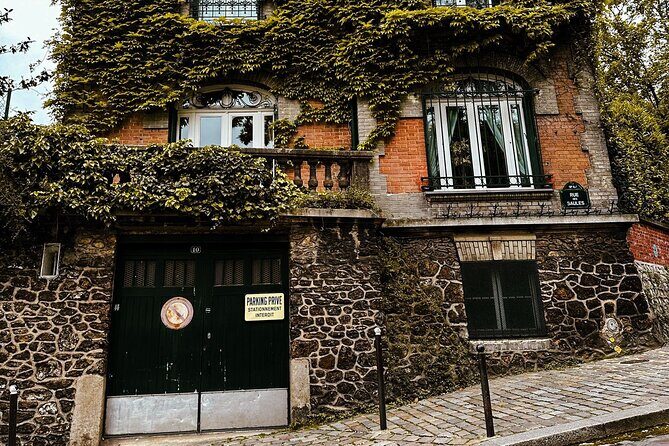
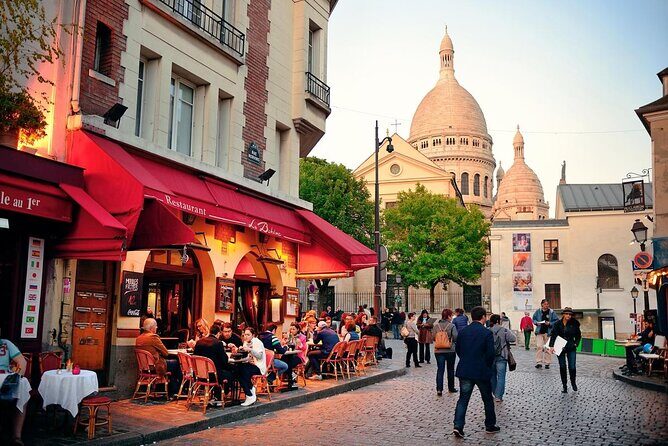
Next up is Place du Tertre, the small, cafe-lined cobbled square where buskers and portrait painters work. This is the “Montmartre scene” stop, with lively street energy and classic Paris textures underfoot.
Since it’s free to visit, it’s easy to treat this as your first moment to slow down for atmosphere. The practical tip here is timing: if you want portraits, watch how artists set up and ask early, because people often form lines.
Place Dalida and the tribute-to-a-star pause
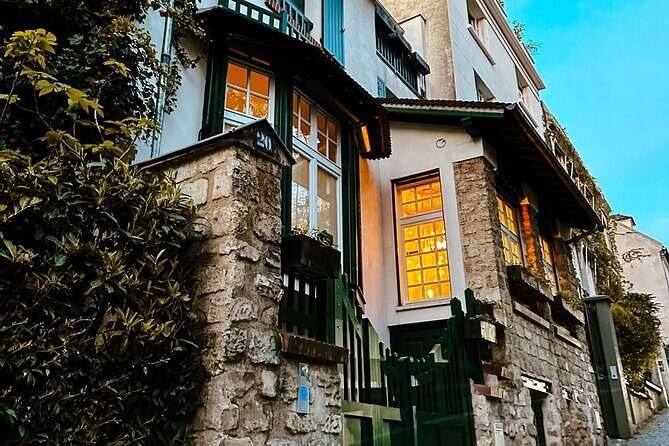
You’ll also stop at Place Dalida, on the corner where Rue Girardon meets Rue de l’Abreuvoir, creating an L-shaped street configuration. The guide’s stories here connect the square to Montmartre’s performer legacy, which helps turn streets into characters.
After that, the walk includes a pause described as a tribute to the star of Montmartre. The exact name tied to that tribute isn’t spelled out in the details you provided, but the point is clear: Montmartre celebrates its legends in public space, not just in old photos.
The vineyard moment: Paris’s last surviving vines
One of the best surprises in Montmartre is that you can still see the only vineyards that still exist in Paris. The tour builds in a stop for it, which works because it breaks up the usual church-and-cafe rhythm.
If you’re a “how does this city actually work” kind of traveler, this vineyard stop gives you a different angle on Paris. You’re seeing proof that not every inch of the hill became tourist souvenir shops and stone façades. It’s a small moment, but it adds variety fast.
Saint-Denis landmark and Saint-Pierre de Montmartre: old stones, older stories
The walk then includes Saint-Denis, listed as a historical landmark. With the information provided, the specific details of what you’re seeing there aren’t fully described, but the tour still uses it as a bridge between the lively squares and the older religious sites.
Then comes Église Saint-Pierre de Montmartre, dating back to the 12th century. When a church is that old, it doesn’t just look historical; it feels anchored. This is another free stop, and it’s a good place to slow down your pace for a few minutes so the hilltop walking doesn’t blur together.
Sacré-Cœur: domes, mosaics, stained glass, and a crypt
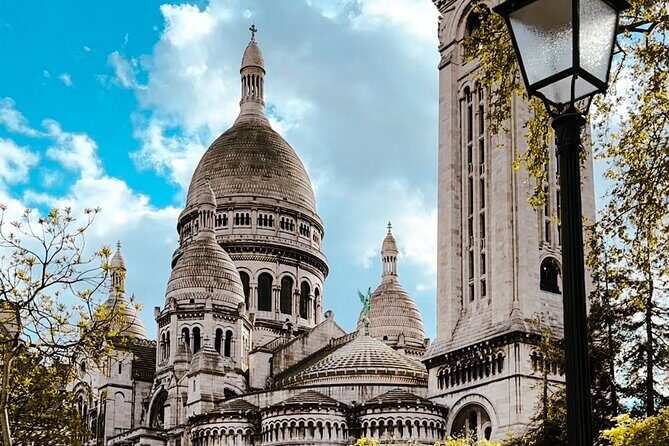
The big finish is Basilique du Sacré-Cœur de Montmartre, completed in 1914. The outside gives you the iconic domed white church, and the interior is where it gets extra interesting: mosaics, stained-glass windows, and a crypt.
The tour lists this stop as a longer one (about 15 minutes), which matters because Sacré-Cœur rewards time. Even if you keep it simple, you want a moment to look up and a moment to look around. This is also where you’ll get those classic photos beside the basilica.
Practical note: Sacré-Cœur sits at the top of the hill, so plan your energy accordingly. This is why the walking tour’s length (1 hour 45) is helpful; it gives you the climb and the payoff without turning your evening into an endurance event.
Au Lapin Agile: classic French songs in a 19th-century stone house
To cap it off, you’ll reach Au Lapin Agile, a landmark venue in a 19th-century stone house. The theme here is music: chanteuses singing classic French songs.
Even if you’re not buying tickets for a full performance, the cultural weight of the venue is part of the experience. This stop adds a final “Montmartre is alive” note after the churches and viewpoints.
The best way to get value here is to listen for the stories your guide shares while you’re standing near the place. It turns the venue from a name on a map into a location with a feeling.
Guide quality matters, and Kateryna gets praised for it
One of the highlights in feedback is the way guides tell the neighborhood story. Kateryna is specifically noted for being amazing, giving a fun rundown of the area and weaving in history in a way that sticks.
That matters because Montmartre can be confusing if you’re just wandering. Streets curve, squares overlap, and landmarks blend together. A strong guide helps you connect what you see now with what mattered here before.
If your guide is less talkative, you may get the sights but miss some of the meaning. The structure helps, but the storytelling is a big part of why this walk earns such strong ratings.
Price and value: is $35 worth 1 hour 45 in Montmartre?
At $35 per person for about 1 hour 45 minutes, the value is mostly about focus. You’re paying for a guide to organize your time in a neighborhood where self-guided wandering can cost you time and context.
You also get bottled water, which is a small inclusion but a real convenience on an evening walk. And because the listed stops have free admission tickets, you’re not stacking extra costs while you move from one point to another.
Where to be honest with yourself: if you already know Montmartre well and you only want photos, you might feel $35 is extra. But if you’re new to Paris or you want the story behind the stones, paying for guidance is one of the smarter spends you’ll make.
Who this walk is perfect for
This tour fits best if you:
- want to see key Montmartre landmarks without spending your evening planning
- like art, street culture, and music connections in the same walk
- prefer guided storytelling over reading a bunch of plaques on your own
- want a manageable hill experience with a set length
It’s also ideal as a first Montmartre stop. You come away with names, locations, and a sense of the neighborhood’s creative energy, so later wandering feels easier.
If you’re the type who hates walking, this might feel like too much. It’s a walking tour, and the hill affects pacing. But for most visitors, the “move for 1 hour 45, then stop” format is exactly right.
Should you book this Montmartre walking tour?
I’d book it if you want a guided, story-led evening that hits Montmartre’s major markers and a few thoughtful extras. The combination of Wall of Love, art history at Bateau-Lavoir, and the final mix of Sacré-Cœur plus Au Lapin Agile gives you more variety than a simple viewpoint circuit.
Skip it only if you’d rather roam freely for longer, or if you’re not interested in the art-and-people side of Montmartre. For first-timers and busy schedules, this is a clean way to get real Montmartre in under two hours.
FAQ
How long is the Montmartre walking tour?
The tour lasts about 1 hour 45 minutes.
How much does the tour cost?
It costs $35.00 per person.
What time does the tour start?
The start time is 6:00 pm.
Where do I meet the guide?
You meet at Métro Abbesses, 9 Rue des Trois Frères, 75018 Paris, France.
Where does the tour end?
It ends at the Sacré-Cœur Basilica, 35 Rue du Chevalier de la Barre, 75018 Paris, France.
What is included in the price?
The tour includes a live guide and bottled water.
What is not included?
Dinner and private transportation are not included.
Are tickets required for the stops?
The provided stop details list admission ticket free for the stops on the walk.
How big is the group?
The tour has a maximum of 25 travelers.
Can I cancel for a full refund?
Yes. You can cancel up to 24 hours in advance for a full refund.
Is the tour near public transportation, and can I bring a service animal?
Yes, it is near public transportation, and service animals are allowed.