REVIEW · PARIS
Private 3 Hour Historical Walking Tour in Paris Medieval
Book on Viator →Operated by Localers · Bookable on Viator
Medieval Paris gets personal fast. This private 3-hour walk links three big landmarks into one clear story, led by an art historian who explains what you’re seeing and why it mattered. I love the close-up focus on Gothic details at Ile de la Cité, like how to tell a gargoyle from a grotesque, and I love that Sainte-Chapelle’s stained glass goes from pretty window to real medieval engineering.
One thing to keep in mind: this tour has a high price tag (it’s $480.57 per person), so you’ll want to arrive early and stay reachable on the day of the tour. When the guide is on time, it feels like time well spent. When plans slip, it’s costly and stressful, so plan for a smooth start.
If you’re the kind of traveler who enjoys architecture, symbols, and the human drama behind famous buildings, this is a very satisfying way to spend an afternoon in Paris.
In This Review
- Key highlights that make this tour work
- Why this medieval walk feels different from a checklist
- Ile de la Cité: Gothic sculpture lessons beside the Seine
- Sainte-Chapelle stained glass and medieval engineering, not just pretty windows
- Conciergerie: royal palace to prison to revolution
- The art historian guide: why private matters for architecture
- Admission included and skip-the-line: time saved is the real currency
- Price and logistics: what $480.57 per person buys you
- How to plan your walk on the day
- Who this tour suits best
- Should you book this medieval walk?
- FAQ
- How long is the private medieval walking tour?
- What’s included in the tour price?
- Is this tour private?
- Which stops are part of the itinerary?
- What language is the guide?
- Where does the tour start?
- Will I need hotel pickup or drop-off?
- Do I get a ticket on my phone?
- Can I cancel and get a refund?
Key highlights that make this tour work

- Private, art-historian storytelling: the pace and explanations fit your group’s pace and questions
- Three medieval stops in one loop: Ile de la Cité, Sainte-Chapelle, and the Conciergerie connect cleanly
- Admission included: you don’t waste time buying tickets for the main sights
- Skip-the-line strategy: you save time at key monuments when possible
- Guides with strong teaching talent: names like Solene, Anna, Johanna, and Vanessa are mentioned as putting the era into context
- Small details you’ll notice after the tour: like internal flying buttresses at Sainte-Chapelle’s base
Why this medieval walk feels different from a checklist
Paris has “see it” sightseeing that moves you from spot to spot. This tour is more like “see it properly.” The big difference is the guide: you’re not just looking at stone and glass, you’re learning the language of medieval design—what those shapes meant, what those spaces were built to do, and how power showed up in buildings.
You’ll also get the benefit of a private format. That matters when you’re standing in front of something busy and famous. A guide can point, stop, and explain in plain terms, then adjust when you ask questions that aren’t on a fixed script.
The other practical win is that the tour includes admission for each stop. That turns the afternoon into a smoother flow. Instead of juggling ticket lines while your group freezes in the cold (or sweats in the sun), you keep moving through the sights with less friction.
You can also read our reviews of more walking tours in Paris



Ile de la Cité: Gothic sculpture lessons beside the Seine
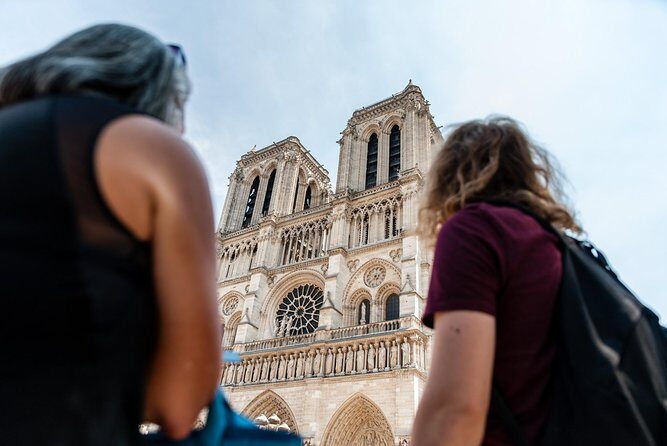
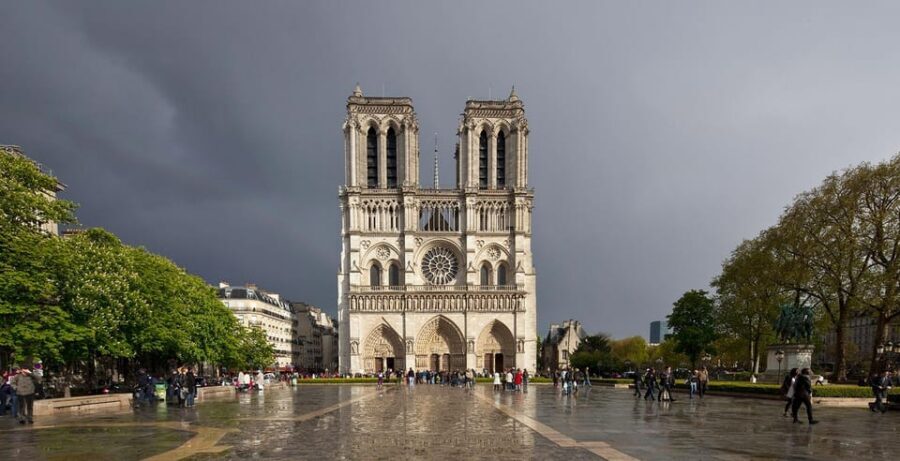
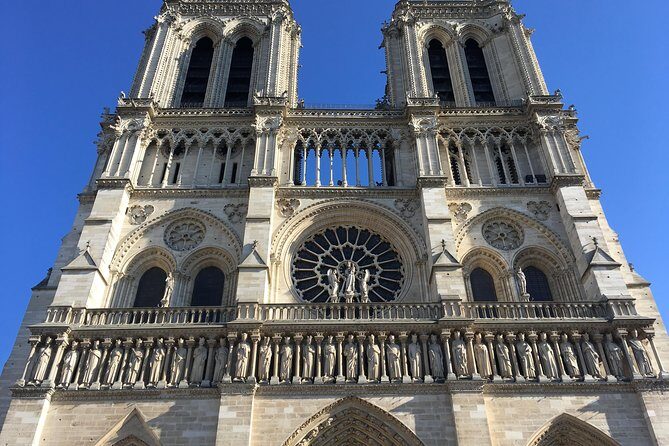
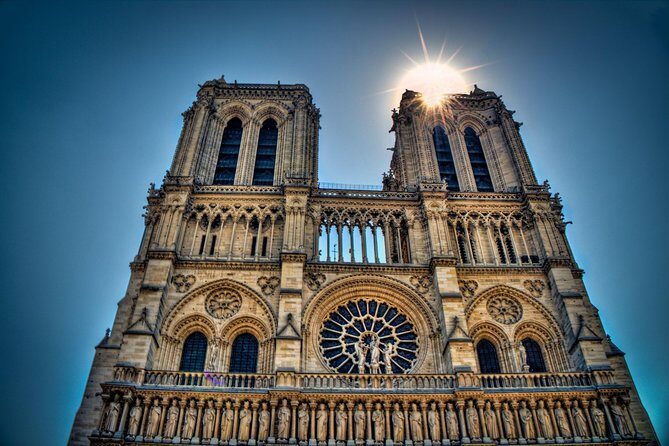
Your tour starts on Île de la Cité, the island by Notre-Dame where the city still feels like it’s built on layers. This is the zone where you can sense the shift from Romanesque forms to the high drama of Gothic architecture.
At this stop, the guide helps you read the stone façade like a puzzle. You’ll spend time on details that most people skip because they assume they’re just decoration. One of the standout teaching moments here is learning the difference between a gargoyle and a grotesque—basically, not all carved faces do the same job. You’ll also get context for how Notre-Dame’s medieval design worked to be seen from different angles across the square and from the surrounding river views.
A practical note: there’s still visible impact from the past fire, including partial destruction of the roof. That changes the experience. You’re not getting a perfectly untouched image of medieval Paris. What you are getting is a clear look at why the cathedral was such a masterpiece of its era—and how the remaining structure still tells the story.
You’ll also be positioned to enjoy the riverside mood. The Seine is right there, and Île de la Cité is naturally photogenic, which makes it easier to take breaks, reset, and keep your energy up for the next two major stops.
Sainte-Chapelle stained glass and medieval engineering, not just pretty windows
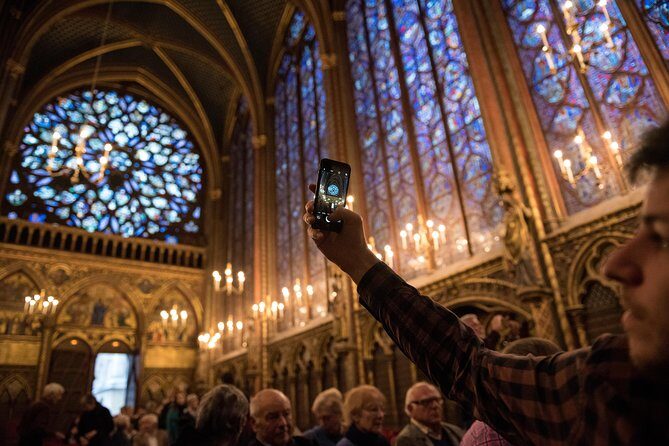
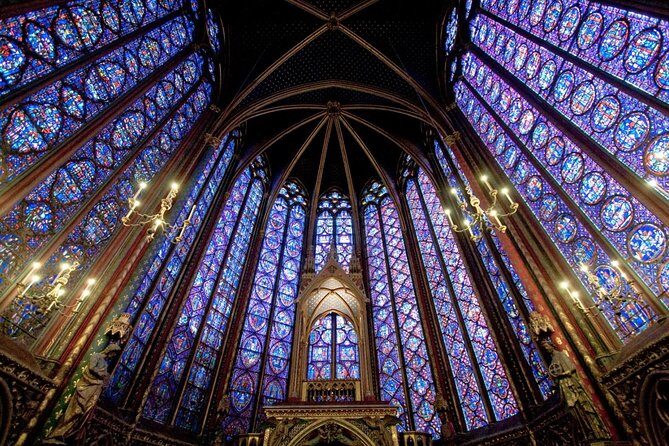
If Ile de la Cité gets you into Gothic mood, Sainte-Chapelle turns it up. This chapel is famous for a simple reason: its walls are made almost entirely of stained glass. But the tour doesn’t treat it like a museum selfie stop. You’ll learn what it took to make those walls work—how the design pushed light into the space and how medieval builders solved engineering problems while also creating a visual statement of power.
Your hour here is built around stories and explanations, including who commissioned the project and why it was so ambitious and costly. That context matters because it changes how you interpret what you’re seeing. Instead of thinking, This is gorgeous glass, you start thinking, Someone really wanted this place to mean something.
A small detail that can make a big difference: you’ll be directed to look for the internal flying buttresses at the base. Many visitors miss structural elements because they focus only on the stained glass. With the guide’s cue, you start seeing how the building holds itself up, not just what it looks like.
Timing is important for Sainte-Chapelle. It’s the kind of place where you’ll want to slow down so the light, color, and scale really land. The private format helps because you can adjust to the group’s comfort level without feeling rushed.
Conciergerie: royal palace to prison to revolution
The Conciergerie is where the story turns darker. This former royal palace later became one of the most notorious prisons tied to the French Revolution, and the shift in tone is part of the point.
You’ll step into spaces that show medieval and early modern power through architecture. One of the most impressive features is the Salle des Gens d’Armes—described as the world’s largest Gothic hall. The guide focuses on the vaulted ceilings and the scale so you get the “wow” moment for the structure, not just the historical label.
Then it gets human. You’ll learn that prison conditions varied by a person’s social status. That’s not just trivia; it changes how you picture the rooms. Instead of seeing cells as one-size-fits-all, you start understanding the prison as a system that reflected hierarchy.
And then comes one of the most dramatic Revolution stories connected to this place: you retrace Marie Antoinette’s fateful trip to the guillotine. The guide’s job here is to keep it factual and understandable rather than turning it into a dramatic retelling. The payoff is that you leave with a mental map: not just a name, but a sequence of events tied to real rooms and corridors.
This stop is also a good point in the tour to reset. It’s emotionally heavier than the chapel, and it’s easy to feel overwhelmed in famous spaces. A guide who can pace the explanations keeps it from becoming a blur.
The art historian guide: why private matters for architecture
A “private tour” sounds like a marketing phrase. In practice, it changes what the hour feels like.
With an art historian guide, you’re not hearing a generic script. You’re getting a sense of how medieval designers thought: how they communicated through carvings, how they built religious spaces to shape emotion through light, and how politics and justice shaped architecture.
You’ll likely notice differences in teaching style from guide to guide. Some groups have been led by people such as Solene, Anna, Johanna, and Vanessa, and the common thread in how they’re described is the ability to put the era into context. That matters for first-time visitors because it turns a collection of famous buildings into a coherent story.
If you tend to learn best by asking questions, private is a big advantage. You can spend extra time on a detail you’re stuck on, or ask how something worked structurally rather than just what it represents. For architecture-minded travelers, that’s the whole value.
You can also read our reviews of more private tours in Paris






Admission included and skip-the-line: time saved is the real currency
This tour includes admission tickets for each of the three main stops. That sounds straightforward, but it’s a big deal in Paris.
Here’s why: when you’re paying for a guided experience, you want your hours to be spent in the sights, not in a queue outside them. Skip-the-line support at key monuments helps you do more sightseeing per hour, and it reduces the stress of arrival timing—especially when weather changes quickly.
So even if you compare this tour to other walking tours that have no admissions included, the math shifts. You’re not only paying for narration. You’re also bundling entry into a guided, timed flow.
That said, the total cost is still high for a single person. If you’re traveling solo, you’ll want to feel strongly about architecture and historical storytelling. If you’re a small group who values a focused, guided approach, it starts to look more reasonable because the guide time is concentrated on your group.
Price and logistics: what $480.57 per person buys you
Let’s talk value without sugarcoating it. $480.57 per person is a premium. For many people, that’s the main decision point.
So what are you actually getting for the money?
- A private art historian guide for about three hours
- Admission included for Ile de la Cité, Sainte-Chapelle, and the Conciergerie
- Help with skip-the-line entry at key monuments
- A structured route with three stops that relate to each other
- A mobile ticket (you’re not hunting for paperwork)
What you’re not getting is the thing that would normally justify the price for some travelers: hotel pickup and drop-off, plus food and drinks. This is very much a walk-and-see format, and you’ll want to build a plan for snacks and hydration on your own.
If you’re used to spending less on city walks, you may feel sticker shock. But if you’re the kind of traveler who wants to understand what you’re looking at—not just look at it—this tour is built for you.
How to plan your walk on the day
This tour starts at Cité75004 Paris, France and ends back at the meeting point. That’s useful because it means you don’t need to re-orient around a distant drop-off.
You’ll also want to treat the first minutes seriously. A private tour only works if the group meets the guide quickly. The tour is designed to save time with skip-the-line entry, so once you’re late, you can lose the benefit.
Practical tips that help:
- Be at the meeting point a bit early so you can settle without rushing
- Keep your phone ready in case you need to contact the provider
- Dress for standing and walking through historic interiors and courtyards, which can be chilly or slow-paced depending on the season
If you like your sightseeing to have structure, this tour’s pacing is a plus. Three stops, about an hour each, keeps you moving while still allowing enough time to understand what matters.
Who this tour suits best
This is a strong fit if:
- You care about architecture and want to learn how medieval design communicates
- You want religious art, engineering details, and political history in one route
- You prefer a guide who can tailor explanations rather than a crowded group format
- You’re visiting for the first time and want a medieval “map” that sticks
It might be less ideal if:
- You only want the simplest highlights with zero explanation
- You’re on a tight budget and want to spend less per person
- You don’t want to walk between multiple indoor and outdoor stops
Should you book this medieval walk?
Book this tour if you want more than photos. The value is in how the guide teaches you to see—through Gothic details at Île de la Cité, through stained-glass design at Sainte-Chapelle, and through the prison-to-revolution mood of the Conciergerie.
Don’t book it on impulse. At $480.57 per person, you should be sure you’ll enjoy art-and-history explanations, and that your group will actually use the included admissions and skip-the-line advantage.
If that sounds like your kind of Paris day, this is a smart way to turn medieval ruins and royal rooms into a story you can follow from start to finish.
FAQ
How long is the private medieval walking tour?
It runs for about 3 hours total, with roughly 1 hour at each stop.
What’s included in the tour price?
Admission tickets for the sights are included, and you also get a private art historian guide. Food and drinks are not included.
Is this tour private?
Yes. It’s a private tour, so only your group participates.
Which stops are part of the itinerary?
You’ll visit Île de la Cité (near Notre-Dame), Sainte-Chapelle, and the Conciergerie.
What language is the guide?
The tour is offered in English.
Where does the tour start?
The meeting point is in Cité75004 Paris, France.
Will I need hotel pickup or drop-off?
No. Hotel pickup and drop-off are not included.
Do I get a ticket on my phone?
Yes. You’ll receive a mobile ticket.
Can I cancel and get a refund?
You can cancel for a full refund if you cancel up to 24 hours in advance of the experience start time.