REVIEW · PARIS
Paris Walking Tour , Historical Sites .
Book on Viator →Operated by Ned · Bookable on Viator
Crowds fade fast on this route.
This Paris walking tour strings together five very different central neighborhoods in about half a day, with the fun twist of seeing how Jewish traditions and modern fashion show up in Le Marais. I also like the small group size (max 7), which makes it easy to ask questions and keep the walk moving.
I like that the big landmarks are paired with “real Paris” streets—think Left Bank cafés near Saint-Germain-des-Prés, the Seine views around Île de la Cité, then right into Le Marais cobblestones and bites, and ending at the perfectly symmetrical Place des Vosges. One possible drawback: you cover a lot of ground in around three hours, so you’ll want decent walking shoes and a willingness to keep a steady pace.
In This Review
- Key Points Before You Go
- Why This Paris Historical Walking Route Works in Half a Day
- Start at Saint-Sulpice: Cardinal Directions Fountain and Left Bank Stroll
- Saint-Germain-des-Prés: Shops, Museums, and Food-Market Time
- Pont Neuf to the Seine: Old Bridge Views and Île de la Cité Landmarks
- Le Marais and Jewish Fashion: Cobblestone Streets, Bagels, and Synagogue Streets
- Place des Vosges: Symmetry, Art Galleries, and Victor Hugo’s Old Address
- What the Guide Adds (Especially When You’re in a Group of Seven)
- Timing and Walking Reality for a Comfortable 3 Hours
- Price and What You Actually Get for $96.79
- Who Should Book This Tour (and Who Might Skip It)
- Should You Book This Paris Walking Tour of Historical Sites?
- FAQ
- How long is the Paris Walking Tour of Historical Sites?
- Where does the tour start?
- Where does the tour end?
- How much does the tour cost?
- What language is the tour offered in?
- How large is the group?
- Is there a mobile ticket?
- Are admissions at the stops free?
- Is the tour near public transportation?
- Are service animals allowed?
- Is free cancellation available?
Key Points Before You Go

- Max 7 travelers means more back-and-forth with your guide instead of a lecture from the back
- Free entry at the stops listed keeps your money aimed at the experience, not ticket fees
- Five neighborhoods in one loop helps you understand how Paris feels street by street
- Le Marais focus on Jewish life and fashion goes beyond postcard explanations
- Seine + Île de la Cité viewpoints tie Pont Neuf to Notre-Dame and Sainte-Chapelle from the river
- End at Place des Vosges gives you a beautiful landing spot with art galleries and cafés nearby
Why This Paris Historical Walking Route Works in Half a Day

If you only have a short time in Paris, this tour makes the city make sense fast. You’re not doing “one famous site after another.” Instead, you move across neighborhoods that each have their own rhythm: the Left Bank church-and-courtyard vibe, Saint-Germain-des-Prés shopping and literary history, the Seine’s iconic bridge views, then the tight, stylish streets of Le Marais, and finally the calm symmetry of Place des Vosges.
The small group limit of seven is a big deal. On a walking tour, it’s the difference between feeling like you’re herded and feeling like you’re actually out with someone who knows where to pause and what to notice.
Also, the route is built for people who want both meaning and atmosphere: you’ll see religious landmarks, yes, but you’ll also learn why these areas developed the way they did—and what locals still do here today (food stops, shopping streets, and the feeling of neighborhood life).
You can also read our reviews of more walking tours in Paris



Start at Saint-Sulpice: Cardinal Directions Fountain and Left Bank Stroll
Your walk starts at Église Saint-Sulpice in the 6th arrondissement. This church is often overshadowed by bigger names, but it’s impressive on its own—especially because it’s the second-largest church in Paris. One of the standout features is the fountain of the four cardinal directions, the kind of detail you’d miss if you were just passing through.
The setting matters too. You’re in an open area near the Saint-Germain-des-Prés feel, close to where you’d naturally walk toward the Luxembourg Gardens area. Even if you don’t go inside every church you pass in Paris, Saint-Sulpice sets the tone for the whole tour: stone, scale, and a very Paris kind of quiet around busy streets.
Practical note: Saint-Sulpice is listed as free to access, so you’re not tied to extra ticket costs at the start. You’ll get value right away, even if you only spend a short time looking closely.
Saint-Germain-des-Prés: Shops, Museums, and Food-Market Time

Next you shift into the Saint-Germain-des-Prés quarter, one of those Paris neighborhoods that feels layered. The tour’s focus here is not just “what’s famous,” but how the area works day to day: fine shops, a strong arts and literature presence, and the kind of museum concentration that makes it easy to extend your trip if you want more.
You’ll also get directed toward food options—especially the kinds of markets and food shops people actually use. That’s part of the reason this tour feels authentic. It’s not only about what happened centuries ago. It’s also about where people still meet, browse, snack, and hang out.
One thing to keep in mind: the tour time in this section is about 35 minutes, so you won’t have a long sit-down lunch planned by the route. If you want to eat while you’re there, you’ll need to treat this as “sniff and choose,” then come back later for a proper meal.
Pont Neuf to the Seine: Old Bridge Views and Île de la Cité Landmarks

From Saint-Germain-des-Prés, you reach Pont Neuf—the oldest standing bridge in Paris. The bridge’s timeline is the kind of detail that makes history feel real: construction was decreed in the late 1500s during Henri’s reign, and the project resumed during the reign of Henri IV. You’re not just seeing a bridge; you’re seeing a living record of how Paris kept rebuilding itself.
Then the tour leans into one of Paris’s best lessons: watch the city from the river. You’ll walk by the Seine and around Île de la Cité, with time to take in the mood and sights along the water. The route includes the flower market area, plus the sense of place on Île de la Cité, which was the site of the fortress of a Roman governor.
As for the famous landmarks, you’ll pass key views including Notre-Dame de Paris and Sainte-Chapelle. The wording here is important: the tour is about seeing them from the river walk, not necessarily turning it into a full building-by-building visit. That still works well, because the Seine gives you the scale and perspective that street-level photos often miss.
If you’re the type who loves “main sight, but with good walking views,” this is your stretch.
Le Marais and Jewish Fashion: Cobblestone Streets, Bagels, and Synagogue Streets
Le Marais is where the tour’s theme becomes especially fun. You’re walking into one of central Paris’s most distinctive areas, full of cobblestone streets, small shops, independent fashion boutiques, and art galleries.
But the tour doesn’t stop at design and architecture. You’ll also learn how Jewish traditions connect with modern life here. The focus is practical and specific: think delis, bagel shops, and synagogues alongside the shopping and brunch culture that defines Le Marais today. It’s a reminder that neighborhoods can be both historical and current at the same time.
This section runs about one hour, which is a nice balance. It’s long enough to feel the maze of streets and the neighborhood’s flavor, but short enough that you’re not trapped in “tour mode” forever. You can pick a couple of streets to explore further on your own afterward without feeling like you missed everything.
One consideration: Le Marais can feel crowded compared with the calmer church-square vibe earlier in the day. The tour is still capped at seven people, so your guide can keep the group together, but you’ll still be sharing sidewalks.
You can also read our reviews of more historical tours in Paris






Place des Vosges: Symmetry, Art Galleries, and Victor Hugo’s Old Address
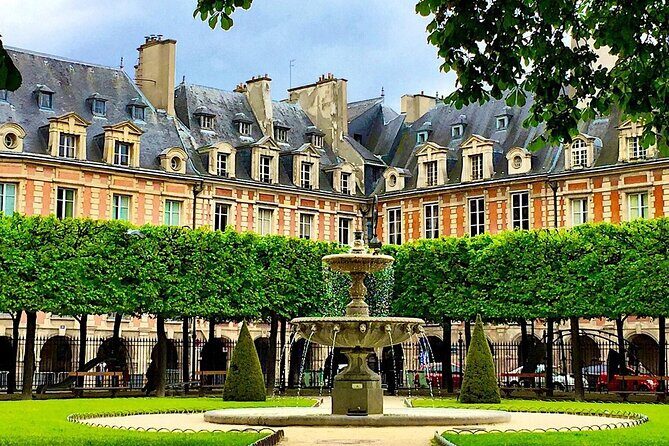
Your final stop is Place des Vosges, one of the oldest and most beautiful squares in Paris. The big headline here is the structure: it’s perfectly symmetrical, bordered by 36 buildings. If you like urban design, you’ll enjoy how the space feels planned and calm after the tighter streets of Le Marais.
The tour also points you toward the cultural layer of the square: many art galleries line the place, and the Victor Hugo House is here as a museum. Victor Hugo lived on the second floor from 1832 to 1848, so you’re finishing with a strong literary connection that fits well with the Saint-Germain-des-Prés start.
This stop runs about one hour, so you can do a couple of things at a comfortable pace: slow walk the square’s perimeter for the symmetry, take photos, and then decide whether you want to stop for a drink or keep exploring nearby.
The end point at Place des Vosges is a smart landing spot. It’s central, easy to re-enter Paris travel plans from, and visually satisfying even if you’re tired.
What the Guide Adds (Especially When You’re in a Group of Seven)

A walking tour lives or dies by the guide, and the name attached to this one is Neda. The praise pattern is consistent: energy, humor, and an ability to connect history to daily Paris life.
What you can realistically expect from that kind of guiding:
- You’ll get answers on the spot, not vague “maybe check later” responses
- You’ll get more context than facts alone—how neighborhoods changed and why they feel the way they do now
- You’ll likely get practical direction after the walk, including ideas on places to eat or further explore
That last part matters more than people think. A good guide helps you turn one afternoon into a smarter whole trip.
And because the group is small, you’re less likely to feel stuck behind someone who’s staring at their phone. The pace feels more human. You’re walking with a person, not just following dots on a map.
Timing and Walking Reality for a Comfortable 3 Hours
This tour is listed at about three hours, and the route includes multiple short stops plus walking stretches: Saint-Sulpice, a neighborhood walk in Saint-Germain-des-Prés, a quick Pont Neuf pause, river walking around Île de la Cité, then Le Marais, then Place des Vosges.
So yes, it’s “easy sightseeing,” but it’s still walking. The best way to enjoy it is to treat it like an afternoon stroll with moments of focus, not a “sit-and-look” museum day.
My practical advice:
- Wear shoes you’re comfortable in for continuous walking
- Bring water, even if you plan to buy something later
- Expect some street noise on busy sections, especially around central river viewpoints and Le Marais
If you’re sensitive to heat or cold, the good news is that you’ll have natural pauses near churches and squares. The bad news is there are no long indoor breaks built into the basic flow.
Price and What You Actually Get for $96.79
At $96.79 per person, this isn’t a bargain like a free self-guided walk—but it also isn’t inflated by paid attraction tickets. The listed stops are free to access, which shifts the value toward what you’re paying for: an organized route, on-the-ground guidance, and interpretation.
Here’s how I’d judge the value:
- You’re paying for someone to connect five neighborhoods so they feel like a story rather than separate postcards
- You’re paying for the small-group interaction, which can genuinely improve how much you notice
- You’re paying for time efficiency: you cover a lot of central Paris without spending your afternoon planning every turn
If you normally try to DIY your first day in a new city, you’ll still be able to do it after this. But you’ll have better instincts for where to wander next. That kind of trip momentum is hard to price, and it’s usually what makes guided walking worth it.
Who Should Book This Tour (and Who Might Skip It)
This is a great match if you:
- Want a first-day orientation to central Paris that’s more interesting than a checklist
- Enjoy neighborhood character—church squares, market streets, and fashion-shopping areas
- Like the idea of combining big landmarks (bridge and river views) with local-life detail
- Prefer a smaller group where you can ask questions and get real answers
You might consider something else if:
- You want a mostly indoor, long-stop itinerary with minimal walking
- You’re looking for a full “ticketed museum day” with extended entrances
For most people who visit Paris with just a few days, this hits the sweet spot: strong sites, clear pacing, and a route that teaches you how the city connects.
Should You Book This Paris Walking Tour of Historical Sites?
I think you should book it if you value a smart route and a guide who treats Paris like a living place, not just a list of famous buildings. The combination of Saint-Sulpice, Pont Neuf and the Seine, Le Marais, and Place des Vosges gives you variety without chaos—and the max of seven keeps it personal.
If you’re trying to decide between doing this and wandering alone, I’d make the call like this: book it when you want your afternoon to feel guided and efficient. Skip it when you already have a confident plan and you’d rather spend the day choosing cafés street by street.
FAQ
How long is the Paris Walking Tour of Historical Sites?
It’s listed at about 3 hours.
Where does the tour start?
The meeting point is 1 Pl. Saint-Sulpice, 75006 Paris, France.
Where does the tour end?
The tour ends at Place des Vosges, 75004 Paris, France.
How much does the tour cost?
The price is $96.79 per person.
What language is the tour offered in?
It’s offered in English.
How large is the group?
The tour has a maximum of 7 travelers.
Is there a mobile ticket?
Yes, the tour includes a mobile ticket.
Are admissions at the stops free?
The listed stops have free admission tickets in the tour details.
Is the tour near public transportation?
Yes, it’s near public transportation.
Are service animals allowed?
Yes, service animals are allowed.
Is free cancellation available?
Yes. You can cancel up to 24 hours in advance for a full refund.